



Community hub
Recent from talks
Knowledge base stats:
Talk channels stats:
Members stats:
Blackburn Dart
The Blackburn Dart was a carrier-based torpedo bomber biplane aircraft, designed and manufactured by the British aviation company Blackburn Aircraft. It was the standard single-seat torpedo bomber operated by the Fleet Air Arm (FAA) between 1923 and 1933.
Work on what would become the Dart started in 1919 as a private venture. Originally known as the T.1 Swift, it performed its maiden flight in September 1920. Three aircraft were ordered for evaluation to fulfil Air Ministry Specification 3/20, which received the name Dart. First flown in October 1921, its performance quickly impressed officials and a production order was issued to Blackburn on behalf of the FAA. The Swift name was retained for the pursuit of export sales. Several Darts were supplied to overseas operators, including the Imperial Japanese Navy, Spanish Navy and the United States Navy. Greece opted to procure a modified seaplane variant of the aircraft, the Blackburn Velos, which was operated by the Greek Navy as a torpedo bomber.
During late 1919, Blackburn commenced design work on what would become the Dart; it was initially pursued as a private venture. Around this time, the Air Ministry had reissued its requirement for a new carrier-based torpedo-bomber that would replace the Sopwith Cuckoo, the standard torpedo bomber of the era being flown from the aircraft carriers of the Royal Navy. Blackburn's efforts were led by their chief designer, Major Frank Bumpus. Designing was undertaken in close collaboration with the British engineering company D. Napier & Son. This new aircraft was originally named the T.1 Swift.
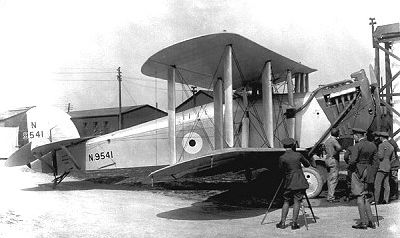
It was a relatively large single-seat biplane, which was in several respects considered to be a conventional design for the era. It was built around a central nucleus in which the centre fuselage, top centre section, lower wing roots, and undercarriage attachments were one rigid structure composed of steel tubing. This structure provided sufficient strength to withstand the high stresses of carrier operations and carry a heavy concentrated payload, while also being relatively easy to maintain and repair. A similar tubular structure was used for the rear fuselage. The fuselage had an unusual humped appearance due to the decking forward of the pilot sloping sharply downwards to maximise forward visibility over the engine, which was particularly useful during landings.
The Swift had staggered two-bay equal-span wings that could be folded for storage; this arrangement meant Blackburn was the first British company to address the issue of a foldable staggered wing cellule. The centre section of the wing structure was steel, while the outer sections were composed of wood, all of which were covered by fabric. Ailerons were present on all four wings. The tail unit had a braced tailplane and fin with a balanced rudder. The divided landing gear had main wheels on shock absorber (oleo) legs that allowed the fitting of a standard torpedo below the fuselage.
A novelty was the detachable mounting for the engine, which facilitated its replacement as a complete power unit and enabled its swapping in a matter of hours. Another advanced feature was the presence of a fireproof bulkhead between the engine bay and the self-sealing fuel tank in the fuselage, which could accommodate up to 66 imp gal (300 L; 79 US gal) of fuel; a gravity-fed tank housing up to 15 imp gal (68 L; 18 US gal) was present in the centre-top section. It was not necessary to jettison the undercarriage wheels prior to releasing the torpedo, unlike some contemporary aircraft, they were releasable to minimise the tendency for the aircraft to nose over during a forced water landing, for which floatation bags were present in the fuselage. The undercarriage incorporated a triangular support structure, a lengthy support axle, and a rubber compression shock absorber leg. Slings fitted to the top centre section were used to hoist the aircraft aboard ship.
By July 1920, the prototype Swift was sufficiently complete as to permit it to go on be static display to the public at the Olympia Aero Show but without a radiator or controls. The aircraft had already been placed on the British Government's secret list, which meant that it could only be displayed without specialised naval equipment, such as its torpedo release apparatus. The torpedo had to be placed on the ground between the undercarriage rather than being placed in its operational position.
During September 1920, the prototype Swift conducted its maiden flight; it reportedly almost crashed during the flight on account of its miscalculated centre of gravity. This problem was solved by sweeping back the wings. Following this modification, the Swift proved largely satisfactory in flight; on 23 December 1920, it was brought to RAF Martlesham Heath for performance trials by the Aeroplane and Armament Experimental Establishment. One requested change, made in January 1921, was the fitting of an enlarged rudder to improve directional control. By 20 April, the trials had been completed.
Hub AI
Blackburn Dart AI simulator
(@Blackburn Dart_simulator)
Blackburn Dart
The Blackburn Dart was a carrier-based torpedo bomber biplane aircraft, designed and manufactured by the British aviation company Blackburn Aircraft. It was the standard single-seat torpedo bomber operated by the Fleet Air Arm (FAA) between 1923 and 1933.
Work on what would become the Dart started in 1919 as a private venture. Originally known as the T.1 Swift, it performed its maiden flight in September 1920. Three aircraft were ordered for evaluation to fulfil Air Ministry Specification 3/20, which received the name Dart. First flown in October 1921, its performance quickly impressed officials and a production order was issued to Blackburn on behalf of the FAA. The Swift name was retained for the pursuit of export sales. Several Darts were supplied to overseas operators, including the Imperial Japanese Navy, Spanish Navy and the United States Navy. Greece opted to procure a modified seaplane variant of the aircraft, the Blackburn Velos, which was operated by the Greek Navy as a torpedo bomber.
During late 1919, Blackburn commenced design work on what would become the Dart; it was initially pursued as a private venture. Around this time, the Air Ministry had reissued its requirement for a new carrier-based torpedo-bomber that would replace the Sopwith Cuckoo, the standard torpedo bomber of the era being flown from the aircraft carriers of the Royal Navy. Blackburn's efforts were led by their chief designer, Major Frank Bumpus. Designing was undertaken in close collaboration with the British engineering company D. Napier & Son. This new aircraft was originally named the T.1 Swift.
It was a relatively large single-seat biplane, which was in several respects considered to be a conventional design for the era. It was built around a central nucleus in which the centre fuselage, top centre section, lower wing roots, and undercarriage attachments were one rigid structure composed of steel tubing. This structure provided sufficient strength to withstand the high stresses of carrier operations and carry a heavy concentrated payload, while also being relatively easy to maintain and repair. A similar tubular structure was used for the rear fuselage. The fuselage had an unusual humped appearance due to the decking forward of the pilot sloping sharply downwards to maximise forward visibility over the engine, which was particularly useful during landings.
The Swift had staggered two-bay equal-span wings that could be folded for storage; this arrangement meant Blackburn was the first British company to address the issue of a foldable staggered wing cellule. The centre section of the wing structure was steel, while the outer sections were composed of wood, all of which were covered by fabric. Ailerons were present on all four wings. The tail unit had a braced tailplane and fin with a balanced rudder. The divided landing gear had main wheels on shock absorber (oleo) legs that allowed the fitting of a standard torpedo below the fuselage.
A novelty was the detachable mounting for the engine, which facilitated its replacement as a complete power unit and enabled its swapping in a matter of hours. Another advanced feature was the presence of a fireproof bulkhead between the engine bay and the self-sealing fuel tank in the fuselage, which could accommodate up to 66 imp gal (300 L; 79 US gal) of fuel; a gravity-fed tank housing up to 15 imp gal (68 L; 18 US gal) was present in the centre-top section. It was not necessary to jettison the undercarriage wheels prior to releasing the torpedo, unlike some contemporary aircraft, they were releasable to minimise the tendency for the aircraft to nose over during a forced water landing, for which floatation bags were present in the fuselage. The undercarriage incorporated a triangular support structure, a lengthy support axle, and a rubber compression shock absorber leg. Slings fitted to the top centre section were used to hoist the aircraft aboard ship.
By July 1920, the prototype Swift was sufficiently complete as to permit it to go on be static display to the public at the Olympia Aero Show but without a radiator or controls. The aircraft had already been placed on the British Government's secret list, which meant that it could only be displayed without specialised naval equipment, such as its torpedo release apparatus. The torpedo had to be placed on the ground between the undercarriage rather than being placed in its operational position.
During September 1920, the prototype Swift conducted its maiden flight; it reportedly almost crashed during the flight on account of its miscalculated centre of gravity. This problem was solved by sweeping back the wings. Following this modification, the Swift proved largely satisfactory in flight; on 23 December 1920, it was brought to RAF Martlesham Heath for performance trials by the Aeroplane and Armament Experimental Establishment. One requested change, made in January 1921, was the fitting of an enlarged rudder to improve directional control. By 20 April, the trials had been completed.