




Community hub
Recent from talks
Contribute something to knowledge base
Content stats: 0 posts, 0 articles, 1 media, 0 notes
Members stats: 0 subscribers, 0 contributors, 0 moderators, 0 supporters
Subscribers
Supporters
Contributors
Moderators
Blackness Castle
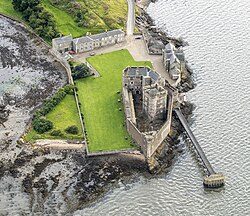
Blackness Castle is a 15th-century fortress, near the village of Blackness, Scotland, on the south shore of the Firth of Forth.
It was built, probably on the site of an earlier fort, by Sir George Crichton in the 1440s. At this time, Blackness was the main port serving the Royal Burgh of Linlithgow, one of the main residences of the Scottish monarch. The castle, together with the Crichton lands, passed to James II of Scotland in 1453, and the castle has been crown property ever since. It served as a state prison, holding such prisoners as Cardinal Beaton and the 6th Earl of Angus.
Strengthened by Sir James Hamilton of Finnart in the mid-16th century, the castle became one of the most advanced artillery fortifications of its time in Scotland. A century later, these defences were not enough to prevent Blackness falling to Oliver Cromwell's army in 1650. Some years after the siege, the castle was repaired, and again served as a prison and a minor garrison. In 1693, the spur protecting the gate was heightened, and the Stern Tower shortened as a base for three heavy guns. Barracks and officers' quarters were added in the 1870s, when the castle was used as an ammunition depot, until 1912. The castle was briefly reused by the army during World War I. It is now a Scheduled Ancient Monument, in the care of Historic Environment Scotland.
Because of its site, jutting into the Forth, and its long, narrow shape, the castle has been characterised as "the ship that never sailed". The north and south towers are often named "stem" and "stern", with the central tower called the "main mast".
The barony of Blackness was held in the mid-15th century by Sir George Crichton, Lord High Admiral of Scotland, Sheriff of Linlithgow, and later Earl of Caithness. The Crichtons were one of the most politically powerful Scottish families at the time, and were close to James II; George Crichton was governor of Stirling Castle when the King murdered the 8th Earl of Douglas there in 1452, and Crichton's cousin, William, was Chancellor of Scotland from 1439 to 1453. The castle was probably built in the mid-1440s, during a time of feuding between the Crichtons and the "Black" Douglases, which had resulted in the destruction of Crichton's tower at Barnton in Edinburgh in 1444.
Blackness Castle is first mentioned in 1449, and was already serving as a state prison as well as Crichton's residence. The original building comprised a curtain wall and the north tower, with the central tower isolated in the central courtyard. A hall range may have stood to the south, while the whole was defended by a rock-cut ditch and accessed by a gate in the east wall.
George Crichton handed over the Crichton lands, including Blackness Castle, to James II in 1453. His dispossessed heir, James Crichton, captured the castle and held it briefly against the King, who besieged and recaptured it the same year. Blackness became a royal fortress, as well as continuing to serve as a prison, and was put into the care of a keeper, who was often the Sheriff of Linlithgow.
James IV came to Blackness on 11 July 1506 after visiting the Isle of May sailing with the Lion and another ship. He was welcomed by four shawm players. In November 1512 the Great Michael and the Margaret were at Blackness. James IV came aboard the Michael on St Andrew's day to hold an audience with the French ambassador, Charles de Tocque, sieur de la Mothe. The Auld Alliance of Scotland and France was confirmed.
Blackness Castle
Blackness Castle is a 15th-century fortress, near the village of Blackness, Scotland, on the south shore of the Firth of Forth.
It was built, probably on the site of an earlier fort, by Sir George Crichton in the 1440s. At this time, Blackness was the main port serving the Royal Burgh of Linlithgow, one of the main residences of the Scottish monarch. The castle, together with the Crichton lands, passed to James II of Scotland in 1453, and the castle has been crown property ever since. It served as a state prison, holding such prisoners as Cardinal Beaton and the 6th Earl of Angus.
Strengthened by Sir James Hamilton of Finnart in the mid-16th century, the castle became one of the most advanced artillery fortifications of its time in Scotland. A century later, these defences were not enough to prevent Blackness falling to Oliver Cromwell's army in 1650. Some years after the siege, the castle was repaired, and again served as a prison and a minor garrison. In 1693, the spur protecting the gate was heightened, and the Stern Tower shortened as a base for three heavy guns. Barracks and officers' quarters were added in the 1870s, when the castle was used as an ammunition depot, until 1912. The castle was briefly reused by the army during World War I. It is now a Scheduled Ancient Monument, in the care of Historic Environment Scotland.
Because of its site, jutting into the Forth, and its long, narrow shape, the castle has been characterised as "the ship that never sailed". The north and south towers are often named "stem" and "stern", with the central tower called the "main mast".
The barony of Blackness was held in the mid-15th century by Sir George Crichton, Lord High Admiral of Scotland, Sheriff of Linlithgow, and later Earl of Caithness. The Crichtons were one of the most politically powerful Scottish families at the time, and were close to James II; George Crichton was governor of Stirling Castle when the King murdered the 8th Earl of Douglas there in 1452, and Crichton's cousin, William, was Chancellor of Scotland from 1439 to 1453. The castle was probably built in the mid-1440s, during a time of feuding between the Crichtons and the "Black" Douglases, which had resulted in the destruction of Crichton's tower at Barnton in Edinburgh in 1444.
Blackness Castle is first mentioned in 1449, and was already serving as a state prison as well as Crichton's residence. The original building comprised a curtain wall and the north tower, with the central tower isolated in the central courtyard. A hall range may have stood to the south, while the whole was defended by a rock-cut ditch and accessed by a gate in the east wall.
George Crichton handed over the Crichton lands, including Blackness Castle, to James II in 1453. His dispossessed heir, James Crichton, captured the castle and held it briefly against the King, who besieged and recaptured it the same year. Blackness became a royal fortress, as well as continuing to serve as a prison, and was put into the care of a keeper, who was often the Sheriff of Linlithgow.
James IV came to Blackness on 11 July 1506 after visiting the Isle of May sailing with the Lion and another ship. He was welcomed by four shawm players. In November 1512 the Great Michael and the Margaret were at Blackness. James IV came aboard the Michael on St Andrew's day to hold an audience with the French ambassador, Charles de Tocque, sieur de la Mothe. The Auld Alliance of Scotland and France was confirmed.
Recent media
Recent media