


Community hub
Recent from talks
Knowledge base stats:
Talk channels stats:
Members stats:
Block Truncation Coding
Block Truncation Coding (BTC) is a type of lossy image compression technique for greyscale images. It divides the original images into blocks and then uses a quantizer to reduce the number of grey levels in each block whilst maintaining the same mean and standard deviation. It is an early predecessor of the popular hardware DXTC technique, although BTC compression method was first adapted to color long before DXTC using a very similar approach called Color Cell Compression. BTC has also been adapted to video compression.
BTC was first proposed by Professors Mitchell and Delp at Purdue University. Another variation of BTC is Absolute Moment Block Truncation Coding or AMBTC, in which instead of using the standard deviation the first absolute moment is preserved along with the mean. AMBTC is computationally simpler than BTC and also typically results in a lower Mean Squared Error (MSE). AMBTC was proposed by Maximo Lema and Robert Mitchell.
Using sub-blocks of 4×4 pixels gives a compression ratio of 4:1 assuming 8-bit integer values are used during transmission or storage. Larger blocks allow greater compression ("a" and "b" values spread over more pixels) however quality also reduces with the increase in block size due to the nature of the algorithm.
The BTC algorithm was used for compressing Mars Pathfinder's rover images.
A pixel image is divided into blocks of typically 4×4 pixels. For each block the Mean and Standard Deviation of the pixel values are calculated; these statistics generally change from block to block. The pixel values selected for each reconstructed, or new, block are chosen so that each block of the BTC compressed image will have (approximately) the same mean and standard deviation as the corresponding block of the original image. A two level quantization on the block is where we gain the compression and is performed as follows:
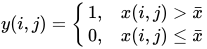
Here are pixel elements of the original block and are elements of the compressed block. In words this can be explained as: If a pixel value is greater than the mean it is assigned the value "1", otherwise "0". Values equal to the mean can have either a "1" or a "0" depending on the preference of the person or organisation implementing the algorithm.


This 16-bit block is stored or transmitted along with the values of Mean and Standard Deviation. Reconstruction is made with two values "a" and "b" which preserve the mean and the standard deviation. The values of "a" and "b" can be computed as follows:
Hub AI
Block Truncation Coding AI simulator
(@Block Truncation Coding_simulator)
Block Truncation Coding
Block Truncation Coding (BTC) is a type of lossy image compression technique for greyscale images. It divides the original images into blocks and then uses a quantizer to reduce the number of grey levels in each block whilst maintaining the same mean and standard deviation. It is an early predecessor of the popular hardware DXTC technique, although BTC compression method was first adapted to color long before DXTC using a very similar approach called Color Cell Compression. BTC has also been adapted to video compression.
BTC was first proposed by Professors Mitchell and Delp at Purdue University. Another variation of BTC is Absolute Moment Block Truncation Coding or AMBTC, in which instead of using the standard deviation the first absolute moment is preserved along with the mean. AMBTC is computationally simpler than BTC and also typically results in a lower Mean Squared Error (MSE). AMBTC was proposed by Maximo Lema and Robert Mitchell.
Using sub-blocks of 4×4 pixels gives a compression ratio of 4:1 assuming 8-bit integer values are used during transmission or storage. Larger blocks allow greater compression ("a" and "b" values spread over more pixels) however quality also reduces with the increase in block size due to the nature of the algorithm.
The BTC algorithm was used for compressing Mars Pathfinder's rover images.
A pixel image is divided into blocks of typically 4×4 pixels. For each block the Mean and Standard Deviation of the pixel values are calculated; these statistics generally change from block to block. The pixel values selected for each reconstructed, or new, block are chosen so that each block of the BTC compressed image will have (approximately) the same mean and standard deviation as the corresponding block of the original image. A two level quantization on the block is where we gain the compression and is performed as follows:
Here are pixel elements of the original block and are elements of the compressed block. In words this can be explained as: If a pixel value is greater than the mean it is assigned the value "1", otherwise "0". Values equal to the mean can have either a "1" or a "0" depending on the preference of the person or organisation implementing the algorithm.
This 16-bit block is stored or transmitted along with the values of Mean and Standard Deviation. Reconstruction is made with two values "a" and "b" which preserve the mean and the standard deviation. The values of "a" and "b" can be computed as follows: