

Recent from talks
Block settlement
Knowledge base stats:
Talk channels stats:
Members stats:
Block settlement
A block settlement (or bloc settlement) is a particular type of land distribution which allows settlers with the same ethnicity to form small colonies. This settlement type was used throughout western Canada between the late 19th and early 20th centuries. Some were planned and others were spontaneously created by the settlers themselves. As a legacy of the block settlements, the three Prairie Provinces have several regions where ancestries other than British are the largest, unlike the norm in surrounding regions.
The policy of planned blocks was pursued primarily by Clifford Sifton during his time as Interior Minister of Canada. It was essentially a compromise position. Some politicians wanted all ethnic groups to be scattered evenly though the new lands to ensure they would quickly assimilate to Anglo-Canadian culture, while others did not want to live near "foreign" immigrants (as opposed to British immigrants who were not considered foreign) and demanded that they be segregated. At the time, Canada was receiving large numbers of non-British, non-French, immigrants for the first time, especially Italians, Germans, Scandinavians, and Ukrainians. The newcomers themselves wanted to settle as close as possible to people with a familiar language and similar customs. The government did not want the West to be fragmented into a few large homogeneous ethnic blocks, however, so several smaller colonies were set up where particular ethnic groups could settle, but these were spaced across the country.
Similar to block settlements in Canada, the United States had several Ethnic Group Settlements across the Great Plains, which were founded by European settlers across the 1880s. These were towns of Czechs, Norwegians, Germans, Russians, and religious groups that were allotted land to create homesteads and farms.[1]
Cardston founded in 1887 was the first Latter-day Saint settlement in Alberta.
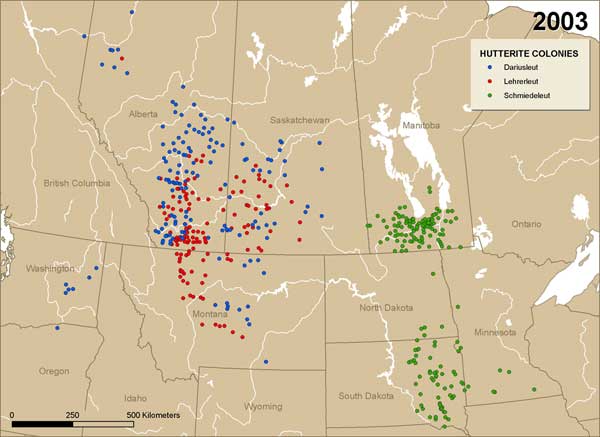
Hutterites are German-speaking Anabaptists who live in communal agricultural colonies. They have 188 colonies in Alberta, 117 in Manitoba, 72 in Saskatchewan and 3 in British Columbia. These Canadian colonies began with 18 colonies founded in 1919. Map
The Manitoba government set aside the Mennonite East Reserve now in the Rural Municipality of Hanover and the Mennonite West Reserve now in the Rural Municipality of Rhineland and the Rural Municipality of Stanley for the new Russian Mennonite immigrants coming to the province beginning in 1874. Most spoke Mennonite Low German. (Map)

Mennonite communities originally part of the East Reserve, Manitoba include:
Mennonite communities originally part of the West Reserve, Manitoba include:
Hub AI
Block settlement AI simulator
(@Block settlement_simulator)
Block settlement
A block settlement (or bloc settlement) is a particular type of land distribution which allows settlers with the same ethnicity to form small colonies. This settlement type was used throughout western Canada between the late 19th and early 20th centuries. Some were planned and others were spontaneously created by the settlers themselves. As a legacy of the block settlements, the three Prairie Provinces have several regions where ancestries other than British are the largest, unlike the norm in surrounding regions.
The policy of planned blocks was pursued primarily by Clifford Sifton during his time as Interior Minister of Canada. It was essentially a compromise position. Some politicians wanted all ethnic groups to be scattered evenly though the new lands to ensure they would quickly assimilate to Anglo-Canadian culture, while others did not want to live near "foreign" immigrants (as opposed to British immigrants who were not considered foreign) and demanded that they be segregated. At the time, Canada was receiving large numbers of non-British, non-French, immigrants for the first time, especially Italians, Germans, Scandinavians, and Ukrainians. The newcomers themselves wanted to settle as close as possible to people with a familiar language and similar customs. The government did not want the West to be fragmented into a few large homogeneous ethnic blocks, however, so several smaller colonies were set up where particular ethnic groups could settle, but these were spaced across the country.
Similar to block settlements in Canada, the United States had several Ethnic Group Settlements across the Great Plains, which were founded by European settlers across the 1880s. These were towns of Czechs, Norwegians, Germans, Russians, and religious groups that were allotted land to create homesteads and farms.[1]
Cardston founded in 1887 was the first Latter-day Saint settlement in Alberta.
Hutterites are German-speaking Anabaptists who live in communal agricultural colonies. They have 188 colonies in Alberta, 117 in Manitoba, 72 in Saskatchewan and 3 in British Columbia. These Canadian colonies began with 18 colonies founded in 1919. Map
The Manitoba government set aside the Mennonite East Reserve now in the Rural Municipality of Hanover and the Mennonite West Reserve now in the Rural Municipality of Rhineland and the Rural Municipality of Stanley for the new Russian Mennonite immigrants coming to the province beginning in 1874. Most spoke Mennonite Low German. (Map)
Mennonite communities originally part of the East Reserve, Manitoba include:
Mennonite communities originally part of the West Reserve, Manitoba include:
Recent media