
Recent from talks
Blombos Cave
Knowledge base stats:
Talk channels stats:
Members stats:
Blombos Cave
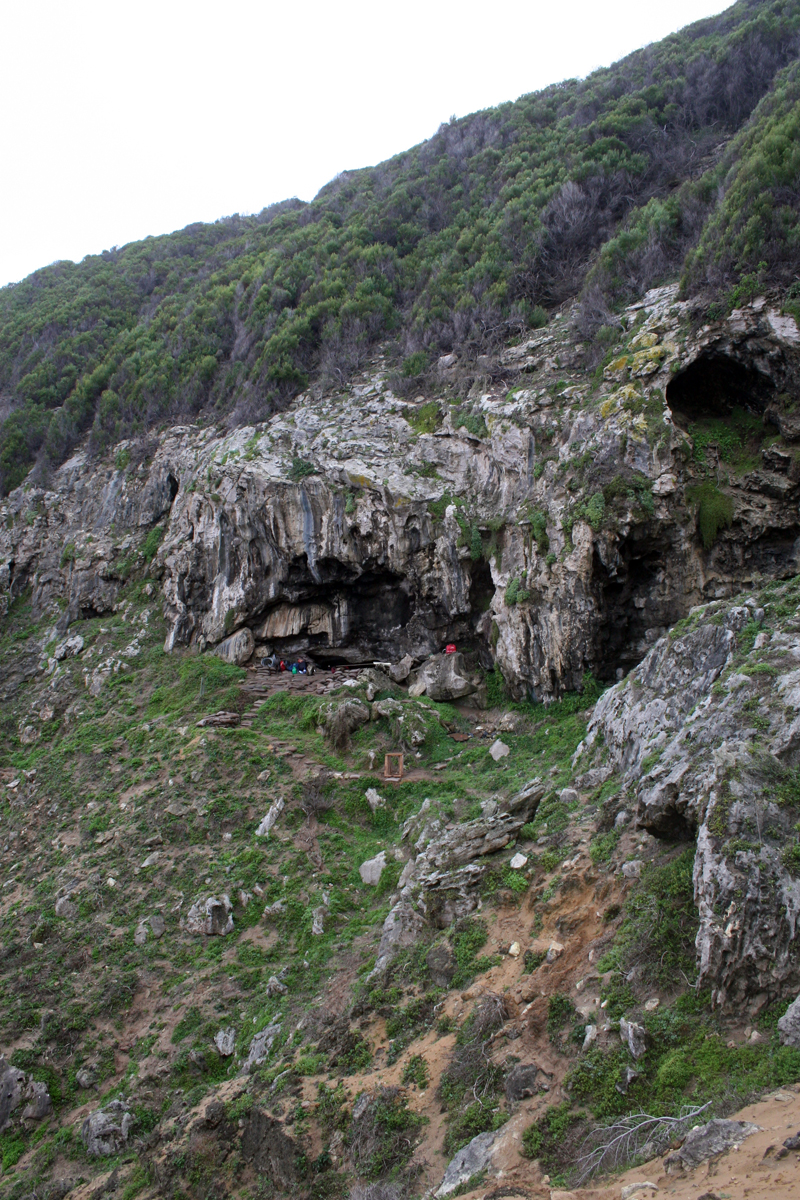
Blombos Cave is an archaeological site located in Blombos Private Nature Reserve, about 300 km east of Cape Town on the Southern Cape coastline, South Africa. The cave contains Middle Stone Age (MSA) deposits currently dated at between c. 100,000 and 70,000 years Before Present (BP), and a Late Stone Age sequence dated at between 2000 and 300 years BP. The cave site was first excavated in 1991 and field work has been conducted there on a regular basis since 1997, and is ongoing.
The excavations at Blombos Cave have yielded important new information on the behavioural evolution of anatomically modern humans. The archaeological record from this cave site has been central in the ongoing debate on the cognitive and cultural origin of early humans and to the current understanding of when and where key behavioural innovations emerged among Homo sapiens in southern Africa during the Late Pleistocene. Archaeological material and faunal remains recovered from the Middle Stone Age phase in Blombos Cave – dated to ca. 100,000–70,000 years BP – are considered to represent greater ecological niche adaptation, a more diverse set of subsistence and procurements strategies, adoption of multi-step technology and manufacture of composite tools, stylistic elaboration, increased economic and social organisation and occurrence of symbolically mediated behaviour.
The most informative archaeological material from Blombos Cave includes engraved ochre, engraved bone ochre processing kits, marine shell beads, refined bone and stone tools and a broad range of terrestrial and marine faunal remains, including shellfish, birds, tortoise and ostrich egg shell, and mammals of various sizes. These findings, together with subsequent re-analysis and excavation of other Middle Stone Age sites in southern Africa, have resulted in a paradigm shift with regard to the understanding of the timing and location of the development of modern human behaviour.
On 29 May 2015 Heritage Western Cape formally protected the site as a provincial heritage site.
Cross-hatching done in ochre on a stone fragment found at Blombos Cave is believed to be the earliest known drawing done by a human in the world.
Blombos Cave was first excavated in 1991–1992 as a part of Professor Christopher S. Henshilwood's (1995) doctoral thesis. at the University of Cambridge: Holocene archaeology of the coastal Garcia State Forest, southern Cape, South Africa. Blombos Cave was originally one of nine Holocene Later Stone Age sites that Henshilwood excavated and it was first given the acronym GSF8 (Garcia State Forest, site no. 8). In 1997 GSF8 was renamed Blombos Cave and given its current acronym: BBC. From 1999 to 2011 in total ten field seasons, each six weeks long, have been carried out at the cave site.
From the initial excavations conducted in the early 1990s, the Blombos Cave project has adopted and established new and innovative research agendas in the study of southern African prehistory. While Henshilwood's initial, doctoral research was directed towards the more recent Later Stone Age occupation levels, the focus since 1997 has been on the Middle Stone Age sequence. The Blombos Cave project has since then developed academically, economically and administratively, from being a local and small-scale test excavation to becoming an international, full scale, high-technological archaeological project.
In 2010–2015 the cave site was the focus of the multi-disciplinary, pan-continental research program, the TRACSYMBOLS project. It was led by Professor Christopher S. Henshilwood based at the Department of Archaeology, History, Cultural Studies and Religion at the University of Bergen and the University of the Witwatersrand, South Africa, together with Professor Francesco d'Errico from the University of Bordeaux 1, France. The aim of TRACSYMBOLS project is to examine how key behavioural innovations emerged among Homo sapiens and Homo neanderthalensis in southern Africa and Europe respectively, and to explore whether and how environmental variability influenced this development between 180,000 – 25,000 years ago, primarily by combining archaeological results, original multi-proxy palaeoenvironmental data and climatic simulations for two continents.
Hub AI
Blombos Cave AI simulator
(@Blombos Cave_simulator)
Blombos Cave
Blombos Cave is an archaeological site located in Blombos Private Nature Reserve, about 300 km east of Cape Town on the Southern Cape coastline, South Africa. The cave contains Middle Stone Age (MSA) deposits currently dated at between c. 100,000 and 70,000 years Before Present (BP), and a Late Stone Age sequence dated at between 2000 and 300 years BP. The cave site was first excavated in 1991 and field work has been conducted there on a regular basis since 1997, and is ongoing.
The excavations at Blombos Cave have yielded important new information on the behavioural evolution of anatomically modern humans. The archaeological record from this cave site has been central in the ongoing debate on the cognitive and cultural origin of early humans and to the current understanding of when and where key behavioural innovations emerged among Homo sapiens in southern Africa during the Late Pleistocene. Archaeological material and faunal remains recovered from the Middle Stone Age phase in Blombos Cave – dated to ca. 100,000–70,000 years BP – are considered to represent greater ecological niche adaptation, a more diverse set of subsistence and procurements strategies, adoption of multi-step technology and manufacture of composite tools, stylistic elaboration, increased economic and social organisation and occurrence of symbolically mediated behaviour.
The most informative archaeological material from Blombos Cave includes engraved ochre, engraved bone ochre processing kits, marine shell beads, refined bone and stone tools and a broad range of terrestrial and marine faunal remains, including shellfish, birds, tortoise and ostrich egg shell, and mammals of various sizes. These findings, together with subsequent re-analysis and excavation of other Middle Stone Age sites in southern Africa, have resulted in a paradigm shift with regard to the understanding of the timing and location of the development of modern human behaviour.
On 29 May 2015 Heritage Western Cape formally protected the site as a provincial heritage site.
Cross-hatching done in ochre on a stone fragment found at Blombos Cave is believed to be the earliest known drawing done by a human in the world.
Blombos Cave was first excavated in 1991–1992 as a part of Professor Christopher S. Henshilwood's (1995) doctoral thesis. at the University of Cambridge: Holocene archaeology of the coastal Garcia State Forest, southern Cape, South Africa. Blombos Cave was originally one of nine Holocene Later Stone Age sites that Henshilwood excavated and it was first given the acronym GSF8 (Garcia State Forest, site no. 8). In 1997 GSF8 was renamed Blombos Cave and given its current acronym: BBC. From 1999 to 2011 in total ten field seasons, each six weeks long, have been carried out at the cave site.
From the initial excavations conducted in the early 1990s, the Blombos Cave project has adopted and established new and innovative research agendas in the study of southern African prehistory. While Henshilwood's initial, doctoral research was directed towards the more recent Later Stone Age occupation levels, the focus since 1997 has been on the Middle Stone Age sequence. The Blombos Cave project has since then developed academically, economically and administratively, from being a local and small-scale test excavation to becoming an international, full scale, high-technological archaeological project.
In 2010–2015 the cave site was the focus of the multi-disciplinary, pan-continental research program, the TRACSYMBOLS project. It was led by Professor Christopher S. Henshilwood based at the Department of Archaeology, History, Cultural Studies and Religion at the University of Bergen and the University of the Witwatersrand, South Africa, together with Professor Francesco d'Errico from the University of Bordeaux 1, France. The aim of TRACSYMBOLS project is to examine how key behavioural innovations emerged among Homo sapiens and Homo neanderthalensis in southern Africa and Europe respectively, and to explore whether and how environmental variability influenced this development between 180,000 – 25,000 years ago, primarily by combining archaeological results, original multi-proxy palaeoenvironmental data and climatic simulations for two continents.
Recent media