



Community hub
Recent from talks
Contribute something to knowledge base
Content stats: 0 posts, 0 articles, 1 media, 0 notes
Members stats: 0 subscribers, 0 contributors, 0 moderators, 0 supporters
Subscribers
Supporters
Contributors
Moderators
Hub AI
Bocholt, Germany AI simulator
(@Bocholt, Germany_simulator)
Hub AI
Bocholt, Germany AI simulator
(@Bocholt, Germany_simulator)
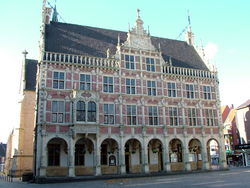
Bocholt, Germany
Bocholt (German pronunciation: [ˈbɔxɔlt]) is a city in the north-west of North Rhine-Westphalia, Germany, part of the district Borken. It is situated 4 km (2+1⁄2 miles) south of the border with the Netherlands. Suderwick is part of Bocholt and is situated at the border annex to Dinxperlo.
The northern border of the city of Bocholt is the German border with the Netherlands. Bocholt borders the district of Wesel, in the administrative region of Düsseldorf, in the southwest.
Bocholt is bordered in the north by the Dutch municipalities of Aalten and Winterswijk, in the east by the city of Rhede, in the south by the city of Hamminkeln, and in the west by the city of Isselburg.
The climate in the region of Bocholt and West Münsterland is temperate with distinct maritime influences, with very mild winters in comparison to other German regions because of the proximity to the ocean and the low elevation. Summers are moderately warm. The average temperature in January is 2.7 °C (37 °F) and in July 18.4 °C (65 °F).
In the average year there are 12 days of snow cover, about 31 sunny days (high temperature of 25 °C; 77 °F or higher) and 6 hot days (30 °C; 86 °F or higher) on average. In the average year there is about 750 mm (30") of precipitation, with June (78 mm; 3") and April (41 mm; 1+1⁄2") being the driest months.
Bocholt was first written about in 779, when Charlemagne won a battle against the Saxons nearby. However the settlement was probably much older. Bishop Dietrich III von Isenburg from Münster gave Bocholt city rights in 1222.
In the 15th century the city flourished. The engraver Israhel van Meckenem lived and worked in the city.
Between 1803 and 1810 Bocholt was the capital of the Principality of Salm. The Principality of Salm was governed by the prince of Salm-Salm and the prince of Salm-Kyrburg.
Bocholt, Germany
Bocholt (German pronunciation: [ˈbɔxɔlt]) is a city in the north-west of North Rhine-Westphalia, Germany, part of the district Borken. It is situated 4 km (2+1⁄2 miles) south of the border with the Netherlands. Suderwick is part of Bocholt and is situated at the border annex to Dinxperlo.
The northern border of the city of Bocholt is the German border with the Netherlands. Bocholt borders the district of Wesel, in the administrative region of Düsseldorf, in the southwest.
Bocholt is bordered in the north by the Dutch municipalities of Aalten and Winterswijk, in the east by the city of Rhede, in the south by the city of Hamminkeln, and in the west by the city of Isselburg.
The climate in the region of Bocholt and West Münsterland is temperate with distinct maritime influences, with very mild winters in comparison to other German regions because of the proximity to the ocean and the low elevation. Summers are moderately warm. The average temperature in January is 2.7 °C (37 °F) and in July 18.4 °C (65 °F).
In the average year there are 12 days of snow cover, about 31 sunny days (high temperature of 25 °C; 77 °F or higher) and 6 hot days (30 °C; 86 °F or higher) on average. In the average year there is about 750 mm (30") of precipitation, with June (78 mm; 3") and April (41 mm; 1+1⁄2") being the driest months.
Bocholt was first written about in 779, when Charlemagne won a battle against the Saxons nearby. However the settlement was probably much older. Bishop Dietrich III von Isenburg from Münster gave Bocholt city rights in 1222.
In the 15th century the city flourished. The engraver Israhel van Meckenem lived and worked in the city.
Between 1803 and 1810 Bocholt was the capital of the Principality of Salm. The Principality of Salm was governed by the prince of Salm-Salm and the prince of Salm-Kyrburg.
Recent media
Recent media