
Recent from talks
Bodhidharma
Knowledge base stats:
Talk channels stats:
Members stats:
Bodhidharma
Bodhidharma was a semi-legendary Buddhist monk who lived during the 5th or 6th century CE. He is traditionally credited as the transmitter of Chan Buddhism to China, and is regarded as its first Chinese patriarch. He is also popularly regarded as the founder of Shaolin kung fu, an idea popularized in the 20th century, but based on the 17th century Yijin Jing and the Daoist association of daoyin gymnastics with Bodhidharma.
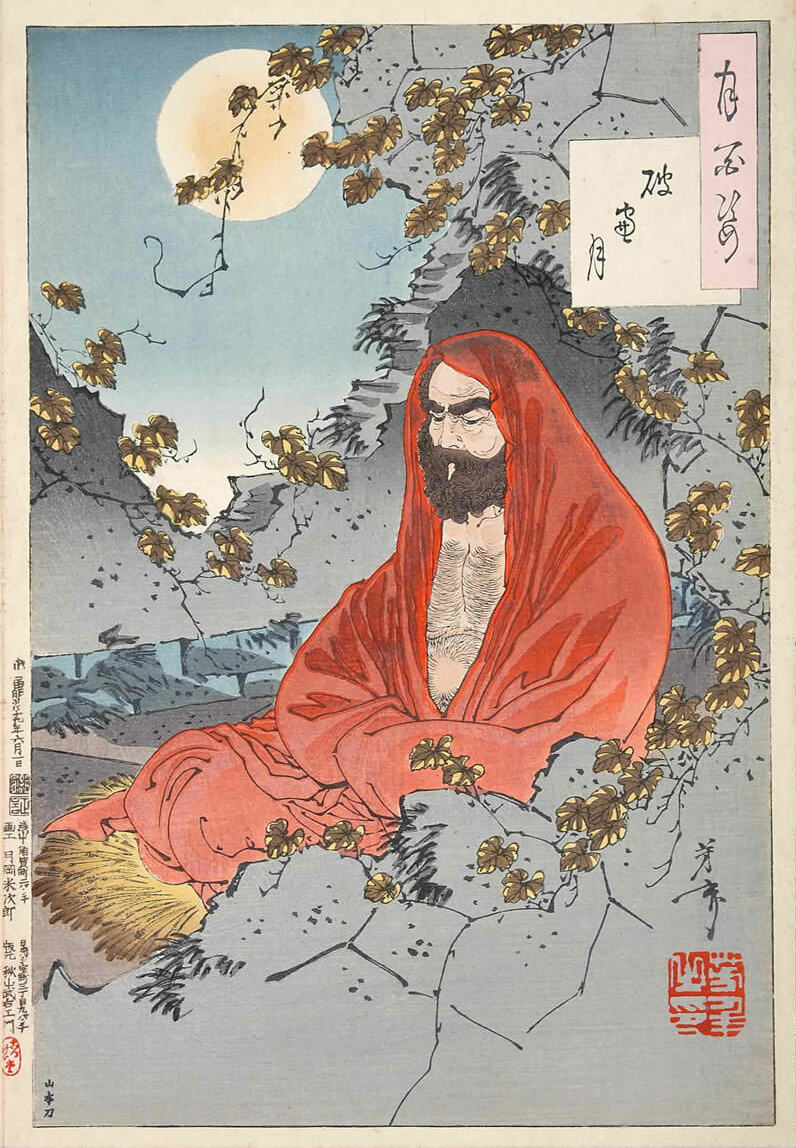
Little contemporary biographical information on Bodhidharma exists, and subsequent accounts are layered with legend and unreliable details. According to the principal Chinese sources, Bodhidharma came from the Western Regions, which typically refers to Central Asia but can also include the Indian subcontinent. He is described as either a "Persian Central Asian" or a "South Indian [...] the third son of a great Indian king." Aside from the Chinese accounts, several popular traditions also exist regarding Bodhidharma's origins. Throughout Buddhist art, Bodhidharma is depicted as an ill-tempered, large-nosed, profusely bearded, wide-eyed non-Chinese person.
The accounts also differ on the date of his arrival. One early account claims that he arrived during the Liu Song dynasty (420–479 CE). Later accounts date his arrival to the Liang dynasty (502–557 CE). Bodhidharma was primarily active in the territory of the Northern Wei (386–534 CE). Modern scholarship dates him to about the early 5th century CE.
Bodhidharma's teachings and practice center on meditation and the Laṅkāvatāra Sūtra. The Anthology of the Patriarchal Hall (952) identifies Bodhidharma as the 28th Patriarch of Buddhism in an uninterrupted line that extends back to the Gautama Buddha himself.
Bodhidharma means 'dharma of awakening (bodhi)" in Sanskrit and was often shortened to simply Dharma in Chinese. Daruma is the shortened form in Japanese and from where the name of daruma dolls derives, themselves modelled after the monk.
Bodhidharma is associated with several other names, and is also known by the name Bodhitara. Faure notes that:
Bodhidharma's name appears sometimes truncated as Bodhi, or more often as Dharma (Ta-mo). In the first case, it may be confused with another of his rivals, Bodhiruci.
Bodhidharma is his dharma name. According to tradition, he was given this name by his teacher Prajnatara (or Prajñādhara and Panyatara). His name prior to monkhood is said to have been Jayavarman or Bodhidhana.
Hub AI
Bodhidharma AI simulator
(@Bodhidharma_simulator)
Bodhidharma
Bodhidharma was a semi-legendary Buddhist monk who lived during the 5th or 6th century CE. He is traditionally credited as the transmitter of Chan Buddhism to China, and is regarded as its first Chinese patriarch. He is also popularly regarded as the founder of Shaolin kung fu, an idea popularized in the 20th century, but based on the 17th century Yijin Jing and the Daoist association of daoyin gymnastics with Bodhidharma.
Little contemporary biographical information on Bodhidharma exists, and subsequent accounts are layered with legend and unreliable details. According to the principal Chinese sources, Bodhidharma came from the Western Regions, which typically refers to Central Asia but can also include the Indian subcontinent. He is described as either a "Persian Central Asian" or a "South Indian [...] the third son of a great Indian king." Aside from the Chinese accounts, several popular traditions also exist regarding Bodhidharma's origins. Throughout Buddhist art, Bodhidharma is depicted as an ill-tempered, large-nosed, profusely bearded, wide-eyed non-Chinese person.
The accounts also differ on the date of his arrival. One early account claims that he arrived during the Liu Song dynasty (420–479 CE). Later accounts date his arrival to the Liang dynasty (502–557 CE). Bodhidharma was primarily active in the territory of the Northern Wei (386–534 CE). Modern scholarship dates him to about the early 5th century CE.
Bodhidharma's teachings and practice center on meditation and the Laṅkāvatāra Sūtra. The Anthology of the Patriarchal Hall (952) identifies Bodhidharma as the 28th Patriarch of Buddhism in an uninterrupted line that extends back to the Gautama Buddha himself.
Bodhidharma means 'dharma of awakening (bodhi)" in Sanskrit and was often shortened to simply Dharma in Chinese. Daruma is the shortened form in Japanese and from where the name of daruma dolls derives, themselves modelled after the monk.
Bodhidharma is associated with several other names, and is also known by the name Bodhitara. Faure notes that:
Bodhidharma's name appears sometimes truncated as Bodhi, or more often as Dharma (Ta-mo). In the first case, it may be confused with another of his rivals, Bodhiruci.
Bodhidharma is his dharma name. According to tradition, he was given this name by his teacher Prajnatara (or Prajñādhara and Panyatara). His name prior to monkhood is said to have been Jayavarman or Bodhidhana.
Recent media