



Community hub
Recent from talks
Knowledge base stats:
Talk channels stats:
Members stats:
Boharm
57°30′50″N 3°07′02″W / 57.5140°N 3.1173°W
Boharm is a rural parish in the Speyside area of north Scotland, midway between Aberlour and Fochabers, and north of Dufftown. It lies on minor roads to either side of the A95. The main settlements in the parish are Maggieknockater and Mulben.
Despite its tiny size it is linked to two men who have been Moderator of the General Assembly, the highest position in the Church of Scotland.
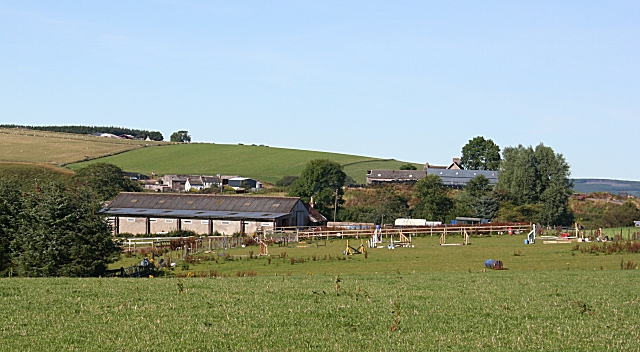
A distinctly rural parish it consists mainly of farm estates and has no village centre as such. The parish has an area of 68.4 km2 (26.4 sq mi).
The settlement was originally called Bocharin, meaning a bow-shape around a cairn or rocky hill, the hill in question being Ben Aigan, east of the River Spey and Rothes.
In his article on the parish for the Statistical Account of Scotland, 1791–9, Rev Lewis Forbes describes it thus:
The length, between the parish of Mortlich, at the west, and the parish of Bellie, at the east, is from 7 to 9 English miles; the breadth, from the parish of Botriphnie, at the south, to the highest cultivated land on the mountain, northward, is from 2 to 3 English miles; but the figure of the parish is so irregular, that these measures are to be regarded as the mean, rather than the particular length and breadth.
The general appearance of the country may be conceived as an extensive valley from east to west, having all the arable land hanging on the declivities of both sides, there being little or no plain on the banks of the brooks, which, rising in the hills, bend their courses to either hand; to Fiddich, on the west; and, by the east, turning by the north-west to Spey. From this general description, Airndilly, the seat of David M‘Dowall Grant, Esq; falls to be excepted, being delightfully situated on a rising ground, above a pretty extensive plain, half encircled by the Spey, in the south-western end of the parish, near to which, a little farther down the river, lie the haughs of Kailymore, a part of the same estate, signifying the great wood; which epithet, in some degree, it still comparatively merits. The soil here is sandy, warm, and fertile; but, in general, over the rest of the parish, it is a stiff, rich, deep clay, generally on a bed of limestone, and very retentive of water, with which it is too frequently supplied, the summit of the mountain attracting or intercepting the clouds borne along from the ocean by the north and north-westerly winds, on which account the harvests are rather late; and, though the air be moist, yet there is no distemper generally prevalent.
Hub AI
Boharm AI simulator
(@Boharm_simulator)
Boharm
57°30′50″N 3°07′02″W / 57.5140°N 3.1173°W
Boharm is a rural parish in the Speyside area of north Scotland, midway between Aberlour and Fochabers, and north of Dufftown. It lies on minor roads to either side of the A95. The main settlements in the parish are Maggieknockater and Mulben.
Despite its tiny size it is linked to two men who have been Moderator of the General Assembly, the highest position in the Church of Scotland.
A distinctly rural parish it consists mainly of farm estates and has no village centre as such. The parish has an area of 68.4 km2 (26.4 sq mi).
The settlement was originally called Bocharin, meaning a bow-shape around a cairn or rocky hill, the hill in question being Ben Aigan, east of the River Spey and Rothes.
In his article on the parish for the Statistical Account of Scotland, 1791–9, Rev Lewis Forbes describes it thus:
The length, between the parish of Mortlich, at the west, and the parish of Bellie, at the east, is from 7 to 9 English miles; the breadth, from the parish of Botriphnie, at the south, to the highest cultivated land on the mountain, northward, is from 2 to 3 English miles; but the figure of the parish is so irregular, that these measures are to be regarded as the mean, rather than the particular length and breadth.
The general appearance of the country may be conceived as an extensive valley from east to west, having all the arable land hanging on the declivities of both sides, there being little or no plain on the banks of the brooks, which, rising in the hills, bend their courses to either hand; to Fiddich, on the west; and, by the east, turning by the north-west to Spey. From this general description, Airndilly, the seat of David M‘Dowall Grant, Esq; falls to be excepted, being delightfully situated on a rising ground, above a pretty extensive plain, half encircled by the Spey, in the south-western end of the parish, near to which, a little farther down the river, lie the haughs of Kailymore, a part of the same estate, signifying the great wood; which epithet, in some degree, it still comparatively merits. The soil here is sandy, warm, and fertile; but, in general, over the rest of the parish, it is a stiff, rich, deep clay, generally on a bed of limestone, and very retentive of water, with which it is too frequently supplied, the summit of the mountain attracting or intercepting the clouds borne along from the ocean by the north and north-westerly winds, on which account the harvests are rather late; and, though the air be moist, yet there is no distemper generally prevalent.