Hubbry Logo
Bohemian ClubBohemian ClubMain
Open search
Bohemian Club
Community hub
Bohemian Club
logo
8 pages, 0 posts
0 subscribers
Be the first to start a discussion here.
Bohemian Club
Bohemian Club
from Wikipedia

The Bohemian Club is a private club with two locations: a city clubhouse in the Nob Hill district of San Francisco, California, and the Bohemian Grove, a retreat north of the city in Sonoma County.[2] Founded in 1872 from a regular meeting of journalists, artists, and musicians, it soon began to accept businessmen and entrepreneurs as permanent members, as well as offering temporary membership to university presidents (notably Berkeley and Stanford) and military commanders who were serving in the San Francisco Bay Area. Today, the club has a membership of many local and global leaders, ranging from artists and musicians to businessmen.[citation needed] Membership remains restricted to men only.[3]

Key Information

Clubhouse

[edit]
The Bohemian Club's City Clubhouse, from the corner of Taylor Street and Post Street

The City Club is located in a six-story masonry building at the corner of Post Street and Taylor Street, two blocks west of Union Square, and on the same block as both the Olympic Club and the Marines Memorial Club. The clubhouse contains dining rooms, meeting rooms, a bar, a library, an art gallery, a theater, and guest rooms.

Bohemian Grove

[edit]
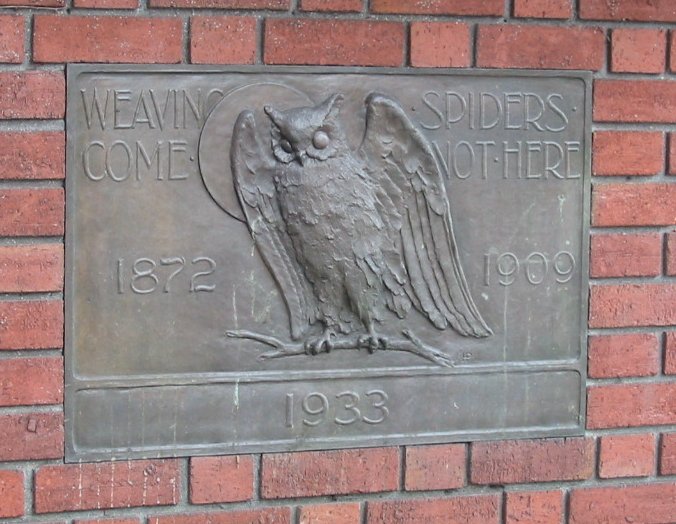
The club's mascot owl cast in masonry perched over the main entrance at 624 Taylor Street. The owl is flanked by the letters B and C and surrounded by words of the club's motto.

Every year, the club hosts a two-week-long (three weekends) camp at Bohemian Grove, which is notable for its illustrious guest list and its eclectic Cremation of Care ceremony which mockingly burns an effigy of "Care"[4] (the normal woes of life) with grand pageantry, pyrotechnics, and brilliant costumes, all done at the edge of a lake and at the base of a forty-foot "stone" owl statue (actually made of concrete).[5] In addition to that ceremony, devised by co-founder James F. Bowman in 1881, there are also two outdoor performances (dramatic and comedic plays), often with elaborate set design and orchestral accompaniment. The more elaborate of the two is the Grove Play, or High Jinks; the more ribald is called Low Jinks.[6] More often than not, the productions are original creations of the Associate members, but active participation of hundreds of members of all backgrounds is traditional.[7]

Nathanial Brittan Party House

[edit]

Nathaniel J. Brittan co-founded the Bohemian Club of San Francisco in 1872 and by 1892 was the president of the club.[8] He built the Nathanial Brittan Party House in San Carlos, California, in order to entertain his friends from the club and to use as a hunting lodge.[9][8][10]

History

[edit]

Bohemianism

[edit]

In New York City and other American metropolises in the late 1850s, groups of young, cultured journalists flourished as self-described "bohemians", until the American Civil War broke them up and sent them out as war correspondents.[11] During the war, reporters began to assume the title "bohemian", and newspapermen in general took up the moniker. "Bohemian" became synonymous with "newspaper writer".[11] California journalist Bret Harte first wrote as "The Bohemian" in The Golden Era in 1861, with this persona taking part in many satirical doings. Harte described San Francisco as a sort of Bohemia of the West.[12] Mark Twain called himself and poet Charles Warren Stoddard bohemians in 1867.[11]

Founding

[edit]

The Bohemian Club was originally formed in April 1872 by and for journalists who wished to promote a fraternal connection among men who enjoyed the arts. Michael Henry de Young, proprietor of the San Francisco Chronicle, provided this description of its formation in a 1915 interview:

The Bohemian Club was organized in the Chronicle office by Tommy Newcombe, Sutherland, Dan O'Connell, Harry Dam, J.Limon and others who were members of the staff. The boys wanted a place where they could get together after work, and they took a room on Sacramento street below Kearny. That was the start of the Bohemian Club, and it was not an unmixed blessing for the Chronicle because the boys would go there sometimes when they should have reported at the office. Very often when Dan O'Connell sat down to a good dinner there he would forget that he had a pocketful of notes for an important story.[13]

Journalists were to be regular members; artists and musicians were to be honorary members.[14] The group quickly relaxed its rules for membership to permit some people to join who had little artistic talent, but enjoyed the arts and had greater financial resources. Eventually, the original "bohemian" members were in the minority and the wealthy and powerful controlled the club.[15][16] Club members who were established and successful, respectable family men, defined for themselves their own form of bohemianism, which included men who were bon vivants, sometime outdoorsmen, and appreciators of the arts.[12] Club member and poet George Sterling responded to this redefinition:

Any good mixer of convivial habits considers he has a right to be called a Bohemian. But that is not a valid claim. There are two elements, at least, that are essential to Bohemianism. The first is devotion or addiction to one or more of the Seven Arts; the other is poverty. Other factors suggest themselves: for instance, I like to think of my Bohemians as young, as radical in their outlook on art and life; as unconventional, and, though this is debatable, as dwellers in a city large enough to have the somewhat cruel atmosphere of all great cities.[17]

Despite his purist views, Sterling associated very closely with the Bohemian Club and caroused with artist and industrialist alike at the Bohemian Grove.[17]

Oscar Wilde, upon visiting the club in 1882, is reported to have said, "I never saw so many well-dressed, well-fed, business-looking Bohemians in my life."[18]

Membership

[edit]
Future San Francisco mayor James D. Phelan as club president, 1891

A number of past membership lists are in the public domain,[14] but modern club membership lists are private. Some prominent figures have been given honorary membership, such as Richard Nixon and William Randolph Hearst. Members have included some U.S. presidents (usually before they are elected to office), many cabinet officials, and CEOs of large corporations, including major financial institutions. Major military contractors, oil companies, banks (including the Federal Reserve), utilities, and national media have high-ranking officials as club members or guests. Many members are, or have been, on the board of directors of several of these corporations; however, artists and lovers of art are among the most active members. The club's bylaws require ten percent of the membership be accomplished artists of all types (composers, musicians, singers, actors, lighting artists, painters, authors, etc.). During the first half of the 20th century, membership in the club was especially valued by painters and sculptors, who exhibited their work on the premises, in both permanent displays and special exhibitions, and did not pay any commissions on sales to members.[19] Many of the club's artists were nationally recognized figures, such as William Keith, Arthur Frank Mathews, Xavier Martinez, Jules Eugene Pages, Edwin Deakin, William Ritschel, Jo Mora, Maynard Dixon, and Arthur Putnam.

The club motto is "Weaving Spiders Come Not Here", a line taken from Act 2, Scene 2, of Shakespeare's A Midsummer Night's Dream. The club motto implies that outside concerns and business deals are to be left outside. When gathered in groups, Bohemians usually adhere to the injunction, though discussion of business often occurs between pairs of members.[20]

Bret Harte Memorial

[edit]
The Bret Harte Memorial by Jo Mora

A bronze relief by Jo Mora is installed on the exterior of the building. It serves as a memorial to author and poet Bret Harte. The relief, which is 3 ft 3+78 in (101.3 cm) by 7 ft 11+58 in (242.9 cm) by 2+12 in (6.4 cm), was first dedicated on August 15, 1919, as a tribute by Mora, who was a member, to fellow Bohemian Club member Harte. The relief shows fifteen characters from books by Harte. It is inscribed:

Proper left, upper corner:

J J MORA AUGUST 15, 1919

Proper left, lower edge:

L. DE ROME BRONZE FOUNDRY

Top center wreath:

IN MEMORIAM BRET HARTE 1836–1902 AD

followed by the founder's mark for L. De Rome. When the original building was torn down, the relief was removed. In 1934, it was reinstalled on the building that stands today.[21]

See also

[edit]

References

[edit]

Bibliography

[edit]
[edit]
Revisions and contributorsEdit on WikipediaRead on Wikipedia
from Grokipedia
The Bohemian Club is a private, all-male social and artistic club founded in in 1872 by a group of newspapermen, artists, actors, and musicians seeking respite from professional rigors through creative pursuits and camaraderie. Incorporated on of that year, it originated as a gathering for bohemian types emphasizing theatricals, literature, and informal discourse, evolving to include affluent patrons to sustain its activities. The club operates from a historic clubhouse in San Francisco's Nob Hill district and owns , a 2,700-acre redwood forest encampment near Monte Rio in Sonoma County, site of its annual two-week midsummer retreat since the late . These encampments feature member-produced plays, concerts, and "Lakeside Talks" by invited speakers on topics ranging from science to policy, fostering bonds among approximately 2,500 members drawn from elite strata in , , and culture, though admission requires sponsorship and blackball-proofing. Notable for its owl emblem symbolizing wisdom and its ritualistic opening ceremony, the "Cremation of Care," which dramatizes banishing worldly worries before a 40-foot statue, the club's opacity has fueled speculation of among power holders, yet documented evidence reveals primarily fraternal recreation and artistic endeavor rather than coordinated . Its male-only policy and high underscore exclusivity, drawing criticism for , while defenders highlight its role in preserving a space for unscripted intellectual exchange amid institutional pressures.

History

Origins in Bohemianism and Founding (1872)

The Bohemian Club originated amid San Francisco's post-Gold Rush bohemian milieu, where journalists, writers, and performers cultivated informal networks to escape bourgeois constraints and pursue artistic expression. This local iteration of echoed European precedents, emphasizing nonconformist lifestyles, literary salons, and mutual support among creative professionals in a rapidly commercializing city. By the early , such gatherings had evolved from tavern meetings into structured associations, reflecting a desire for dedicated spaces amid economic pressures on the press. In late winter or early spring of 1872, approximately half a dozen newspapermen, styling themselves as the city's artistic vanguard, formalized the Bohemian Club to promote fellowship, intellectual discourse, and cultural activities among like-minded men. The founding cohort, including Dan O'Connell, prioritized journalists initially but extended invitations to actors, lawyers, and musicians seeking respite from professional rigors. Official incorporation occurred on April 22, 1872, with bylaws emphasizing conviviality over elitism, though membership remained male-only and invitation-based from inception. Early activities centered on theatrical productions, readings, and debates at rented venues, embodying bohemian ideals of collaborative without immediate commercial intent. This foundation distinguished the club from mere drinking societies, as participants viewed it as a bulwark against San Francisco's growing . Within months, the group adopted the as a nascent of and vigilance, underscoring their self-perceived role as cultural custodians.

Early Expansion and Institutionalization (1870s–1900s)

The Bohemian Club, formalized on March 25, 1872, with 24 charter members primarily consisting of San Francisco newspapermen, experienced rapid initial growth, expanding to over 230 members by 1875 as it attracted individuals interested in literature, art, and camaraderie. Incorporated on April 9, 1872, the organization established early traditions such as the "High Jinks" entertainments, first held on April 13, 1872, which featured artistic performances and revelry, alongside adopting the owl as its mascot and the motto "Weaving spiders come not here" to emphasize a retreat from worldly business concerns. These elements reflected an institutionalizing structure amid the club's bohemian ethos, with monthly gatherings evolving into formalized "Jinks" nights that blended intellectual discourse and theatrical diversions. Membership composition shifted notably by the late , broadening beyond journalists to include affluent professionals and businessmen whose financial support enabled expanded activities, diverging from the original focus on artistic newspaper men while retaining an emphasis on arts appreciation. This expansion facilitated the club's relocation to larger venues, including the Market in 1876 and the Pacific Club in 1889, before purchasing a lot at Sutter and Mason streets in –1892 for a permanent clubhouse, marking a key step in institutional permanence. Outdoor traditions institutionalized with the first Midsummer Encampment on June 29, 1878, held at Camp Taylor in Marin County as a farewell for founding member Henry Edwards, drawing nearly 100 participants for encampment-style revels in redwood groves. The "Cremation of Care" ceremony, symbolizing the banishing of worldly worries, was introduced in 1880 during such events. By the late 1890s, the club pursued dedicated grounds, voting in March 1898 and May 1899 to acquire near Monte Rio, finalizing payment in spring 1900 for 160 acres at a cost of $27,000 and consecrating the site on August 11, 1900, which enabled annual summer retreats and further entrenched the club's encampment culture. Early Grove Plays, precursors to more elaborate pageants, began in 1892 at Mill Valley, solidifying theatrical traditions within the natural setting.

Twentieth-Century Developments and Post-War Growth

In the early decades of the twentieth century, the Bohemian Club experienced significant membership expansion alongside infrastructural developments at . By 1914, total membership stood at 1,259, comprising 787 residents, 241 non-residents, and military affiliates including 19 and 49 officers. This growth reflected increasing appeal among San Francisco's elite, with one in four members of the exclusive also belonging to the Bohemian Club by 1906. Concurrently, the Grove's acreage expanded through land acquisitions, reaching 2,700 acres by 1944 to safeguard against encroaching development, while internal features like a 100-by-400-foot lake were constructed in the mid-1920s and a completed in 1929; these supported 169 encampment camps by that year. Membership composition shifted notably during this period, incorporating more business leaders and capitalists alongside its artistic origins, with 31% of local members listed in the by 1907. By 1933, numbers approached 2,000, necessitating clubhouse renovations that temporarily relocated activities to the Sir Francis Drake Hotel. This influx of industrialists, publishers, and professionals marked a transition toward a network of power elites, including presidents and corporate directors, while maintaining traditions like Grove Plays and Lakeside Talks. World War II interrupted growth, with membership declining to 1,647 by 1941 and encampments suspended from 1943 to 1945. Post-war recovery saw resumption of activities and steady rebound, culminating in thousands of members—predominantly wealthy conservatives—by the club's 1972 centennial. The Grove's camps later consolidated to 124 by 1994 amid ongoing maintenance, such as the 1981 lake relining with concrete and earth, underscoring sustained operational expansion. This era solidified the club's role as a retreat for influential figures, including post-war political attendees like .

Facilities and Properties

San Francisco Clubhouse

The San Francisco clubhouse of the Bohemian Club is located at 624 Taylor Street, at the corner of Post and Taylor Streets in the Lower Nob Hill neighborhood of , two blocks west of Union Square. This six-story masonry structure serves as the club's primary urban facility for year-round social gatherings, artistic performances, and business meetings among members, complementing the seasonal Bohemian Grove encampment. The building includes dining rooms, a bar, , , theater, meeting spaces, and guest accommodations on upper floors. Following the and fire, which destroyed early club properties, the Bohemian Club operated from temporary locations before establishing a permanent city headquarters. An earlier clubhouse designed by Loring P. Rixford in 1909–1910 at the same site was a three-story building, but the current structure was constructed in 1934 under architect Lewis P. Hobart. Hobart's design adopted a five-story -sheathed form with a Georgian Revival aesthetic, incorporating Mediterranean Revival and elements prevalent in 1930s architecture. The building's facade features a three-part vertical composition: a high exposed base on Post Street tapering uphill to no base on Taylor Street, accented by decorative spandrel brickwork and Art Deco-style window bays. Terra cotta bas-relief panels by sculptor Haig Patigian adorn the exterior between the second and third floors, depicting allegorical figures related to the club's bohemian ethos. Plaques bearing the club's emblem and motto, "Weaving spiders come not here," are also prominent on the exterior, echoing traditions from the club's founding era. Additional sculptures include a Jo Mora piece and a plaque illustrating characters from Bret Harte's works, honoring the club's literary roots. Interior spaces support the club's focus on arts and camaraderie, with lounges for informal discussions and dedicated areas for theatrical "jinks" performances. The clubhouse remains an active hub for elite networking, though access is restricted to members and invited guests, preserving its private character since inception.

Bohemian Grove Encampment Grounds

The Bohemian Grove comprises a 2,700-acre private campground situated in Monte Rio, Sonoma County, California, approximately 75 miles north of along the Russian River. Owned by the Bohemian Club, a -based gentlemen's club established in , the grounds serve as the primary site for the club's annual midsummer retreats. The property features a dense stand of ancient coastal redwoods, some exceeding 300 feet in height and over a thousand years old, preserved amid surrounding timberlands. Initial encampments began in at rented sites nearby, transitioning to club-owned land with the purchase of 160 acres in for $27,000; subsequent acquisitions, including expansions in the to avert , enlarged the holdings to the current extent by 1944. Development emphasized rustic integrated into the natural terrain, including selective clearing for campsites while maintaining the redwood canopy. An artificial lake was constructed as a central feature, alongside a mountain stream proximate to early camp areas, supporting both recreational and performative uses. The grounds host over 100 individual camps—clustered enclaves of cabins and leisure quarters—such as Mandalay, Hill Billies, Owl’s Nest, and Isles of Aves, designed for small groups of members and guests. Infrastructure includes tram systems for internal transport, a clubhouse architecturally styled by , amphitheaters, and stages amid the forest, facilitating communal gatherings in a setting that blends seclusion with organized amenities. These elements underscore the site's evolution from informal artist retreats to a structured, preserve.

Ancillary Properties and Memorials

The Bohemian Club features the Bret Harte Memorial, a bronze relief sculpture commissioned from club member Jo Mora and dedicated on August 15, 1919. Located on the Post Street facade of the clubhouse at 624 Taylor Street, the plaque honors Francis (1836–1902), a founding member known for his stories of pioneers such as The Outcasts of Poker Flat and . The sculpture depicts fifteen characters drawn from Harte's works, including Tennessee's Partner, M'Liss, and the figure from the poem "Plain Language from Truthful James" known as the Heathen Chinee. Cast by the L. De Rome Bronze Foundry, it was removed in 1933 during the demolition of the original clubhouse and reinstalled on the new structure in 1934. This memorial stands as a tribute to Harte's literary contributions and his role in the club's early bohemian ethos. Public records indicate no significant ancillary properties beyond the primary San Francisco clubhouse and the encampment grounds, with land holdings primarily expanded within the Grove to approximately 2,700 acres by the early . Memorials within the Grove, such as symbolic statues associated with rituals, serve ceremonial purposes rather than commemorating specific individuals.

Membership and Governance

Eligibility Criteria and Selection Process

Membership in the Bohemian Club is restricted to men, a policy the organization has maintained despite legal challenges under California's , successfully arguing its status as a private club with selective criteria focused on personal associations rather than public accommodation. The club's bylaws require that at least 100 members be "professional" individuals—such as , musicians, writers, actors, or other creative professionals—to preserve its founding emphasis on bohemian and pursuits, though the majority of members today consist of businessmen, politicians, and other elites deemed compatible with this ethos. Prospective members must be nominated by at least two regular members in good standing, who provide endorsements attesting to the candidate's character, professional accomplishments, and qualities that would enhance the club's social and intellectual cohesion. Nominations undergo review by a , which evaluates suitability based on alignment with the club's private, invitation-only nature; approval advances the candidate to a vote by the full membership, where consensus is required amid long waiting lists that can span years or decades due to the cap of approximately 2,500 members. This process prioritizes personal networks and vetted compatibility over open applications, reflecting the club's origins in fostering exclusive bonds among those with influence in , , and . New members pay an initiation fee of about $25,000 upon acceptance, in addition to substantial annual dues that contribute to operational costs exceeding millions annually, as reported in the club's nonprofit filings. These financial barriers, combined with the nomination and vetting requirements, ensure selectivity, with historical data indicating waitlists often extending 10 to 15 years for high-profile candidates.

Composition and Notable Members

The Bohemian Club's membership comprises influential men from diverse professional backgrounds, including business executives, government officials, artists, musicians, and journalists, reflecting its origins in fostering camaraderie between creative "bohemians" and practical leaders. The club enforces an all-male policy and limits total membership to around 2,500 individuals, prioritizing those who can contribute to its artistic and intellectual traditions while upholding exclusivity through sponsorship by existing members. This composition has evolved from its 19th-century focus on San Francisco's literary and journalistic elite to a broader assembly of national and international figures post-World War II, with businessmen and policymakers increasingly predominant. Notable political members have included U.S. Presidents , , , and , alongside figures such as California Governor Edmund G. Brown Sr. and Senator Percy. In business and finance, prominent attendees encompass and executives from the family, known for their roles in major and energy projects. The artistic contingent features entertainers like and writers such as William F. Buckley Jr., maintaining the club's foundational emphasis on cultural pursuits amid its elite networking. Early 20th-century artist-members included painters like and Norton Bush, who helped establish the club's bohemian ethos through exhibitions and performances.

Internal Structure and Leadership

The Bohemian Club operates under a governance structure centered on a comprising 15 members, elected exclusively from and by the club's regular members. This board holds authority over major decisions, including financial oversight, facility management, and policy formulation for both the San Francisco clubhouse and Bohemian Grove encampment. Regular members, predominantly businessmen who pay full dues, constitute the voting electorate, ensuring that leadership reflects the interests of this core group, which has grown dominant since the club's early years when artistic founders sought financial backing from affluent patrons. Executive leadership is provided by officers including a president, one or more vice presidents, a , and a , positions typically drawn from the board or senior membership and serving terms aligned with annual or biennial cycles as reflected in tax filings. The president, for instance, directs high-level operations and represents the club in external matters, such as approvals for use. These roles emphasize administrative efficiency and continuity, with the managing the club's substantial assets derived from dues and endowments. Membership structure supports this hierarchy through differentiated classes: regular members exercise full privileges including voting and encampment participation; performing members, often artists or musicians, contribute to entertainments like theatrical productions in exchange for reduced dues; and honorary members, elected for eminence in , , or public life, incur no fees but lack voting . This tiered system, evolved from the club's origins among journalists and bohemians, incentivizes artistic input while prioritizing fiscal stability from regular members, who now form the majority. Committees subordinate to the board handle specialized functions, such as encampment logistics and artistic programming, fostering operational specialization without diluting board authority.

Activities and Traditions

Annual Midsummer Encampment

The Bohemian Club's Annual Midsummer Encampment originated in 1878 as a farewell gathering for a departing member, held initially near Lagunitas Creek in . Early iterations rotated among sites in , including Duncans Mills, Guerneville, and Camp Meeker, before settling in the Monte Rio area in 1893 on leased land from the Sonoma Lumber Company. To secure the redwood forest for ongoing use and prevent , the club purchased the property—spanning approximately 2,700 acres—in 1899 from Melvin Cyrus Meeker, who had operated a venture there; subsequent acquisitions expanded holdings through the mid-20th century. Held annually in July at in Monte Rio, Sonoma County, the encampment typically lasts two weeks, encompassing three weekends and attracting peak attendance of around 2,000 male participants—primarily club members with a limited number of invited guests. The grounds feature over 115 private camps, communal enclaves equipped with cabins, tents, and amenities ranging from rustic to elaborate, complete with personal staff in some cases; notable examples include , an upscale hilltop site, and Hill Billies, emphasizing intimate socializing within the redwood canopy. The event operates as an all-male , employing roughly 300 male staff to handle , , and services, with no women permitted on the premises. It structures daily life around communal meals, , and member-led entertainments designed to promote artistic expression, relaxation, and bonds among attendees, insulated from external professional demands. Midweek numbers are lower, allowing quieter interludes, while weekends intensify activity across the site's trails, lakeside areas, and performance venues.

The Cremation of Care Ritual

The is an elaborate theatrical ritual performed annually by Bohemian Club members to open their two-week midsummer encampment at , a 2,700-acre redwood retreat near . First conducted in 1880 during an early club outing at Meeker's Grove in Sonoma County, it has since become a scripted tradition emphasizing escape from daily burdens. The ceremony, lasting approximately 50 minutes, involves around 250 participants portraying roles such as hooded priests and torchbearers, and is attended by roughly 1,500 members and guests, including business leaders, politicians, and artists. The ritual begins with a procession carrying a coffin containing an effigy representing "Dull Care"—symbolizing worldly worries and responsibilities—to an artificial lake and a 30- to 40-foot concrete -shaped altar. Elements include chants such as "Begone, detested Care, begone!", performances by a figure, music, and a climactic symbolic of the effigy accompanied by . This mock-Druidic production unfolds before the statue, a central Grove symbol, on the first night of the encampment, typically in July. Its purpose is to ritually expel participants' cares, promoting fellowship and relaxation while adhering to the club's motto, "Weaving spiders come not here," which prohibits business discussions during the retreat. Members view it as a key event fostering group cohesion and tradition, with informants describing it as a "big deal" that reinforces shared identity among attendees. Documented in club pamphlets and historical reports, the ceremony maintains a formal, symbolic structure without evidence of deviation from its established form across over a century of performances.

Artistic Performances, Talks, and Social Customs

The Bohemian Club's artistic performances originated with the "High Jinks," first staged in shortly after the club's founding as an unpretentious, all-male entertainment featuring intellectual revels with moderate drinking, inspired by literary traditions. These evolved by incorporating a "Low Jinks" counterpart of more vulgar elements, separated by drinks and dinner, and shifted outdoors in for gatherings in coastal forests. By the late , performances had developed into elaborate Grove Plays, formalizing as musical pageants in 1902 within a natural redwood amphitheater during the annual encampment. Grove Plays typically feature mythical or fantastical themes, with some historical settings, staged with grand sets, costumes, and orchestral accompaniment, often carrying moral undertones and achieving a quasi-religious tone through institutional tradition. Examples include Truth, Life, Wings, and The Quest of the Gorgon, reflecting influences from theatrical producer David Belasco's majestic style. A specific production, The Eldorado in 1977, dramatized greedy gold miners displacing Spaniards in 19th-century , with club members like Casper Weinberger in minor roles. Lakeside Talks, held daily at 12:30 p.m. beside an artificial lake, consist of informal addresses by prominent figures assuming the audience's capacity for influence on discussed issues. Historical speakers have included prior to his presidency and during his senatorial tenure, alongside regular appearances by after his 1913 club membership. In 1977, former California Governor Edmund G. "Pat" Brown spoke on state water issues and the , while Gerald R. Ford outlined national recovery plans and John McCosker addressed sex-changing fish species near the Galapagos. Social customs during the encampment emphasize relaxation and cohesion through camp-based activities, with over 100 themed camps like and Cave Man hosting intimate gatherings, rivalries, and specialized events such as the Poison Oak camp's Bulls' Balls Lunch featuring roasted cattle testicles. Traditions include all-day music, nighttime programs of comedy skits, singing, and acting open to all members, alongside toasts, lamb-chop feasts, mint juleps, and recreations like , , and canoeing, supported by substantial wine and liquor provisions but prohibiting radios, televisions, and most external media. These practices foster a fraternity-like atmosphere of tribal camaraderie, detached from professional concerns.

Cultural and Societal Impact

Fostering Creativity and Elite Networks

The Bohemian Club promotes creativity through its longstanding tradition of producing original Grove Plays, elaborate musical dramas crafted and staged by members at the annual Bohemian Grove encampment. These works, which trace their origins to the club's inaugural "High Jinks" theatrical gatherings in 1878, feature custom-composed music, scenery built on-site, and narratives drawing from mythology, history, and nature, involving collaboration among artists, composers, and performers within the membership. By 1908, critic and member Porter Garnett defended the plays as a structured outlet for artistic expression, countering perceptions of amateurism with their scale and member-driven innovation. This participatory format has sustained creative output for over a century, with annual productions requiring hundreds of hours from volunteers, fostering skills in writing, directing, and production among professionals who balance these pursuits with primary careers. Complementing artistic endeavors, the club cultivates elite networks via the relaxed, sequestered environment of , where approximately 2,000 to 3,000 attendees—predominantly affluent men from , , and —engage in unstructured socializing around campfires, concerts, and private tents. The daily Lakeside Talks, held since at least the early , feature addresses by high-profile speakers on topics ranging from to scientific advancements, enabling direct access and rapport-building among influencers; for instance, talks have included Treasury officials elucidating fiscal intricacies to audiences of bankers and executives. Empirical studies of membership rosters reveal a statistically significant overrepresentation of corporate leaders and policymakers, with network analyses indicating that Bohemian affiliations correlate positively with positions in the upper echelons of American power structures, facilitating informal alliances and resource exchanges beyond formal hierarchies. Such dynamics underscore the club's role in bridging creative and establishment spheres, though academic examinations of these ties, often conducted by sociologists critiquing concentrated influence, highlight potential risks of insular decision-making detached from broader societal input.

Contributions to American Arts and Leadership

The Bohemian Club, chartered in 1872 in San Francisco, emerged as a hub for artistic innovation during the post-Gold Rush era, drawing writers including Ambrose Bierce, Joaquin Miller, Henry George, and honorary members Mark Twain and Bret Harte, with subsequent affiliates such as Jack London and Frank Norris. From the 1870s to about 1915, it nurtured a peak period for West Coast visual arts, particularly landscape painting, through members like William Keith, Thomas Hill, Maynard Dixon, and Jules Tavernier, whose 1878 work Dance in a Subterranean Roundhouse at Clear Lake, California exemplified the club's encouragement of regionally inspired creativity. Artistic traditions solidified with the debut of "High Jinks" intellectual revels in 1872, followed by the first outdoor performance on June 29, 1878, in Marin County, and the inception of elaborate Grove Plays in 1902 at near Monte Rio. These annual musical pageants, staged in a natural amphitheater with large-scale sets and orchestras, integrated theatrical elements inspired by figures like , sustaining a bohemian amid evolving membership. Shifting toward leadership influence, the club integrated business and political elites, with members serving as CEOs of entities including , , and , alongside government roles held by , as , and Caspar Weinberger as Secretary of Defense. Network analyses indicate its structural (scoring 0.62 among elite organizations) fostered cohesion, evidenced by overlaps like 31% of local members in the 1907 San Francisco . The annual Midsummer Encampment's Lakeside Talks exemplified this by hosting policy-oriented addresses; Richard Nixon's July 1967 speech urged a "long view" of global shifts, including Soviet-Chinese tensions and African instability, while calling for foreign aid modernization focused on and private enterprise, alongside sustained military edge over the . Such gatherings reinforced informal bonds among influencers, contributing to elite coordination without formal decision-making structures.

Role in Countercultural and Conservative Bonding

The Bohemian Club, founded in 1872 by journalists, writers, actors, and lawyers in , initially embodied a bohemian centered on artistic expression and intellectual pursuits, attracting early members such as and honorary affiliates like . By the late , however, membership expanded to include wealthy businessmen and conservative elites, with 31% of local members listed in the San Francisco by 1907, shifting the club's composition toward affluent, predominantly Republican participants. This evolution created a distinctive forum where artistic traditions persisted alongside conservative networking, allowing elites to engage in creative activities without compromising their professional identities. Central to this bonding are the club's theatrical traditions, including the High Jinks—annual intellectual entertainments begun in —and the more elaborate Grove Plays, musical pageants staged since in a natural amphitheater at the encampment. These performances draw on bohemian-inspired pageantry and music, involving members in roles that evoke artistic nonconformity, yet they occur amid camps hosting conservative figures such as in the Hill Billies camp or in . Complementing these are Lakeside Talks, where conservative speakers like delivered addresses, as in his 2000 speech on foreign policy, juxtaposing policy discourse with the encampment's ritualistic informality. The ritual, first performed in 1880, exemplifies this synthesis: a dramatic featuring burning and choral elements before a 40-foot , which permits conservative members—often from corporate and military backgrounds—to participate in symbolic, quasi-mystical acts reminiscent of bohemian excess or countercultural theater. Such activities, combined with the Grove's relaxed setting of , theatricals, and camp-based camaraderie during the two-week midsummer encampment, enhance social cohesion among disparate members, bridging artists and power brokers like or . Within the club, "bohemian" has come to signify loyalty to these shared customs rather than literal artistic , enabling conservative elites to appropriate bohemian forms for bonding and subtle policy alignment.

Controversies and Criticisms

Charges of Secrecy and Elitism

The Bohemian Club's policies of limited public disclosure regarding its membership roster, event proceedings, and internal rituals have prompted accusations of undue secrecy, with critics contending that such opacity enables unchecked networking among powerful individuals. For example, the club's "Lakeside Talks" at the annual encampment—featuring addresses by politicians, executives, and intellectuals—are not open to outsiders or detailed in , leading to claims that substantive policy deliberations occur behind closed doors. Historical instances, such as the 1942 conceptualization of the during a Grove gathering and 1967 conversations between and on presidential ambitions, have been cited by detractors as evidence of covert influence-peddling masked by privacy norms. Charges of elitism stem from the club's invitation-only admissions process, which prioritizes accomplished men with significant professional standing and financial means, resulting in a roster dominated by corporate leaders, former presidents, and cultural figures from predominantly affluent, white, and conservative backgrounds. Membership entails an initiation fee of approximately $25,000 plus annual dues around $5,000, barriers that exclude broader societal participation and reinforce perceptions of an insulated . The exclusively male composition—maintained since the club's founding by journalists and artists, evolving to include elite businessmen—has drawn particular ire, with opponents arguing it disadvantages women in competitive spheres by facilitating male-only bonding and deal-making unavailable elsewhere. These criticisms manifested in annual protests outside Bohemian Grove from the 1980s through the early 2000s, where activists decried the encampment as a symbol of patriarchal and , sometimes numbering in the hundreds and targeting the event's role in perpetuating inequality. Demonstrators highlighted the Grove's 2,700-acre seclusion and security measures, which bar non-members and amplify suspicions of an unaccountable power nexus. More recent lawsuits, including a 2023 by former valets alleging wage underpayment, have renewed scrutiny of the club's operations, portraying it as emblematic of opaque elite institutions exploiting labor while shielding internal practices. Critics in media outlets, often from progressive perspectives, frame these elements as antithetical to democratic transparency, though the club maintains its gatherings emphasize artistic pursuits and respite under the "Weaving Spiders Come Not Here," prohibiting overt commercial or political scheming.

Conspiracy Theories and Empirical Debunkings

The Bohemian Club's secrecy and elite membership have spawned numerous conspiracy theories, particularly centered on the annual midsummer encampment at , where proponents allege rituals, human sacrifices, and covert plotting by global power brokers to orchestrate events like wars or the New World Order. These narratives often interpret the club's symbol as a pagan akin to and claim that decisions such as the development of the atomic bomb were hatched there, though declassified documents attribute the Project's origins to Los Alamos and other sites in 1942. A pivotal event fueling these claims was conspiracy theorist ' unauthorized entry into on July 15, 2000, alongside journalist , during which Jones secretly filmed portions of the ceremony from a hillside vantage point and subsequently portrayed it in his documentary Dark Secrets: Inside Bohemian Grove as ritualistic mock to an ancient Canaanite god. Jones' footage, capturing robed figures chanting before a large statue and the burning of an effigy, has been cited by theorists as proof of satanic worship and elite immorality, with extrapolations linking it to broader Illuminati-style cabals. Empirical examinations reveal the Cremation of Care as a scripted theatrical pageant first performed in , symbolizing the symbolic incineration of "Dull Care"—personified as an intrusive figure—to permit participants a temporary escape from burdens, enacted annually on the encampment's opening night with pyrotechnics, music, and actors but involving no violence or intent. Sociologist G. William Domhoff's analysis, drawn from participant-observation and archival review in his 1974 book The Bohemian Grove and Other Retreats, describes the ritual and encampment activities as mechanisms for fostering interpersonal bonds through art, lectures, and recreation among affluent men, rather than venues for policy dictation or esoteric rites, noting that "Lakeside Talks" feature prepared speeches on topics like or but lack binding outcomes. Skeptic , evaluating attendee accounts and historical records, likens to a fusion of TED conferences and artistic festivals—exclusive and eccentric, with no women or recording devices to preserve an atmosphere of uninhibited discussion—yet devoid of evidentiary support for conspiratorial malfeasance, attributing persistent myths to the human tendency to infer malice from opacity rather than mundane networking. Despite over 140 years of operations involving thousands of participants, including U.S. presidents like and , no verifiable leaks, legal convictions, or physical traces substantiate claims of criminality or occultism; instead, documented outcomes emphasize cultural productions and informal camaraderie, with secrecy rooted in private property norms rather than cover-ups. The has noted that while protests and infiltrations, such as those by activist groups in the , have publicized guest lists revealing high-profile attendees, these disclosures yielded no proof of illicit coordination, underscoring how in fringe interpretations amplifies theatrical elements into unfounded doomsday scenarios. The Bohemian Club has faced multiple lawsuits alleging violations of labor laws, primarily concerning wage theft, non-payment, and inadequate breaks for seasonal workers at its encampment. In June 2023, three former valets from the Monastery Camp filed a class-action complaint in the U.S. District Court for the Northern District of , claiming they endured 16-hour workdays without meal or rest breaks during the annual July encampment, with captains from individual camps directing off-the-books cash payments to evade , , and benefit requirements. The suit named the Bohemian Club as a joint employer alongside camp operators and payroll firms, asserting the club's oversight of encampment operations contributed to systemic underpayment affecting hundreds of workers across approximately 100 camps. In January 2024, the court dismissed the Bohemian Club from the case, ruling plaintiffs failed to sufficiently allege joint employer liability, though claims against other defendants proceeded. A prior 2016 class-action suit raised identical wage and hour violation claims against the club for Grove workers, resulting in a $7 million settlement without admission of liability. In May 2025, a former cook at the club's headquarters initiated another class-action lawsuit alleging similar failures to provide breaks and pay owed wages, seeking certification for affected employees. These actions highlight recurring patterns of labor practices at the Grove, where temporary staff handle serving, cleaning, and maintenance for elite members, often under captains who prioritize operational demands over compliance. Allegations of worker mistreatment extend to interactions with club members, as detailed in amended 2023 filings from the valets' suit. Plaintiffs accused billionaire William Koch of demanding a hand-wash his underwear during the 2022 encampment, describing it as humiliating exploitation, while three then-members of Congress—, , and —allegedly made disparaging remarks about in the presence of staff. Such claims portray a hierarchical environment where low-wage workers serve high-profile attendees, including politicians and executives, amid the club's emphasis on seclusion and informality. On discrimination fronts, the club defended its male-only membership and hiring policies in a 1986 appellate case against the Fair Employment and Housing Commission, arguing exemption as a private under the Fair Employment and Housing Act despite accusations of discriminatory employment practices. A 2006 federal complaint by employee Miriam Greenwald alleged sex and disability harassment, , retaliation, and denial of accommodations at the club's facilities, though the case's resolution details remain limited in . These challenges underscore tensions between the club's exclusionary traditions and state anti-discrimination mandates, with courts often scrutinizing its nonprofit status and operational scope.

References

Add your contribution
Related Hubs
User Avatar
No comments yet.