
Recent from talks
Rubroboletus satanas
Knowledge base stats:
Talk channels stats:
Members stats:
Rubroboletus satanas
Rubroboletus satanas, commonly known as Satan's bolete or the Devil's bolete, is a basidiomycete fungus of the bolete family (Boletaceae) and one of its most infamous members. It was known as Boletus satanas before its transfer to the new genus Rubroboletus in 2014, based on molecular phylogenetic data.
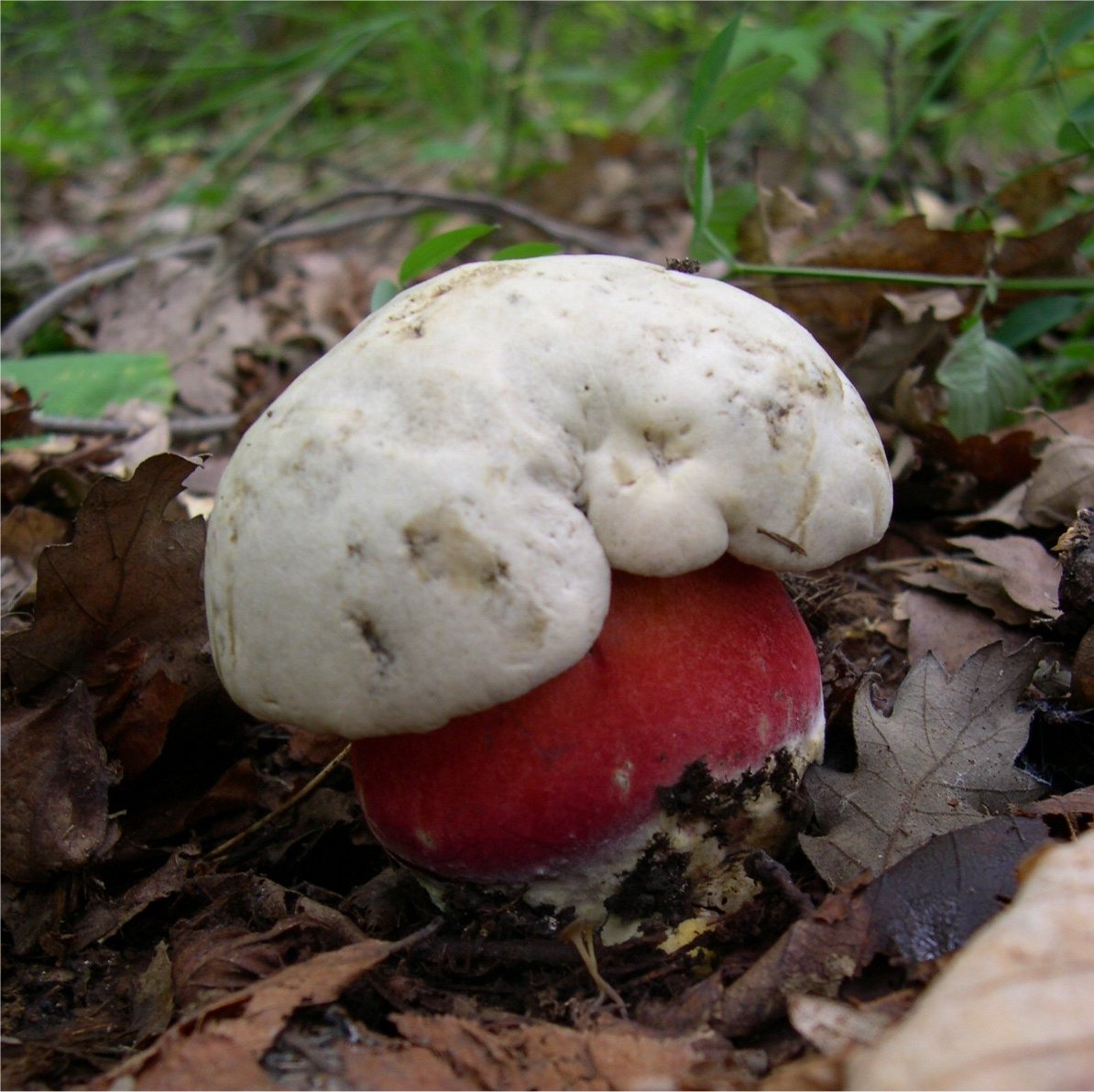
These squat, brightly coloured fruiting bodies are often massive and imposing, with a beige-coloured velvet-textured cap up to 50 cm (20 in) across, yellow to orange-red pores and a bulbous red stem. The flesh turns blue when cut or bruised and the fruit bodies often emit an unpleasant rotten odor.
Found in broad-leaved and mixed woodland in the warmer regions of Europe, it is classified as a poisonous mushroom, known to cause violent gastroenteritis. However, reports of poisoning are rare, due to the striking coloration and unpleasant odor of the fruiting bodies, which discourage experimentation.
Originally known as Boletus satanas, Satan's bolete was described by German mycologist Harald Othmar Lenz in 1831. Lenz was aware of several reports of adverse reactions from people who had consumed this fungus and apparently felt himself ill from its "emanations" while describing it, hence giving it its sinister epithet. The Greek word σατανᾶς (satanas, or Satan) is derived from Hebrew śāṭān (שטן). The American mycologist Harry D. Thiers concluded that material from North America matches the species description; however, genetic testing has since confirmed that western North American collections represent Rubroboletus eastwoodiae, a different species.
Genetic analysis published in 2013 revealed that B. satanas and several other red-pored boletes are part of the "dupainii" clade (named after B. dupainii) and are distantly nested from the core group of Boletus (including B. edulis and relatives) within the Boletineae. This indicated that B. satanas and its relatives belonged to a distinct genus. The species was hence transferred to the new genus Rubroboletus in 2014, along with several allied red-pored, blue-staining bolete species. Genetic testing on several species of the genus revealed that R. satanas is most closely related to R. pulchrotinctus, a morphologically similar but much rarer species occurring in the Mediterranean regions.
Both Rubroboletus satanas and Suillellus luridus are known as ayimantari ('bear mushroom') in eastern Turkey.
The compact cap can reach an impressive 30 cm (12 in), exceptionally 40 cm (16 in), and very rarely 50 cm (20 in) in diameter. It is arguably the largest bolete found in Europe.[citation needed] At first it is hemispherical with an inrolled margin, but becomes convex at maturity as the fruit body expands, while in older specimens the margin might be slightly undulating. When young, the pileus is greyish white to silvery-white or buff, but older specimens tend to develop olivaceous, ochraceous or brownish tinges. The surface of the cap is finely tomentose, becoming smooth at maturity and is often slightly viscid in wet weather. The cuticle is tightly attached to the flesh and does not peel.
The free to slightly adnate tubes are up to 3 mm (1⁄8 in) long, pale yellow or greenish yellow and bluing when cut. The pores (tube mouths) are rounded, yellow to orange at first, but soon turning red from the point of their attachment to the stem outwards, eventually becoming entirely purplish red or carmine-red at full maturity and instantly bluing when touched or bruised. The stipe is 5–15 cm (2–6 in), extraordinarily 20 cm (8 in), very rarely 25 cm (10 in) long, distinctly bulbous (4–12 cm or 1.6–4.7 in, extraordinarily 16 cm or 6.3 in, very rarely 20 cm or 7.9 in), and often wider than its length, becoming more ventricose as the fungus expands but remaining bulbous at the base. Its colour is golden-yellow to orange at the apex, becoming increasingly pinkish-red to reddish-orange further down and deep carmine-red to purple-red towards the base. It is decorated in a fine, yellowish to reddish hexagonal net, sometimes confined to the upper half of the stipe. The flesh is thick, spongy and whitish, but may be yellow to straw-coloured in immature specimens and is sometimes reddish at the stem base. It slowly turns a faded blue colour when cut, bluing more intensely around the apex and above the tubes. The smell is weak and pleasantly musky in young fruit bodies, but becomes increasingly putrid in older specimens, reminiscent of carrion. Young specimens have a reportedly pleasant, nutty taste. The spore print is olivaceous green.
Hub AI
Rubroboletus satanas AI simulator
(@Rubroboletus satanas_simulator)
Rubroboletus satanas
Rubroboletus satanas, commonly known as Satan's bolete or the Devil's bolete, is a basidiomycete fungus of the bolete family (Boletaceae) and one of its most infamous members. It was known as Boletus satanas before its transfer to the new genus Rubroboletus in 2014, based on molecular phylogenetic data.
These squat, brightly coloured fruiting bodies are often massive and imposing, with a beige-coloured velvet-textured cap up to 50 cm (20 in) across, yellow to orange-red pores and a bulbous red stem. The flesh turns blue when cut or bruised and the fruit bodies often emit an unpleasant rotten odor.
Found in broad-leaved and mixed woodland in the warmer regions of Europe, it is classified as a poisonous mushroom, known to cause violent gastroenteritis. However, reports of poisoning are rare, due to the striking coloration and unpleasant odor of the fruiting bodies, which discourage experimentation.
Originally known as Boletus satanas, Satan's bolete was described by German mycologist Harald Othmar Lenz in 1831. Lenz was aware of several reports of adverse reactions from people who had consumed this fungus and apparently felt himself ill from its "emanations" while describing it, hence giving it its sinister epithet. The Greek word σατανᾶς (satanas, or Satan) is derived from Hebrew śāṭān (שטן). The American mycologist Harry D. Thiers concluded that material from North America matches the species description; however, genetic testing has since confirmed that western North American collections represent Rubroboletus eastwoodiae, a different species.
Genetic analysis published in 2013 revealed that B. satanas and several other red-pored boletes are part of the "dupainii" clade (named after B. dupainii) and are distantly nested from the core group of Boletus (including B. edulis and relatives) within the Boletineae. This indicated that B. satanas and its relatives belonged to a distinct genus. The species was hence transferred to the new genus Rubroboletus in 2014, along with several allied red-pored, blue-staining bolete species. Genetic testing on several species of the genus revealed that R. satanas is most closely related to R. pulchrotinctus, a morphologically similar but much rarer species occurring in the Mediterranean regions.
Both Rubroboletus satanas and Suillellus luridus are known as ayimantari ('bear mushroom') in eastern Turkey.
The compact cap can reach an impressive 30 cm (12 in), exceptionally 40 cm (16 in), and very rarely 50 cm (20 in) in diameter. It is arguably the largest bolete found in Europe.[citation needed] At first it is hemispherical with an inrolled margin, but becomes convex at maturity as the fruit body expands, while in older specimens the margin might be slightly undulating. When young, the pileus is greyish white to silvery-white or buff, but older specimens tend to develop olivaceous, ochraceous or brownish tinges. The surface of the cap is finely tomentose, becoming smooth at maturity and is often slightly viscid in wet weather. The cuticle is tightly attached to the flesh and does not peel.
The free to slightly adnate tubes are up to 3 mm (1⁄8 in) long, pale yellow or greenish yellow and bluing when cut. The pores (tube mouths) are rounded, yellow to orange at first, but soon turning red from the point of their attachment to the stem outwards, eventually becoming entirely purplish red or carmine-red at full maturity and instantly bluing when touched or bruised. The stipe is 5–15 cm (2–6 in), extraordinarily 20 cm (8 in), very rarely 25 cm (10 in) long, distinctly bulbous (4–12 cm or 1.6–4.7 in, extraordinarily 16 cm or 6.3 in, very rarely 20 cm or 7.9 in), and often wider than its length, becoming more ventricose as the fungus expands but remaining bulbous at the base. Its colour is golden-yellow to orange at the apex, becoming increasingly pinkish-red to reddish-orange further down and deep carmine-red to purple-red towards the base. It is decorated in a fine, yellowish to reddish hexagonal net, sometimes confined to the upper half of the stipe. The flesh is thick, spongy and whitish, but may be yellow to straw-coloured in immature specimens and is sometimes reddish at the stem base. It slowly turns a faded blue colour when cut, bluing more intensely around the apex and above the tubes. The smell is weak and pleasantly musky in young fruit bodies, but becomes increasingly putrid in older specimens, reminiscent of carrion. Young specimens have a reportedly pleasant, nutty taste. The spore print is olivaceous green.
Recent media