Hubbry Logo
BoletusBoletusMain
Open search
Boletus
Community hub
Boletus
logo
8 pages, 0 posts
0 subscribers
Be the first to start a discussion here.
Boletus
Boletus
from Wikipedia

Boletus
Boletus edulis
Scientific classification Edit this classification
Kingdom: Fungi
Division: Basidiomycota
Class: Agaricomycetes
Order: Boletales
Family: Boletaceae
Genus: Boletus
L. (1753)
Type species
Boletus edulis
Bull. (1782)
Diversity
over 100 species
Synonyms[1][2]
Boletus
View the Mycomorphbox template that generates the following list
Pores on hymenium
Cap is convex or flat
Hymenium is adnate
Stipe is bare
Ecology is mycorrhizal

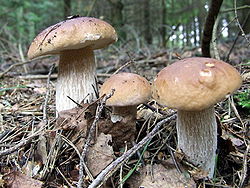
Boletus is a genus of mushroom-producing fungi, comprising over 100 species. The genus Boletus was originally broadly defined and described by Carl Linnaeus in 1753, essentially containing all fungi with hymenial pores instead of gills. Since then, other genera have been defined gradually, such as Tylopilus by Petter Adolf Karsten in 1881, and old names such as Leccinum have been resurrected or redefined. Some mushrooms listed in older books as members of the genus have now been placed in separate genera. These include such as Boletus scaber, now Leccinum scabrum, Tylopilus felleus, Chalciporus piperatus and Suillus luteus. Most boletes have been found to be ectomycorrhizal fungi, which means that they form a mutualistic relationship with the roots system of certain kinds of plants.[3] More recently, Boletus has been found to be massively polyphyletic, with only a small percentage of the over 300 species that have been assigned to Boletus actually belonging there and necessitating the description and resurrection of many more genera.[2][4][5][6]

The name is derived from the Latin term bōlētus 'mushroom' from the Ancient Greek βωλίτης, bōlitēs,[7] ultimately from βῶλος, bōlos 'lump' or 'clod'.[8] However, the βωλίτης of Galen is thought to have been the much prized Amanita caesarea.[9]

Phylogenetic tree of Boletus

[edit]

B. austroedulis Halling & N.A.Fechner 2014

B. pallidus= Imleria pallida (Frost 1873) A.Farid, A.R.Franck & J.Bolin 2020

source:[10]

Edibility

[edit]

The genus Boletus contains many members which are edible, such as Boletus edulis, Boletus aereus and Boletus barrowsii.

Boletes with red pores may be toxic.[11]

See also

[edit]

References

[edit]
[edit]
Revisions and contributorsEdit on WikipediaRead on Wikipedia
from Grokipedia
Boletus is a of ectomycorrhizal fungi in the family and order , comprising boletoid mushrooms characterized by fleshy basidiomata with a central stipe, a porous hymenophore that is when young and turns yellowish to olive-brown with age, and smooth, to ovoid basidiospores that produce an olive-brown . The , Boletus edulis, known as the porcini or king , exemplifies the genus with its ventricose to cylindrical stipe often featuring reticulate ornamentation, unchanging or rarely bruising context, and a strong nutty , making it one of the most economically valuable wild mushrooms globally. Historically broad and polyphyletic, encompassing up to 300 based on morphological traits like tubular hymenophores and smooth spores, the genus has been redefined through multi-gene phylogenetic analyses to the monophyletic "porcini sensu stricto" , excluding many former members now placed in genera such as Xanthoconium and Tylopilus. These fungi form symbiotic associations with trees in temperate and tropical regions worldwide, often found in forests with or hardwoods, contributing to cycling in ecosystems while some , like B. edulis, are prized for culinary uses but can be confused with toxic look-alikes. The genus is divided into five major lineages—"porcini s. str.," "Obtextiporus," "Inferiboletus," "Alloboletus," and "Orientiboletus"—highlighting its evolutionary diversity revealed by molecular studies.

Taxonomy

Etymology and History

The genus name Boletus derives from the Latin bōlētus, a term for "mushroom," which traces back to the Ancient Greek βωλίτης (bōlitēs), ultimately from βῶλος (bōlos), meaning "lump" or "clod," reflecting the soft, rounded form of the fruiting body. This name was first formally applied as a genus in Carl Linnaeus's Species Plantarum (1753), where he classified several pore-bearing fungi under Boletus, establishing it as a foundational taxon in fungal nomenclature despite the absence of the modern type species B. edulis from his original list. In the early 19th century, Elias Magnus Fries significantly expanded the genus in his Systema Mycologicum (1821), defining Boletus broadly to encompass all fleshy fungi with pore-like hymenial structures, resulting in an initial inclusion of over 300 species and solidifying its role as a catch-all for boletes. This comprehensive approach, while influential, led to taxonomic challenges as morphological diversity became evident, prompting revisions by subsequent mycologists. Fries's framework dominated fungal classification for decades, emphasizing macroscopic features like pore arrangement over microscopic details. During the late 19th and early 20th centuries, taxonomists such as Edouard-Jean Gilbert began narrowing Boletus by recognizing distinct subgroups, with Gilbert's work in the 1930s highlighting variations in spore color and habitat that warranted separation. Rolf Singer advanced these efforts in the 1940s through detailed monographs on bolete anatomy and , segregating genera like (for slimy-capped species) and (for dry, bruising boletes) from the core Boletus s.s., based on stipe texture, pore reaction, and symbiotic associations. Pre-molecular revisions also addressed anomalies, such as the 19th-century placement of now-independent taxa like Gyroporus—characterized by hollow, detachable stipes—within Boletus before Quélet erected the genus in 1888. These efforts laid the groundwork for later DNA-based refinements that further delimited the genus.

Current Classification

Boletus belongs to the phylum , class , order , and family . Following taxonomic revisions initiated in the early , the genus Boletus in the strict sense (sensu stricto) has been narrowly defined to include approximately 30 divided into five major lineages—"porcini s. str.," "Obtextiporus," "Inferiboletus," "Alloboletus," and "Orientiboletus"—including the core "porcini s. str." group centered on the Boletus edulis and its close relatives exhibiting traits such as reticulate spore ornamentation. These boundaries were redefined through multi-gene phylogenetic analyses, with key contributions from Nuhn et al. (2013), who used nuclear large subunit rDNA, translation elongation factor 1-α, and data to demonstrate that many traditionally included species are polyphyletic and belong to distinct genera. Similarly, Wu et al. (2014) employed a broader multi-locus approach across the , identifying seven major clades and proposing 22 new generic-level taxa, thereby restricting Boletus s.s. to a monophyletic assemblage centered on the B. edulis lineage. In a recent development, Boletus lakhanpalii, originally described from , was transferred to the newly erected genus Pseudobaorangia in 2025 based on combined morphological features—such as its unique hymenophore and cystidioles—and molecular evidence from nrLSU, RPB2, and TEF1-α sequences, which placed it outside the core Boletus .

Phylogenetic Position

The phylogenetic position of the genus Boletus within the family has been elucidated through molecular analyses, primarily using nuclear regions such as the (ITS), large subunit (LSU) rDNA, and the protein-coding gene RPB2. These markers have consistently demonstrated that Boletus sensu stricto (s.s.), comprising five major lineages centered on the type species Boletus edulis, forms a monophyletic within the Boletoideae of . Early foundational work established the monophyly of the order , including , using LSU rDNA sequences from a broad sampling of basidiomycetes, revealing as a well-supported to other agaricomycete lineages. Subsequent multi-gene phylogenies have refined the placement of Boletus s.s., showing it as a distinct separated from genera like Xerocomellus, which resides in the separate Xerocomoidae. For instance, analyses incorporating ITS, LSU, RPB2, and translation elongation factor 1-α (tef1-α) genes highlight the B. edulis as robustly supported (bootstrap values >90%, posterior probabilities >0.95), with internal diversification reflecting evolutionary splits among Eurasian and North American lineages. Recent phylogenomic studies using 1,764 single-copy orthologous genes from whole-genome data further confirm the of Boletus s.s., estimating its crown age at approximately 29–30 million years ago and placing it as sister to a including the Central African endemic Boletus alliaceus and Paxilloboletus africanus. These trees feature Boletus branching early within Boletoideae, distinct from butter boletes in Butyriboletus, which form a neighboring but separate supported by both molecular and morphological . Updates in 2023 using multi-locus datasets (ITS, LSU, RPB2) have reinforced these relationships, identifying Butyriboletus as a consistent to Boletus s.s. in expanded Asian samplings, with high nodal support underscoring the separation of the B. edulis from polyphyletic elements previously lumped in broader Boletus. A 2025 study on Pseudobaorangia lakhanpalii (formerly misclassified as Boletus lakhanpalii) exemplifies phylogenetic incongruence in older classifications, using ITS, nrLSU, and tef1-α to resolve it as a distinct monophyletic outside Boletus s.s., highlighting how molecular data correct historical misplacements and stabilize boundaries within subclades.

Morphology

Gross Morphology

The fruitbodies of Boletus species are typically pileate-stipitate, featuring a central stipe supporting a bearing a porous hymenophore rather than gills, a defining trait of the as originally circumscribed by Fries. The (pileus) is convex when young, expanding to flat or nearly so with maturity, and measures 5-30 cm in diameter in representative species such as B. edulis; its surface ranges from smooth and dry to viscid when moist, with coloration varying from shades of brown, olive, or reddish hues across the . Beneath the cap, the hymenophore consists of a layer of tubes forming pores that are adnate to , initially to and typically unchanging upon injury in Boletus s.s., though aging to yellowish or olive-brown. The stipe is central and robust, typically 5-20 cm tall and 2-10 cm thick, frequently featuring a reticulate pattern at the apex and a bulbous or tapered base in species such as B. edulis; its color often matches or contrasts the cap, from to brown. The context, or flesh, is white to pale yellow, firm, and unchanging upon cutting, a key trait distinguishing Boletus s.s. from many bruising genera. Boletus fruitbodies exhibit a terrestrial habit, occurring solitary to gregarious without a volva or annulus, distinguishing them from many other basidiomycetes.

Microscopic Characteristics

The microscopic characteristics of Boletus are essential for taxonomic identification, revealing cellular structures that distinguish the genus from related boletes. Basidiospores in Boletus are typically smooth, to ovoid in shape, and measure 12-20 µm in length by 4-7 µm in width, as seen in the type B. edulis. These spores exhibit an inamyloid reaction in Melzer's reagent, often appearing ochraceous without the characteristic blue-black staining, which helps differentiate Boletus from genera with spores. Basidia, the spore-bearing cells, are club-shaped (clavate) and predominantly 4-spored, with heights ranging from 25-40 µm and widths of 7-12 µm, as observed in standard preparations. They arise from the lining the tube surfaces and lack clamp connections at their bases, a consistent absence across Boletus hyphae that supports the genus's phylogenetic separation from clamp-bearing relatives like . The pileipellis of Boletus is structured as a trichodermium or gelatinized trichoderm, comprising interwoven to vertically arranged hyphae. Hymenial cystidia, including pleurocystidia on tube faces, are to clavate and 25-50 µm long, while cheilocystidia on pore edges are typically absent. Key diagnostic traits include the microscopic confirmation of reticulate ornamentation on the stipe surface, arising from raised hyphal aggregates visible under high magnification, which is prominent in core Boletus species. Staining reactions provide additional identifiers: spore prints are olive-brown, reflecting the pigmentation of mature basidiospores in mass deposits. Application of 3% KOH to the cap surface often yields a to reddish-brown reaction in many Boletus taxa, aiding differentiation from non-reactive in allied genera.

Distribution and Habitat

Geographic Range

Boletus are predominantly distributed across the , encompassing temperate and boreal forests of , , and . The genus Boletus s.str. comprises approximately 50–60 worldwide. This dominance reflects the genus's adaptation to cooler climates in these regions, where thrive in association with various tree hosts. For instance, , one of the most widespread members, occurs commonly in the European Alps, the of eastern , and the Himalayan ranges of . In , the includes a limited number of , approximately four such as B. edulis and B. aereus, primarily in central and southern areas, including mountainous and habitats. Eastern supports several , contributing to the approximately 24 recognized across the continent overall, primarily in deciduous and mixed forests, while features significant diversity in eastern and central regions with about 29 , though remains incomplete in some areas. Tropical zones host fewer overall, limited by unsuitable climatic conditions. Presence in the is limited and largely non-native, with rare endemic species such as Boletus austroedulis in and introduced populations of B. edulis established in through human-mediated dispersal via pine plantations. South American records are similarly sparse, confined to a handful of sites in temperate zones. Recent observations indicate potential range expansions linked to climatic shifts, such as increased sightings of in southern European locales beyond its traditional Mediterranean core since the early , possibly influenced by warmer temperatures.

Environmental Preferences

Boletus species generally thrive in well-drained soils that prevent waterlogging, with preferences varying by region but commonly including loamy textures rich in . In European habitats, many favor sandy or soils, which support their ectomycorrhizal growth while maintaining and nutrient availability. For instance, B. edulis often occurs in sandy or loamy substrates, often in areas with good drainage to avoid excess accumulation. These soil conditions, typically acidic with ranging from 4.5 to 6.5, facilitate penetration and mycelial expansion without saturation. The genus prefers temperate to boreal climates, where fruiting bodies emerge primarily in late summer to fall, coinciding with seasonal rainfall and cooling temperatures. Optimal soil temperatures for development and fruiting fall between 10°C and 20°C, allowing mycelial activity without stress from extremes. Annual precipitation of 800–1600 mm supports growth, particularly in humid conditions that promote sporocarp formation, though excessive dryness or heat can inhibit production. Terrain suitability includes forest edges, clearings, and open woodlands from up to 2000 m in elevation, where light penetration and moderate slopes enhance microclimatic stability. These locations provide the necessary balance of and shade, with species often found on slopes less than 20% to optimize drainage and exposure. At higher elevations, such as in mountainous regions, dew and fog contribute to , extending fruiting potential even in drier periods. Microhabitat factors emphasize high relative (around 70–80%) for sporocarp maturation, coupled with avoidance of waterlogged zones to prevent mycelial decay; at (20–34%) is ideal, but standing water is detrimental.

Ecology and Life Cycle

Symbiotic Associations

Boletus species are predominantly ectomycorrhizal fungi, forming mutualistic associations with the roots of various trees by enveloping fine root tips in a fungal sheath known as the Hartig net, which facilitates the exchange of nutrients and water between the fungus and its host. This symbiosis enhances the host plant's uptake of essential minerals from the soil, particularly in nutrient-poor environments. Common host genera include Pinus (pines), Quercus (oaks), Fagus (beeches), and Betula (birches), where the fungal hyphae extend into the soil to access resources beyond the reach of plant roots alone. The degree of host specificity varies among Boletus species, with some exhibiting broad compatibility and others showing more restricted associations. For instance, forms ectomycorrhizae with a wide array of over 30 tree species across conifers and hardwoods, including members of the , , and families, allowing it to thrive in diverse forest ecosystems. In contrast, species like demonstrate greater specificity, primarily associating with oaks (Quercus spp.) and occasionally beeches (Fagus spp.), which influences their distribution in oak-dominated woodlands. These associations underscore the role of host-fungus compatibility in shaping fungal community structure and forest . In these symbiotic relationships, Boletus fungi supply host plants with mobilized and , often derived from organic compounds through enzymatic activity, while receiving carbohydrates such as sugars from the plant's photosynthates. This nutrient exchange is critical for plant growth, especially in -limited soils, where ectomycorrhizal fungi can increase acquisition by up to several fold compared to non-mycorrhizal roots. transfer, including from recalcitrant organic sources, further supports host vigor and productivity. Although primarily mycorrhizal, rare saprotrophic tendencies have been observed in some Boletus species under disturbed conditions, where they may partially decompose independently of living hosts, though this mode is not dominant.

Reproduction and Development

Boletus species reproduce sexually through the production and dispersal of basidiospores from mature fruitbodies, known as basidiocarps. These spores are ballistospores forcibly ejected from basidia lining the pore surfaces at speeds of 0.6–1.4 m/s over short initial distances of 25–300 µm, after which serves as the primary vector for longer-range dispersal, enabling spores to travel up to 1.5 km or more beyond the source . Spore concentrations peak in late summer and autumn, correlating positively with and , which facilitate release and airborne transport. Upon landing in suitable moist soils, basidiospores germinate to produce primary monokaryotic consisting of haploid hyphae that extend and colonize organic substrates. Compatible hyphae from different then undergo , forming a dikaryotic secondary that develops extensive networks underground, supporting acquisition and persistence over seasons. This secondary represents the dominant vegetative phase in Boletus, with no prominent mechanisms observed. Fruitbody initiation in Boletus is triggered by environmental signals such as rainfall during warm periods, particularly in autumn, which stimulates primordia development from the secondary mycelium. Basidiocarps typically mature within 1–2 weeks following sufficient precipitation (20–40 mm over 24–48 hours), progressing from button-stage primordia to fully expanded caps and stems capable of spore production. In the mature basidiocarp, karyogamy fuses the two haploid nuclei within each basidium to form a diploid zygote, followed immediately by meiosis that yields four haploid basidiospores per basidium, completing the sexual cycle. This process ensures genetic recombination and dispersal for the next generation.

Diversity

Number of Species

The genus Boletus in the strict sense currently encompasses an estimated approximately 30 accepted , a significant reduction from the more than species historically placed within it due to extensive taxonomic segregations informed by molecular data. Species counts are estimated using fungal databases, with Index Fungorum listing over 300 names under Boletus, though only a subset belong to the core Boletus s.s. ; the NCBI Taxonomy database includes numerous entries, many of which are synonyms or outdated classifications. Taxonomic challenges persist due to cryptic species uncovered by , such as the B. edulis complex, which comprises numerous phylogenetic , with at least 27 identified globally differing in genetic and morphological traits. Recent trends show continued reductions in numbers, exemplified by the 2025 transfer of Boletus lakhanpalii to the newly established Pseudobaorangia, thereby decreasing the Boletus count by one (as of 2025). Recent studies continue to uncover cryptic diversity within the .

Selected Species

Boletus edulis serves as the of the Boletus and is widely recognized as the king or porcini. This typically exhibits a convex to flat cap ranging from 7 to 30 cm in diameter, with a smooth to slightly tacky surface colored in shades of brown, often with a paler margin. The pore surface starts white and yellows with maturity, while the stout stipe, up to 25 cm tall and 10 cm thick, features a prominent white reticulate network on its upper portion. It forms ectomycorrhizal associations with diverse trees including pines, spruces, oaks, and beeches, contributing to its widespread distribution across temperate forests in , , and . Boletus aereus, known as the bronze bolete, is distinguished by its dark olive-brown to nearly black cap, which measures 5 to 20 cm across and develops a cracked or areolate texture in dry conditions. The pores are small, white to pale yellow, and the stipe is robust, up to 15 cm long, with a subtle yellowish reticulation that becomes more pronounced toward the apex. This fruits primarily in summer and early autumn, associating ectomycorrhizally with broadleaf trees such as oaks and beeches in Mediterranean and southern European woodlands. Boletus pinophilus, or the pine bolete, is characterized by a reddish-brown to maroon cap, 8 to 20 cm in diameter, that is initially hemispherical and smooth but may become slightly viscid in wet weather. Its pores are white to pale yellow, and the bulbous stipe, reaching 20 cm in height, displays coarse orange-red reticulation, particularly on the upper half. Restricted to , it forms specific ectomycorrhizal partnerships with Pinus species, such as Scots pine, in coniferous forests from late summer through autumn. Boletus sensibilis, referred to as the lurid bolete in some contexts, features a vivid red to reddish-brown cap up to 15 cm wide, with a dry, velvety texture. The pore surface is bright yellow and stains intensely blue upon handling, a reaction that occurs rapidly due to its sensitivity, while the stipe is yellow with red flushing and subtle reticulation. Primarily found in North American forests, it associates with oaks and other trees during summer and fall. Among regional endemics, , known as the reticulate , is notable for its distribution in and association with broadleaf trees. It has a pale brown cap up to 20 cm across, white pores turning yellowish, and a robust stipe with prominent white reticulation. This species fruits in autumn and is valued for its edibility.

Human Uses and Safety

Culinary Applications

, commonly known as the porcino or king , is one of the most prized edible mushrooms worldwide due to its rich, nutty flavor and meaty texture, often utilized fresh, dried, or powdered in various dishes. Fresh specimens are sautéed, grilled, or added to omelets and meats, while dried forms rehydrate well for incorporation into risottos, sauces, and soups, enhancing depth with their concentrated taste derived from glutamates and . In powdered form, B. edulis serves as a to boost savory profiles in stocks, gravies, and baked goods without overpowering other ingredients. Harvesting guidelines emphasize selecting prime specimens to optimize texture and flavor; ideal caps measure 5-10 cm in , offering firm flesh that avoids the sponginess of overripe or the tenderness of immature ones. Collectors cut the stipe close to the base with a knife to minimize disturbance and preserve health, ensuring sustainable yields in subsequent seasons. In global cuisines, B. edulis holds a central role, particularly in Italian dishes where fresh or dried porcini feature prominently in risottos and sauces for their earthy . In , dried boletus (known as suszarki or borowik suszony) is a staple in creamy soups, fillings, and forest stews, valued for its intense aroma when rehydrated. Commercial cultivation attempts in , such as controlled mycorrhizal plantations with host trees like and , have been explored to meet demand, though challenges with limit large-scale success, keeping most supply wild-harvested. Nutritionally, fresh B. edulis offers a low-calorie profile of approximately 30-35 kcal per 100 g, with 3-5% protein content that includes essential , making it a valuable substitute. It is also rich in B-group vitamins, such as and niacin, supporting energy metabolism, and contains vitamin D precursors like , which convert to active 2 upon UV exposure, aiding bone health. Global exports of porcini mushrooms, primarily dried, are valued at approximately 1.5 billion USD as of 2023, with key markets in and driving trade from producers like and .

Toxicity and Identification Risks

Among the species traditionally classified under Boletus, now often reclassified into genera like Rubroboletus and Suillellus, certain ones pose significant risks. Rubroboletus satanas, commonly known as the devil's , is a highly poisonous species that induces severe gastrointestinal distress, including intense , , and , typically manifesting within 30 minutes to three hours after . This stems from bolesatine, a that inhibits protein synthesis, with symptoms potentially lasting several days and requiring medical attention in severe cases. Key identification features include bright red pores that do not change color upon bruising and a distinctive fishy or unpleasant , particularly noticeable in mature specimens. Other species in the former Boletus luridus group, such as Suillellus luridus, are mildly toxic and can lead to gastric upset, including and , especially if consumed raw due to thermolabile toxins that are partially inactivated by thorough cooking. These mushrooms exhibit rapid bluing of the flesh and pores upon handling, a reaction linked to the presence of variegatic acid and related compounds that may contribute to the digestive irritation in uncooked forms. While not life-threatening, ingestion of raw specimens has been associated with disulfiram-like reactions when combined with alcohol, exacerbating symptoms. Misidentification poses substantial risks for foragers, as edible Boletus species like B. edulis can be confused with inedible or toxic look-alikes. Tylopilus felleus, the , mimics the appearance of choice edibles with its brown cap and reticulated stem but is unpalatable due to extreme bitterness from intense taste receptors in its tissues, rendering it inedible despite lacking true . Similarly, slimy-capped species, such as S. luteus, are often mistaken for dry Boletus boletes; their gelatinous and pores lead to digestive discomfort if eaten without removal of the slimy layer. Notably, blue bruising of the flesh—a common trait in many Boletus—is not a reliable indicator of , as both edible species (e.g., B. sensibilis) and poisonous ones (e.g., R. satanas) may exhibit it, while some toxic boletes show no color change. To mitigate these risks, foragers should prioritize analysis, where true Boletus yield an olive-brown deposit, contrasting with the pinkish print of T. felleus, and confirm habitat associations, such as R. satanas favoring soils in broadleaf woodlands. There is no universal for ; treatment focuses on symptomatic relief like hydration and antiemetics, with symptoms from toxic like R. satanas appearing rapidly, underscoring the need for expert verification before consumption.

References

Add your contribution
Related Hubs
User Avatar
No comments yet.