
Recent from talks
Bone-anchored hearing aid
Knowledge base stats:
Talk channels stats:
Members stats:
Bone-anchored hearing aid
A bone-anchored hearing aid (BAHA) is a type of hearing aid based on bone conduction. It is primarily suited for people who have conductive hearing losses, unilateral hearing loss, single-sided deafness and people with mixed hearing losses who cannot otherwise wear 'in the ear' or 'behind the ear' hearing aids. They are more expensive than conventional hearing aids, and their placement involves invasive surgery which carries a risk of complications, although when complications do occur, they are usually minor.
Two of the causes of hearing loss are lack of function in the inner ear (cochlea) and when the sound has problems in reaching the nerve cells of the inner ear. Examples of the first include age-related hearing loss and hearing loss due to noise exposure. A patient born without external ear canals is an example of the latter for which a conventional hearing aid with a mould in the ear canal opening would not be effective. Some with this condition have normal inner ear function, as the external ear canal and the inner ear are developed at different stages during pregnancy. With normal inner anatomy, sound conducted by the skull bone improves hearing.
A vibrator with a steel spring over the head or in heavy frames of eyeglasses pressed towards the bone behind the ear has been used to bring sound to the inner ear. This has, however, several disadvantages, such as discomfort and pain due to the pressure needed. The sound quality is also impaired as much of the sound energy is lost in the soft tissue over the skull bone, particularly for the higher sound frequencies important for speech understanding in noise.
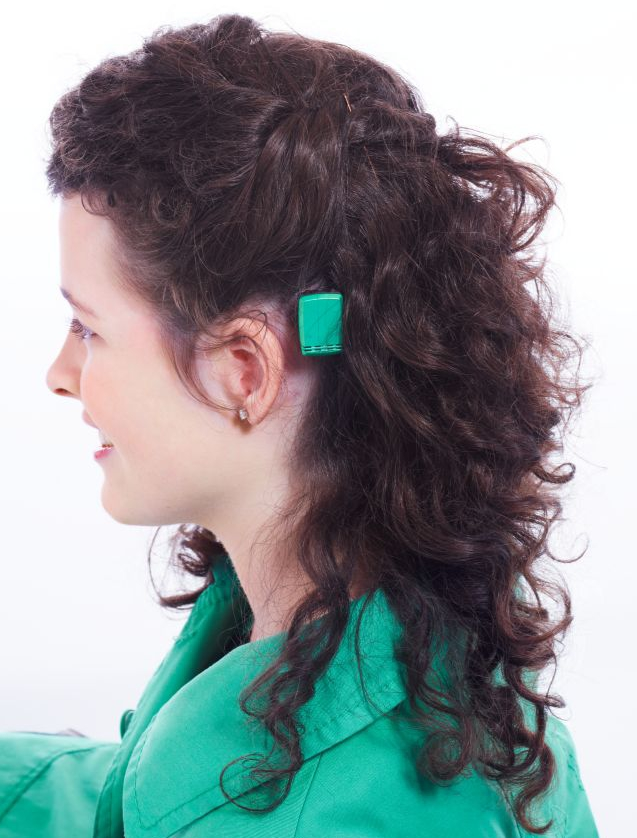
Bone-anchored hearing aids use a surgically implanted abutment to transmit sound by direct conduction through bone to the inner ear, bypassing the external auditory canal and middle ear. A titanium prosthesis is surgically embedded into the skull with a small abutment exposed outside the skin. A sound processor sits on this abutment and transmits sound vibrations to the titanium implant. The implant vibrates the skull and inner ear, which stimulate the nerve fibers of the inner ear, allowing hearing.
The surgery is often performed under local anesthesia and as an outpatient procedure. An important piece of information for patients is that if they for whatever reason are not satisfied with the BAHA solution, removing the implant is easy.
By bypassing the outer or middle ear, BAHA can increase hearing in noisy situations and help localise sounds. In addition to improved speech understanding, it results in a natural sound with less distortion and feedback compared with conventional hearing aids. The ear canal is left open for comfort, and helps to reduce any problems caused by chronic ear infections or allergies. In patients with single-sided sensorineural deafness, BAHA sends the sound by the skull bone from the deaf side to the inner ear of the hearing side. This transfer of sound gives a 360° sound awareness.
BAHAs may facilitate normal speech development.
This fairly common condition is often associated with continuous or intermittent drainage from the ear canal. These patients may also have a hearing loss and need amplification. A conventional air conduction aid with a mold placed in the ear canal opening may not be appropriate due to the drainage, and may even provoke drainage. If the hearing loss is significant an air conduction aid may have difficulty overcoming the dysfunction of the eardrum and middle ear bones. Bone conduction hearing device bypassing the middle ear may be a more appropriate treatment for these patients. Good transmission of sound in the bone, with reduced attenuation and distortion may be possible.
Hub AI
Bone-anchored hearing aid AI simulator
(@Bone-anchored hearing aid_simulator)
Bone-anchored hearing aid
A bone-anchored hearing aid (BAHA) is a type of hearing aid based on bone conduction. It is primarily suited for people who have conductive hearing losses, unilateral hearing loss, single-sided deafness and people with mixed hearing losses who cannot otherwise wear 'in the ear' or 'behind the ear' hearing aids. They are more expensive than conventional hearing aids, and their placement involves invasive surgery which carries a risk of complications, although when complications do occur, they are usually minor.
Two of the causes of hearing loss are lack of function in the inner ear (cochlea) and when the sound has problems in reaching the nerve cells of the inner ear. Examples of the first include age-related hearing loss and hearing loss due to noise exposure. A patient born without external ear canals is an example of the latter for which a conventional hearing aid with a mould in the ear canal opening would not be effective. Some with this condition have normal inner ear function, as the external ear canal and the inner ear are developed at different stages during pregnancy. With normal inner anatomy, sound conducted by the skull bone improves hearing.
A vibrator with a steel spring over the head or in heavy frames of eyeglasses pressed towards the bone behind the ear has been used to bring sound to the inner ear. This has, however, several disadvantages, such as discomfort and pain due to the pressure needed. The sound quality is also impaired as much of the sound energy is lost in the soft tissue over the skull bone, particularly for the higher sound frequencies important for speech understanding in noise.
Bone-anchored hearing aids use a surgically implanted abutment to transmit sound by direct conduction through bone to the inner ear, bypassing the external auditory canal and middle ear. A titanium prosthesis is surgically embedded into the skull with a small abutment exposed outside the skin. A sound processor sits on this abutment and transmits sound vibrations to the titanium implant. The implant vibrates the skull and inner ear, which stimulate the nerve fibers of the inner ear, allowing hearing.
The surgery is often performed under local anesthesia and as an outpatient procedure. An important piece of information for patients is that if they for whatever reason are not satisfied with the BAHA solution, removing the implant is easy.
By bypassing the outer or middle ear, BAHA can increase hearing in noisy situations and help localise sounds. In addition to improved speech understanding, it results in a natural sound with less distortion and feedback compared with conventional hearing aids. The ear canal is left open for comfort, and helps to reduce any problems caused by chronic ear infections or allergies. In patients with single-sided sensorineural deafness, BAHA sends the sound by the skull bone from the deaf side to the inner ear of the hearing side. This transfer of sound gives a 360° sound awareness.
BAHAs may facilitate normal speech development.
This fairly common condition is often associated with continuous or intermittent drainage from the ear canal. These patients may also have a hearing loss and need amplification. A conventional air conduction aid with a mold placed in the ear canal opening may not be appropriate due to the drainage, and may even provoke drainage. If the hearing loss is significant an air conduction aid may have difficulty overcoming the dysfunction of the eardrum and middle ear bones. Bone conduction hearing device bypassing the middle ear may be a more appropriate treatment for these patients. Good transmission of sound in the bone, with reduced attenuation and distortion may be possible.
Recent media