
Recent from talks
Bone metastasis
Knowledge base stats:
Talk channels stats:
Members stats:
Bone metastasis
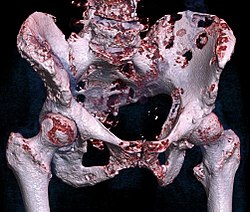
Bone metastasis, or osseous metastatic disease, is a category of cancer metastases that result from primary tumor invasions into bones. Bone-originating primary tumors such as osteosarcoma, chondrosarcoma, and Ewing sarcoma are rare; the most common bone tumor is a metastasis. Bone metastases can be classified as osteolytic, osteoblastic, or both. Unlike hematologic malignancies which originate in the blood and form non-solid tumors, bone metastases generally arise from epithelial tumors and form a solid mass inside the bone. Primary breast cancer patients are particularly vulnerable to develop bone metastases. Bone metastases, especially in a state of advanced disease, can cause severe pain, characterized by a dull, constant ache with periodic spikes of incident pain.
Under normal conditions, bone undergoes continuous remodeling through osteoclast-mediated bone resorption and osteoblast-mediated bone deposition. These processes are normally tightly regulated within bone to maintain bone structure and calcium homeostasis in the body. Dysregulation of these processes by tumor cells leads to either osteoblastic or osteolytic lesions, reflective of the underlying mechanism of development. Typically, osteolytic metastases are more aggressive than osteoblastic metastases, which have a slower course. Regardless of the phenotype, bone metastases commonly show osteoclast proliferation and hypertrophy.
Primary tumors
Bone metastases can cause severe pain, bone fractures, spinal cord compression, hypercalcemia, anemia, spinal instability, decreased mobility, and rapid degradation in the quality of life for patients. Patients have described the pain as a dull ache that grows worse over time, with intermittent periods of sharp, jagged pain. Even under controlled pain management, periods of breakthrough pain can occur rapidly, without warning, several times a day. Pain may be worse at night and partially relieved by activity. Metastases to weightbearing bones may become symptomatic early in the course of disease, as compared to metastases to the flat bones of the rib or sternum.
Major complications secondary to bone metastases are termed Skeletal-Related Events (SREs).
Other symptoms include:
Bone is the third most common location for metastasis, after the lung and liver. While any type of cancer is capable of forming metastatic tumors within bone, the microenvironment of the marrow tends to favor particular types of cancer, including prostate, breast, and lung cancers. In prostate cancer, bone metastases tend to be the only site of metastasis. The most common sites of bone metastases are the spine, pelvis, ribs, skull, and proximal femur.
Common primary tumors
Hub AI
Bone metastasis AI simulator
(@Bone metastasis_simulator)
Bone metastasis
Bone metastasis, or osseous metastatic disease, is a category of cancer metastases that result from primary tumor invasions into bones. Bone-originating primary tumors such as osteosarcoma, chondrosarcoma, and Ewing sarcoma are rare; the most common bone tumor is a metastasis. Bone metastases can be classified as osteolytic, osteoblastic, or both. Unlike hematologic malignancies which originate in the blood and form non-solid tumors, bone metastases generally arise from epithelial tumors and form a solid mass inside the bone. Primary breast cancer patients are particularly vulnerable to develop bone metastases. Bone metastases, especially in a state of advanced disease, can cause severe pain, characterized by a dull, constant ache with periodic spikes of incident pain.
Under normal conditions, bone undergoes continuous remodeling through osteoclast-mediated bone resorption and osteoblast-mediated bone deposition. These processes are normally tightly regulated within bone to maintain bone structure and calcium homeostasis in the body. Dysregulation of these processes by tumor cells leads to either osteoblastic or osteolytic lesions, reflective of the underlying mechanism of development. Typically, osteolytic metastases are more aggressive than osteoblastic metastases, which have a slower course. Regardless of the phenotype, bone metastases commonly show osteoclast proliferation and hypertrophy.
Primary tumors
Bone metastases can cause severe pain, bone fractures, spinal cord compression, hypercalcemia, anemia, spinal instability, decreased mobility, and rapid degradation in the quality of life for patients. Patients have described the pain as a dull ache that grows worse over time, with intermittent periods of sharp, jagged pain. Even under controlled pain management, periods of breakthrough pain can occur rapidly, without warning, several times a day. Pain may be worse at night and partially relieved by activity. Metastases to weightbearing bones may become symptomatic early in the course of disease, as compared to metastases to the flat bones of the rib or sternum.
Major complications secondary to bone metastases are termed Skeletal-Related Events (SREs).
Other symptoms include:
Bone is the third most common location for metastasis, after the lung and liver. While any type of cancer is capable of forming metastatic tumors within bone, the microenvironment of the marrow tends to favor particular types of cancer, including prostate, breast, and lung cancers. In prostate cancer, bone metastases tend to be the only site of metastasis. The most common sites of bone metastases are the spine, pelvis, ribs, skull, and proximal femur.
Common primary tumors
Recent media
