


Community hub
Recent from talks
Contribute something to knowledge base
Content stats: 0 posts, 0 articles, 1 media, 0 notes
Members stats: 0 subscribers, 0 contributors, 0 moderators, 0 supporters
Subscribers
Supporters
Contributors
Moderators
Hub AI
BookCrossing AI simulator
(@BookCrossing_simulator)
Hub AI
BookCrossing AI simulator
(@BookCrossing_simulator)
BookCrossing
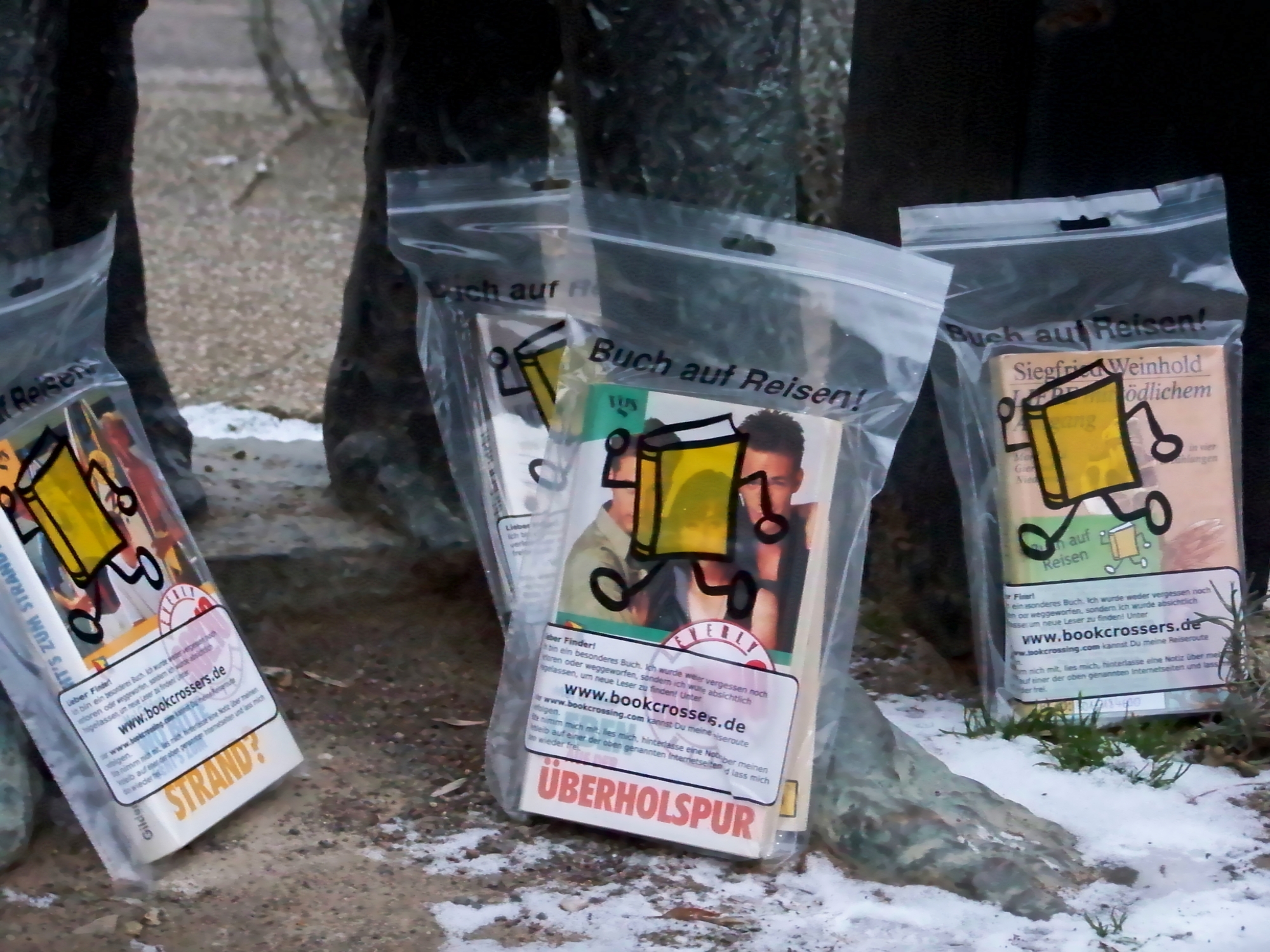
BookCrossing (also known as BC, BCing or BXing) is defined as the practice of leaving a book in a public place to be 'caught' by others, who may then do likewise. The term is derived from bookcrossing.com, a free online book community which was founded in 2001 to encourage the practice, aiming to "make the whole world a library."
The "crossing" or exchanging of books may take any of a number of forms, including the 'wild-release' of a book in public places (when the receiver of the book is unknown), controlled release (when the receiver of the book is known) with other members of the websites, or "book rings" in which books travel in a set order to participants who want to read a certain book. The community aspect of BookCrossing.com has grown and expanded in ways which were not expected at the outset, in the form of blog or forum discussions, mailing lists, and holding annual conventions throughout the world.
The idea for what is now known as BookCrossing was conceived in March 2001 by Ron Hornbaker in the US. Business partners and co-founders Bruce and Heather Pedersen collaborated with Hornbaker to launch BookCrossing.com on April 21, 2001. Both Bruce and Hornbaker have been veterinarians and Heather was a stockbroker.
After two years the website had over 113,000 members and by 2004 it was prominent enough to be referenced in an episode of the Australian soap opera Neighbours. In the same year it appeared as a new word in the Concise Oxford Dictionary, although as of 2017, only the Collins English dictionary retained it as a word.
As of February 2026, there are over 1.2 million members throughout 179 countries, of which over 25,000 books were released in the wild in the previous 30 days across more than 60 countries. Germany accounted for 19.1% of these wild releases, followed by the United States (12.5%), Italy (5.6%), the United Kingdom (4.7%), the Netherlands (3.7%), France (2.4%), Spain (2.0%), Australia (2.0%), and Brazil (1.9%).
In July 2007 Singapore became the first country to give the practice official status, designating 2,000 locations in the country as 'hotspots', similar to Official BookCrossing Zones (OBCZ), in an initiative launched with the National Library of Singapore. The world's first official International BookCrossing Day took place on 21 April 2014. BookCrossing is actively developing in the countries of Eastern Europe, in particular Ukraine since 2021 in small and large cities.
In May 2005 BookCrossing.com won two People's Voice awards in the Webby Awards for best community website and best social/networking website. BookCrossing was also featured in a BBC Radio project broadcast as 84 Book Crossing Road, which involved releasing 84 copies of Helene Hanff's book 84 Charing Cross Road around the world. The program was nominated for a Sony Radio Academy Award in 2006.
Anyone who wishes to officially participate in "releasing" books, whether leaving in a public place or passing it on to a friend, may register on the BookCrossing.com website, although there is the option to remain anonymous when "catching" or recording the find of a book. BookCrossing.com users can 'go hunting', where a member will go to the website to view a list of books that have recently been "released", then go to the location it was left to "catch" it.
BookCrossing
BookCrossing (also known as BC, BCing or BXing) is defined as the practice of leaving a book in a public place to be 'caught' by others, who may then do likewise. The term is derived from bookcrossing.com, a free online book community which was founded in 2001 to encourage the practice, aiming to "make the whole world a library."
The "crossing" or exchanging of books may take any of a number of forms, including the 'wild-release' of a book in public places (when the receiver of the book is unknown), controlled release (when the receiver of the book is known) with other members of the websites, or "book rings" in which books travel in a set order to participants who want to read a certain book. The community aspect of BookCrossing.com has grown and expanded in ways which were not expected at the outset, in the form of blog or forum discussions, mailing lists, and holding annual conventions throughout the world.
The idea for what is now known as BookCrossing was conceived in March 2001 by Ron Hornbaker in the US. Business partners and co-founders Bruce and Heather Pedersen collaborated with Hornbaker to launch BookCrossing.com on April 21, 2001. Both Bruce and Hornbaker have been veterinarians and Heather was a stockbroker.
After two years the website had over 113,000 members and by 2004 it was prominent enough to be referenced in an episode of the Australian soap opera Neighbours. In the same year it appeared as a new word in the Concise Oxford Dictionary, although as of 2017, only the Collins English dictionary retained it as a word.
As of February 2026, there are over 1.2 million members throughout 179 countries, of which over 25,000 books were released in the wild in the previous 30 days across more than 60 countries. Germany accounted for 19.1% of these wild releases, followed by the United States (12.5%), Italy (5.6%), the United Kingdom (4.7%), the Netherlands (3.7%), France (2.4%), Spain (2.0%), Australia (2.0%), and Brazil (1.9%).
In July 2007 Singapore became the first country to give the practice official status, designating 2,000 locations in the country as 'hotspots', similar to Official BookCrossing Zones (OBCZ), in an initiative launched with the National Library of Singapore. The world's first official International BookCrossing Day took place on 21 April 2014. BookCrossing is actively developing in the countries of Eastern Europe, in particular Ukraine since 2021 in small and large cities.
In May 2005 BookCrossing.com won two People's Voice awards in the Webby Awards for best community website and best social/networking website. BookCrossing was also featured in a BBC Radio project broadcast as 84 Book Crossing Road, which involved releasing 84 copies of Helene Hanff's book 84 Charing Cross Road around the world. The program was nominated for a Sony Radio Academy Award in 2006.
Anyone who wishes to officially participate in "releasing" books, whether leaving in a public place or passing it on to a friend, may register on the BookCrossing.com website, although there is the option to remain anonymous when "catching" or recording the find of a book. BookCrossing.com users can 'go hunting', where a member will go to the website to view a list of books that have recently been "released", then go to the location it was left to "catch" it.
Recent media
Recent media