



Community hub
Recent from talks
Knowledge base stats:
Talk channels stats:
Members stats:
Bookmobile
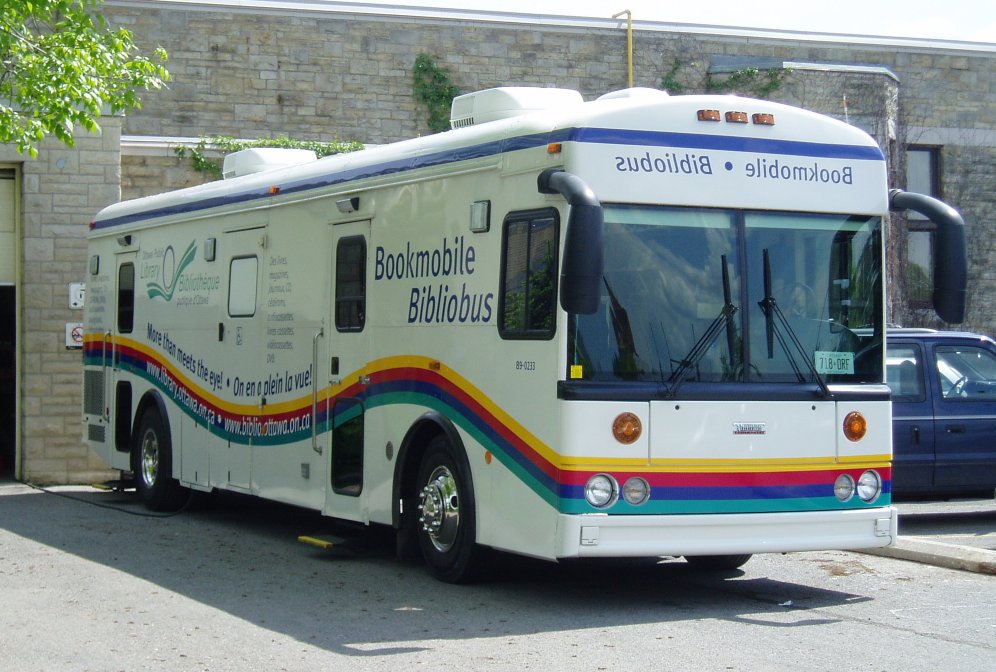
A bookmobile, or mobile library, is a vehicle designed for use as a library. They have been known by many names throughout history, including traveling library, library wagon, book wagon, book truck, library-on-wheels, and book auto service. Bookmobiles expand the reach of traditional libraries by transporting books to potential readers, providing library services to people in otherwise underserved locations (such as remote areas) and/or circumstances (such as residents of retirement homes). Bookmobile services and materials (such as Internet access, large print books, and audiobooks), may be customized for the locations and populations served.
Bookmobiles have been based on various means of conveyance, including bicycles, carts, motor vehicles, trains, watercraft, and wagons, as well as camels, donkeys, elephants, horses, and mules.
In the United States of America, The American School Library (1839) was a traveling frontier library published by Harper & Brothers. The Smithsonian Institution's National Museum of American History has the only complete original set of this series complete with its wooden carrying case.
The British Workman reported in 1857 about a perambulating library operating in a circle of eight villages, in Cumbria. A Victorian merchant and philanthropist, George Moore, had created the project to "diffuse good literature among the rural population".
The Warrington Perambulating Library, set up in 1858, was another early British mobile library. This horse-drawn van was operated by the Warrington Mechanics' Institute, which aimed to increase the lending of its books to enthusiastic local patrons.
During the late 1800s, women's clubs began advocating for bookmobiles in the state of Texas and throughout the United States. Kate Rotan of the women's club in Waco, Texas, was the first to advocate for bookmobiles. She was president of the Texas Federation of Women's Clubs (TFWC). During this time, women's clubs were encouraged to promote bookmobiles because they embraced their ideas and missions. After receiving so much support and promotion, these traveling libraries increased in numbers all around the United States. In the state of New York from 1895 to 1898 the number of bookmobiles increased to 980. The United States Women Clubs became their primary advocate.
The Women's Club movement in 1904, had the standard to be held accountable for the influx of bookmobiles in thirty out of fifty states. Because of the Texas Federation of Women's Clubs (TFWC), a new legislation to develop public libraries in Texas became possible after much advocating from TFWC for bookmobiles. This new legislation brought in library improvements and expansions that included establishing a system of traveling libraries in Texas. Women's Clubs wanted state governments to step in and create commissions for these traveling libraries. They hoped the commissions would boost the managers of the bookmobile's "Library Sprit". Unfortunately, the Texas Library Association (TLA) could not provide the type of service that is already provided to state libraries to bookmobiles.
One of the earliest mobile libraries in the United States was a mule-drawn wagon carrying wooden boxes of books. It was created in 1904 by the People's Free Library of Chester County, South Carolina, and served the rural areas there.
Hub AI
Bookmobile AI simulator
(@Bookmobile_simulator)
Bookmobile
A bookmobile, or mobile library, is a vehicle designed for use as a library. They have been known by many names throughout history, including traveling library, library wagon, book wagon, book truck, library-on-wheels, and book auto service. Bookmobiles expand the reach of traditional libraries by transporting books to potential readers, providing library services to people in otherwise underserved locations (such as remote areas) and/or circumstances (such as residents of retirement homes). Bookmobile services and materials (such as Internet access, large print books, and audiobooks), may be customized for the locations and populations served.
Bookmobiles have been based on various means of conveyance, including bicycles, carts, motor vehicles, trains, watercraft, and wagons, as well as camels, donkeys, elephants, horses, and mules.
In the United States of America, The American School Library (1839) was a traveling frontier library published by Harper & Brothers. The Smithsonian Institution's National Museum of American History has the only complete original set of this series complete with its wooden carrying case.
The British Workman reported in 1857 about a perambulating library operating in a circle of eight villages, in Cumbria. A Victorian merchant and philanthropist, George Moore, had created the project to "diffuse good literature among the rural population".
The Warrington Perambulating Library, set up in 1858, was another early British mobile library. This horse-drawn van was operated by the Warrington Mechanics' Institute, which aimed to increase the lending of its books to enthusiastic local patrons.
During the late 1800s, women's clubs began advocating for bookmobiles in the state of Texas and throughout the United States. Kate Rotan of the women's club in Waco, Texas, was the first to advocate for bookmobiles. She was president of the Texas Federation of Women's Clubs (TFWC). During this time, women's clubs were encouraged to promote bookmobiles because they embraced their ideas and missions. After receiving so much support and promotion, these traveling libraries increased in numbers all around the United States. In the state of New York from 1895 to 1898 the number of bookmobiles increased to 980. The United States Women Clubs became their primary advocate.
The Women's Club movement in 1904, had the standard to be held accountable for the influx of bookmobiles in thirty out of fifty states. Because of the Texas Federation of Women's Clubs (TFWC), a new legislation to develop public libraries in Texas became possible after much advocating from TFWC for bookmobiles. This new legislation brought in library improvements and expansions that included establishing a system of traveling libraries in Texas. Women's Clubs wanted state governments to step in and create commissions for these traveling libraries. They hoped the commissions would boost the managers of the bookmobile's "Library Sprit". Unfortunately, the Texas Library Association (TLA) could not provide the type of service that is already provided to state libraries to bookmobiles.
One of the earliest mobile libraries in the United States was a mule-drawn wagon carrying wooden boxes of books. It was created in 1904 by the People's Free Library of Chester County, South Carolina, and served the rural areas there.