



Community hub
Bookmobile
View on Wikipedia

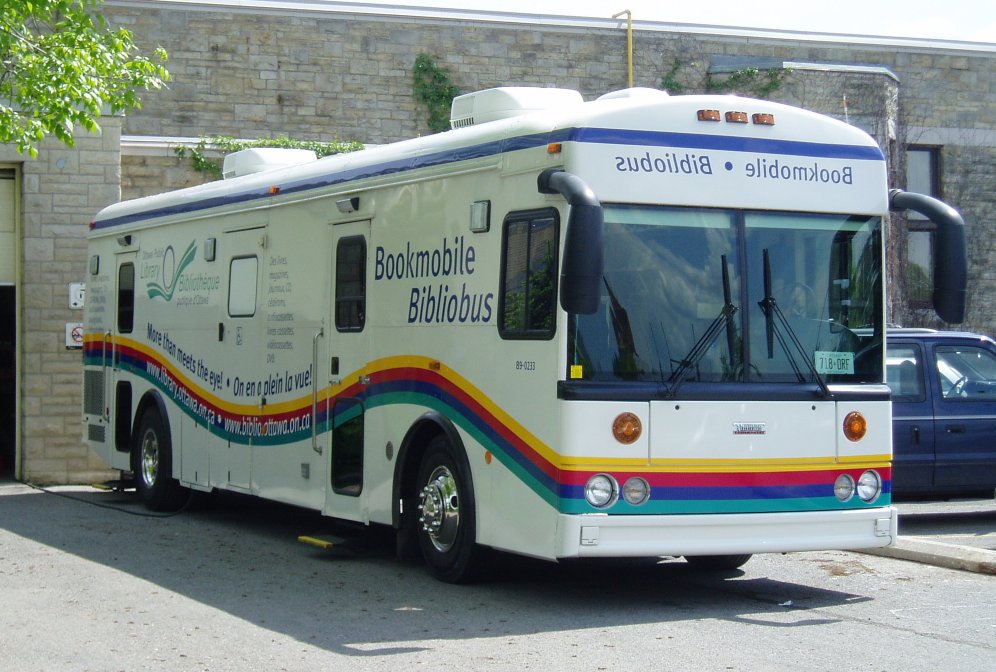
A bookmobile, or mobile library, is a vehicle designed for use as a library.[1][2] They have been known by many names throughout history, including traveling library, library wagon, book wagon, book truck, library-on-wheels, and book auto service.[3] Bookmobiles expand the reach of traditional libraries by transporting books to potential readers, providing library services to people in otherwise underserved locations (such as remote areas) and/or circumstances (such as residents of retirement homes). Bookmobile services and materials (such as Internet access, large print books, and audiobooks), may be customized for the locations and populations served.[4]
Bookmobiles have been based on various means of conveyance, including bicycles, carts, motor vehicles, trains, watercraft, and wagons, as well as camels, donkeys, elephants, horses, and mules.[3][4]
History
[edit]19th century
[edit]
In the United States of America, The American School Library (1839) was a traveling frontier library published by Harper & Brothers. The Smithsonian Institution's National Museum of American History has the only complete original set of this series complete with its wooden carrying case.[5]
The British Workman reported in 1857[6] about a perambulating library operating in a circle of eight villages, in Cumbria.[7] A Victorian merchant and philanthropist, George Moore, had created the project to "diffuse good literature among the rural population".[8]
The Warrington Perambulating Library, set up in 1858, was another early British mobile library.[2] This horse-drawn van was operated by the Warrington Mechanics' Institute, which aimed to increase the lending of its books to enthusiastic local patrons.[9]
During the late 1800s, women's clubs began advocating for bookmobiles in the state of Texas and throughout the United States. Kate Rotan of the women's club in Waco, Texas, was the first to advocate for bookmobiles. She was president of the Texas Federation of Women's Clubs (TFWC). During this time, women's clubs were encouraged to promote bookmobiles because they embraced their ideas and missions. After receiving so much support and promotion, these traveling libraries increased in numbers all around the United States. In the state of New York from 1895 to 1898 the number of bookmobiles increased to 980. The United States Women Clubs became their primary advocate.[10]
20th century
[edit]

The Women's Club movement in 1904, had the standard to be held accountable for the influx of bookmobiles in thirty out of fifty states. Because of the Texas Federation of Women's Clubs (TFWC), a new legislation to develop public libraries in Texas became possible after much advocating from TFWC for bookmobiles. This new legislation brought in library improvements and expansions that included establishing a system of traveling libraries in Texas. Women's Clubs wanted state governments to step in and create commissions for these traveling libraries. They hoped the commissions would boost the managers of the bookmobile's "Library Sprit". Unfortunately, the Texas Library Association (TLA) could not provide the type of service that is already provided to state libraries to bookmobiles.[10]
One of the earliest mobile libraries in the United States was a mule-drawn wagon carrying wooden boxes of books. It was created in 1904 by the People's Free Library of Chester County, South Carolina, and served the rural areas there.[11]
Another early mobile library service was developed by Mary Lemist Titcomb (1857–1932).[12][13][14][15] As a librarian in Washington County, Maryland, Titcomb was concerned that the library was not reaching all the people it could.[13] Meant as a way to reach more library patrons, the annual report for 1902 listed 23 deposit stations, with each being a collection of 50 books in a case that was placed in a store or post office throughout the county.[16] Although popular, Titcomb realized that even this did not reach the most rural residents, and so she cemented the idea of a "book wagon" in 1905, taking the library materials directly to people's homes in remote parts of the county.[4][17][7][15][18] After securing a Carnegie gift of $2,500, Titcomb purchased a black Concord wagon and employed the library janitor to drive it.[19] The book wagon proved popular, with 1,008 volumes distributed within its first six months. [20]
With the rise of motorized transport in America, a pioneering librarian in 1920 named Sarah Byrd Askew began driving her specially outfitted Model T to provide library books to rural areas in New Jersey.[21] The automobile remained rare, however, and in Minneapolis, the Hennepin County Public Library operated a horse-drawn book wagon starting in 1922.[22]
Following the Great Depression in the United States, a WPA effort from 1935 to 1943 called the Pack Horse Library Project covered the remote coves and mountainsides of Kentucky and nearby Appalachia, bringing books and similar supplies on foot and on hoof to those who could not make the trip to a library on their own. Sometimes these "packhorse librarians" relied on a centralized contact to help them distribute the materials.[23]
At Fairfax County, Virginia, county-wide bookmobile service was begun in 1940, in a truck loaned by the Works Progress Administration (WPA). The WPA support of the bookmobile ended in 1942, but the service continued.[24]
The "Library in Action" was a late-1960s bookmobile program in the Bronx, NY, run by interracial staff that brought books to teenagers of color in under-served neighborhoods.[25]
Bookmobiles reached the height of their popularity in the mid-twentieth century.[4][15][26]
In England, bookmobiles, or "traveling libraries" as they were called in that country, were typically used in rural and outlying areas. However, during World War II, one traveling library found popularity in the city of London. Because of air raids and blackouts, patrons did not visit the Metropolitan Borough of Saint Pancras's physical libraries as much as before the war. To meet the needs of its citizens, the borough borrowed a traveling library van from Hastings and in 1941 created a "war-time library on wheels." (The Saint Pancras borough was abolished in 1965 and became part of the London Borough of Camden.)
The Saint Pancras traveling library consisted of a van mounted on a six-wheel chassis powered by a Ford engine. The traveling library could carry more than 2,000 books on open-access shelves that ran the length of the van. The books were arranged in Dewey order, and up to 20 patrons could fit into the van at one time to browse and check out materials. A staff enclosure was at the rear of the van, and the van was lighted with windows in the roof – each fitted with black-out curtains in case of a German bombing raid. The van could even be used at night, as it was fitted with electric roof lamps that could access electrical current from a nearby lamp-standard or civil defense post. The traveling library had a selection of fiction and non-fiction works; it even had a children's section with fairy tales and non-fiction books for kids.
The mayor of the borough christened the van with a speech, saying that "People without books are like houses without windows." Even after heavy night bombings by the Germans, readers visited the Saint Pancras Traveling Library in some of the worst bombed areas.[27]
21st century
[edit]Bookmobiles are still in use in the 21st century, operated by libraries, schools, activists, and other organizations. Although some[who?] feel that the bookmobile is an outmoded service, citing reasons like high costs, advanced technology, impracticality, and ineffectiveness, others cite the ability of the bookmobile to be more cost-efficient than building more branch libraries would be and its high use among its patrons as support for its continuation.[28] To meet the growing demand for "greener" bookmobiles that deliver outreach services to their patrons, some bookmobile manufacturers have introduced significant advances to reduce their carbon footprint, such as solar/battery solutions in lieu of traditional generators, and all-electric and hybrid-electric chassis.[citation needed] Bookmobiles have also taken on an updated form in the form of m libraries,[29] also known as mobile libraries[30] in which patrons are delivered content electronically.[31]
The Internet Archive runs its own bookmobile to print out-of-copyright books on demand.[32] The project has spun off similar efforts elsewhere in the developing world.[33]
The Free Black Women's Library is a mobile library in Brooklyn. Founded by Ola Ronke Akinmowo in 2015, this bookmobile features books written by black women. Titles are available in exchange for other titles written by black female authors.[34]
National Bookmobile Day
[edit]In the U.S., the American Library Association sponsors National Bookmobile Day in April each year, on the Wednesday of National Library Week.[35][36] They celebrate the nation's bookmobiles and the dedicated library professionals who provide this service to their communities.[4]
In February 2021, the American Library Association (ALA), the Association of Bookmobile and Outreach Services (ABOS), and the Association for Rural and Small Libraries (ARSL) agreed to rebrand National Bookmobile Day in recognition of all that outreach library professional do within their communities. Instead, libraries across the country will observe National Library Outreach Day on April 7, 2021. Formerly known as National Bookmobile Day, communities will celebrate the invaluable role library professionals and libraries continuously play in bringing library services to those in need.[37][4]
Countries
[edit]Africa
[edit]- In Kenya, the Camel Mobile Library Service is funded by the National Library Service of Kenya and by Book Aid International and it operates in Garissa and Wajir, near the border with Somalia. The service started with three camels in October 1996 and had 12 in 2006, delivering more than 7,000 books[38] —in English, Somali, and Swahili.[13][39] Masha Hamilton used this service as a background for her 2007 novel The Camel Bookmobile.[40]
- "Donkey Drawn Electro-Communication Library Carts" were being employed in Zimbabwe in 2002 as "a centre for electric and electronic communication: radio, telephone, fax, e-mail, Internet".[41]
- In Nigeria, Funmi Ilori, a former schoolteacher, founded iRead Mobile Library after receiving a grant from the federal government of Nigeria in 2013. The “books on wheels” initiative was realized to promote a sustainable reading culture in children that builds positive reading habits over time and leads to improved growth and development.[42][43] The four iRead Mobile Library buses and their team bring a selection of over 13,000 books and service around 3,000 children with 44 stops per week at schools and community centers and a monthly stop to rural areas outside of Lagos state.[43][44]
Asia
[edit]

- In Bangladesh Bishwo Shahitto Kendro pioneered the concept of mobile library. Mobile library was introduced in Bangladesh in 1999. Then the service was limited to Dhaka, Chattogram, Khulna and Rajshahi only. Now the service is available in 58 districts of the country. There are about 330,000 registered users of this library. These mobile libraries together gives the service of 1900 small libraries in 1900 localities of the country.
- In Brunei, mobile libraries are known as Perpustakaan Bergerak. They are operated by Language and Literature Bureau, the government body which manages public libraries in the country. The service was introduced in 1970.[45]
- In Indonesia in 2015, Ridwan Sururi and his horse "Luna" started a mobile library called Kudapustaka (meaning "horse library" in Indonesian). The goal is to improve access to books for villagers in a region that has more than 977,000 illiterate adults. The duo travel between villages in central Java with books balanced on Luna's back. Sururi also visits schools three times a week.[46]
- In Thailand in 2002, mobile libraries were taking several unique forms.[47]
- Elephant Libraries were bringing books as well as information technology equipment and services to 46 remote villages in the hills of Northern Thailand.[13] This project was awarded the UNESCO International Literacy Prize for 2002.
- A Floating Library had two book boats, one of which was outfitted with computers.
- A three-car "Library Train for Homeless Children" (parked in a siding near the railway police compound) was a "joint project with the railway police in an initiative to keep homeless children from crime and exploitation by channeling them to more constructive activities". The train was being replicated in "a slum community in Bangkok", where it, too, would include a library car, a classroom car, and a computer and music car.
- Book Houses were shipping containers fitted out as libraries with books. The 10 original Book Houses were so popular, another 20 units were already being planned.
- In India, the Boat Library Services were operated under the auspices of the Andhra Pradesh Library Association, Vijayawada, Andhra Pradesh State. Paturi Nagabhushanam initiated boat libraries to inculcate interest in reading of books and libraries among the rural public in 1935 October, as an extended activity of Andhra Pradesh Library Movement. He had run this service for about seven years to benefit the villagers travelling on boats, which was a major travel and transportation facility available in those days. These libraries facilitated Telugu literary journals and books.,[48][49]
- In northern Syria in 2017, the Mobile Library, run by a team from the Syrian NGO Dari Sustainable Development, created the project to encourage education through reading and provide escapism to children throughout the war-torn region.[50] The Mobile Library contains around 2,000 books and reaches thousands of children per year with a dedicated seven-person team. Shihadeh, a member of the Dari project team says, “ the Mobile Library also aims to empower society and the vulnerable people by encouraging reading and building confidence in these children.”[50][51]
- In Ankara, Turkey, sanitation workers came together to salvage books thrown in the trash to create a public library.[52][53] The library is located in an abandoned underground factory and contains a collection of over 6,000 books. The library offers a mobile option out of a repurposed garbage truck, which provides books to underprivileged schools and doubles as a book donation collection vehicle.[54][55]
Australia
[edit]- The First bookmobile in the State of Victoria was operated by Heidelberg Library (now Yarra Plenty Regional Library) in the City of Heidelberg, Melbourne in 1954.[56]
Europe
[edit].jpg)

- In Glasgow, Scotland, in 2002, MobileMeet—a gathering of about 50 mobile libraries that was held annually by the IFLA—there were "mobiles from Sweden, Holland, Ireland, England, and of course Scotland. There were big vans from Edinburgh and small vans from the Highlands. Many of the vans were proudly carrying awards from previous meets."[47]
- Since 1953, the Libraries of the Community of Madrid, Spain, have operated a bibliobus program with books, DVDs, CDs, and other library materials available for checkout.[58][59]
- A floating library, aboard the ship Epos, was begun in 1959 and serves the many small communities on the coast of Western Norway.
- In Estonia, the bookmobile "Katarina Jee" has been running since 2008, serving patrons in suburbs of Tallinn.
- In Finland, the first mobile library was established in Vantaa in 1913.[60] There are currently about 200 bookmobiles in Finland, operating across the country.
- In Italy, Antonio La Cava, a retired teacher of 42 years, drives one of the smallest mobile libraries in the world. The Bibliomotocarro was created by La Cava from a converted 3-wheeler van and his desire to do more to help children discover books and the power of the written word.[61][62] La Cava has traveled with his mini library of over 700 books into the hills and mountains of remote communities for over 20 years to promote literacy, encourage writing, and bring books into the hands of children that need them most.[62][63]
- In Amsterdam, Netherlands, a mobile library called BeibBus, was created in 2010 to deliver books and reading engagement to children without access to a library. The Zaan region, just outside the city, consists of many smaller villages with very narrow streets and limited parking space.[64] The BeibBus was designed by Jord den Hollander to solve this issue with a slimmer design and expansion capabilities. The Biebus is a truck-container travelling to 20 primary schools equipped with over 7,000 books and can accommodate 30-45 children. The unique trailer system offers a more traditional library space containing shelves of books with a transparent ceiling and a second space with a spaceship design to provide an enticing reading room experience.[65]
North America
[edit]- Street Books is a nonprofit book service founded in 2011 in Portland, Oregon, that travels via bicycle-powered cart to lend books to "people living outside".[66]
- Books on Bikes[67] is a program begun in 2013 by the Seattle Public Library that uses a customized bicycle trailer pulled by pedal power to bring library services to community events in Seattle.[68]
- The Library Cruiser is a "book bike" from the Volusia County Libraries that debuted in Florida in September 2015. Library staff ride it to various locations, offering library books for checkout, as well as WiFi service, ebook access help, and information on obtaining a library card.[69]
- Bookleggers Library is nonprofit mobile library program in Miami, Florida founded in 2012 that expands access to free books.[70] The founding director, Nathaniel Sandler, and his library team have a mission to spread books across the city and encourage literacy. One way Bootleggers accomplishes this goal is through what Sandler refers to as “bookmobility.”[70] In 2024, the library team created a book trailer they can utilize to haul books anywhere in the city.[71] In addition, Bootleggers first launched a multimedia Bookbike in 2021 outfitted with a unique shelving system, speakers, and Wi-Fi capabilities to offer even more access to free books.[72]
- The Queens Mobile Library in New York partners with social services agencies like Homes for the Homeless to offer outreach and support to underserved residents in the boroughs. The bus-sized bookmobile services immigrant families and the homeless by providing 2,000 books, free Wi-Fi, videos, and alternative language resources when needed.[73] The Queens Mobile Library does tours to bring materials to senior care homes, parks, churches, resource centers, and community events.[74][75] The Queens Library also has a Bookcycle program, launched in 2018, to bring books and library resources to people in less accessible areas.[76]
South America
[edit]- The Biblioburro is a mobile library by which Colombian teacher Luis Soriano and his two donkeys, Alfa and Beto, bring books to children in rural villages twice a week. CNN chose Soriano as one of their 2010 Heroes of the Year.[4][77][13]
- In Buenos Aires, Argentina, Raul Lemesoff transformed a 1979 Ford Falcon into a bookmobile to look like a military tank.[78] The book tank is equipped with a swiveling turret, a non-functioning gun, and built-in shelves to hold over 900 books.[79] Lemesoff created the travelling library in 2015 on World Book Day to spread the printed word with free books all around urban and rural areas of Argentina. Lemesoff’s motto is “Peace through literature.” He labeled the mobile tank his “weapon of mass instruction.”[78][79]
Gallery
[edit]- Mobile libraries around the world
-
 Bangladesh – 2020
 -
 Brazil – 2011
 -
 Brazil – 2017
 -
 Colombia – 2006
Biblioburro -
 Norway – 2011
Epos -
 Switzerland – 2007
 -
 Fresno County, California (United States) – 2019
 -
 Prague, Czech Republic – 2023


.jpg)

See also
[edit]References
[edit]- ^ "bookmobile". Merriam-Webster. Archived from the original on 23 April 2009. Retrieved 22 October 2022.
- ^ a b Eveleth, Rose (11 October 2013). "The Earliest Libraries-On-Wheels Looked Way Cooler Than Today's Bookmobiles". Smithsonian Magazine. Archived from the original on 18 May 2014. Retrieved 21 October 2022.
- ^ a b Bashaw, Diane (2010). "On the Road Again: A Look at Bookmobiles, Then and Now". Children & Libraries: The Journal of the Association for Library Service to Children. 3 (1): 33. Retrieved 23 April 2022.
- ^ a b c d e f g h Pan, Connie (12 April 2022). "The History of Bookmobiles: Bookmobiles are here, and there and everywhere, to stay". Archived from the original on 12 April 2022. Retrieved 21 October 2022.
- ^ Olmert, Michael (1992). "The Infinite Library, Timeless and Incorruptible". The Smithsonian book of books (1. ed.). Washington, D.C.: Smithsonian Books. ISBN 0-89599-030-X.
- ^ "Perambulating Library". The British Workman. 1 February 1857. Archived from the original on 22 January 2012. Retrieved 27 May 2011.
- ^ a b "Bookmobiles: A Proud History, a Promising Future". American Libraries. 11 April 2012. Archived from the original on 15 March 2017. Retrieved 21 October 2022.
- ^ "George Moore". Mealsgate.com. Archived from the original on 24 March 2012. Retrieved 1 September 2011.
- ^ Orton, Ian (1980). An Illustrated History of Mobile Library Services in the UK with notes on traveling libraries and early public library transport. Sudbury: Branch and Mobile Libraries Group of the Library Association. ISBN 0-85365-640-1.
- ^ a b Cummings, Jennifer. "'How Can We Fail?' The Texas State Library's Traveling Libraries and Bookmobiles, 1916-1966." Libraries & the Cultural Record, vol. 44, no. 3, Aug. 2009, pp. 299–325. EBSCOhost, doi:10.1353/lac.0.0080.
- ^ "History". Chester County Free Public Library. Archived from the original on 13 June 2010. Retrieved 1 May 2010.
- ^ "The first county bookmobile in the US, Western Maryland Regional Library". whilbr.org. Archived from the original on 29 November 2006. Retrieved 14 July 2005.
- ^ a b c d e "A History of the Bookmobile". PBS. 19 July 2011. Archived from the original on 13 March 2019. Retrieved 21 October 2022.
- ^ Joanne E. Passet (1994). "Itinerating Libraries". In Wayne A. Wiegand and Donald G. Davis (ed.). Encyclopedia of Library History. Taylor & Francis. pp. 315–317. ISBN 978-0-8240-5787-9.
- ^ a b c "'Library on Wheels' Travels The Path Of America's First Bookmobile". WBUR Here & Now. 10 April 2018. Archived from the original on 13 April 2018. Retrieved 21 October 2022.
- ^ Washington County Free Library. First Annual Report for the Year ending October 1, 1902.
- ^ Maryland State Archives. "Maryland Women's Hall of Fame". Washington County Free Library.
- ^ Tabler, Dave (16 April 2018). "First bookmobile in the country". Appalachian History. Archived from the original on 19 April 2018. Retrieved 22 October 2022.
- ^ Levinson, Nancy Smiler (1 May 1991). "Takin' it to the Streets: The History of the Book Wagon". Library Journal. 116 (8): 43-45.
- ^ Levinson, Nancy Smiler (1 May 1991). "Takin' it to the Streets: The History of the Book Wagon". Library Journal. 116 (8): 43-45.
- ^ Susan B. Roumfort (1997). "Sarah Byrd Askew, 1877–1942". In Joan N. Burstyn (ed.). Past and Promise: Lives of New Jersey Women. Syracuse University Press. pp. 103–104. ISBN 9780815604181.
- ^ Ehling, Matt (30 June 2011). "The Hennepin County Library system – connecting past with present". MinnPost. No. Politics and Policy. Archived from the original on 27 March 2018. Retrieved 26 March 2018.
- ^ WPA (July 2012). "Packhorse Librarians in Kentucky, 1936–1943" (PDF). University of Kentucky. Archived (PDF) from the original on 21 February 2015. Retrieved 2 April 2014.
- ^ Barbuschak, Christopher, Virginia Room Archivist/Librarian, City of Fairfax Regional Library, Statement by E-Mail, sent Thursday, 16 August 2018, 10:56:52 pm:[...]"in a history book entitled Fairfax County VA A History. On page 618, we found this sentence: "Herndon's Fortnightly Club established a library in 1889, and for many years this facility and the county's bookmobiles were the only library services available in the northwestern part of the county." Fairfax County did not have bookmobiles until 1940. " [...]
- ^ Attig, Derek (12 April 2012). "National Bookmobile Day: Aggregation Edition". HASTAC. Archived from the original on 8 March 2015. Retrieved 19 March 2015.
- ^ Berger, M. (1977). Reading, Roadsters, and Rural America. The Journal of Library History (1974–1987), 12(1), 42–49. JSTOR 25540714
- ^ Sinclair, Frederick (1941). "War-time London's Library on Wheels". Wilson Library Bulletin. 16: 220–223.
- ^ Bashaw, D. (2010). "On the road again: A look at bookmobiles, then and now" (PDF). Children & Libraries. Vol. 8, no. 1. pp. 32–35. Archived from the original (PDF) on 9 November 2014. Retrieved 12 November 2014.
- ^ Se connecter – ProQuest (in French), ProQuest 875711389
- ^ Want, Penny (1990). "The history and development of mobile libraries". Library Management. 11 (2): 5–14. doi:10.1108/EUM0000000000825. ProQuest 57089094.
- ^ Brena Smith; Michelle Jacobs (18 May 2010). "Libraries and patrons on the move: from bookmobiles to "m" libraries". Reference Services Review. 38 (2). doi:10.1108/rsr.2010.24038baa.002. ISSN 0090-7324.
- ^ Jeffrey Schnapp; Matthew Battles (2014). The Library Beyond the Book. Harvard University Press. pp. 103–104. ISBN 978-0-674-72503-4.
- ^ "Bookmobile". The Internet Archive.
- ^ Atwell, Ashleigh (28 February 2018). "Bed-Stuy Pop-Up Library Focuses On Black Women Writers". Bed-Stuy, NY Patch. Archived from the original on 3 October 2018. Retrieved 3 October 2018.
- ^ "National Bookmobile Day". ALA. 17 February 2021. Archived from the original on 13 March 2015. Retrieved 19 March 2015.
- ^ ALA. "Bookmobiles". Pinterest.
- ^ "First ever national library outreach day". ALA. 22 February 2021. Archived from the original on 25 February 2021. Retrieved 14 March 2021.
- ^ "Kenya's children of the desert". Guardian Unlimited. 1 December 2005. Archived from the original on 12 October 2008. Retrieved 1 June 2007.
- ^ "Camel Library Service". Kenyan Camel Book Drive. Archived from the original on 13 July 2014. Retrieved 1 June 2007.
- ^ Hamilton, Masha (1 January 2007). The Camel Bookmobile: A Novel (1st ed.). New York: HarperCollins. ISBN 9780061173486. LCCN 2006041316.
- ^ "Donkeys help provide Multi-media Library Services". IFLAnet (International Federation of Library Associations and Institutions). 25 February 2002. Retrieved 26 March 2018.
- ^ "REVIVING THE READING CULTURE IN AFRICA". World Pulse. Retrieved 2 March 2025.
- ^ a b "Funmi Ilori, Founder of I Read Mobile Library Reveals the secret behind her innovation in the Educational Sector". 2 March 2025. Retrieved 2 March 2025.
- ^ Mitchell, Charlotte. "For the love of books: Mobile libraries around the world". Al Jazeera. Retrieved 2 March 2025.
- ^ "Perpustakaan Bergerak DBP mulakan perkhidmatan" (PDF). Pelita Brunei (in Malay). No. 31. 5 August 1970. pp. 1, 8. Retrieved 14 July 2021.
- ^ "The Indonesian horse that acts as a library". BBC News. 6 May 2015.
- ^ a b "Mobile Section" (PDF). IFLA Newsletter. No. 1. Autumn 2002. Archived (PDF) from the original on 30 March 2017. Retrieved 13 October 2010.
- ^ "The First's of Andhra Pradesh Library Association".
- ^ Varma, P. Sujatha (15 April 2014). "He kept library movement afloat". The Hindu.
- ^ a b Mitchell, Charlotte. "For the love of books: Mobile libraries around the world". Al Jazeera. Retrieved 2 March 2025.
- ^ "Library On Wheels Brings Books To Kids In War-torn Syria". Scripps News. 13 December 2017. Retrieved 2 March 2025.
- ^ Magazine, Smithsonian; Daley, Jason. "Turkish Garbage Collectors Curate Their Own Library". Smithsonian Magazine. Retrieved 5 March 2025.
- ^ TRT World (29 December 2017). New Years Library: Garbage men build a library from "trash" books. Retrieved 5 March 2025 – via YouTube.
- ^ "Books Rescued From the Trash Fill Libraries Across the Country". Pop-Up City. 6 May 2021. Retrieved 5 March 2025.
- ^ "Turkish garbage collectors have created a library from discarded books". Literary Hub. 7 October 2022. Retrieved 5 March 2025.
- ^ "Bookmobile to Aid Heidelberg Readers". Age (Melbourne, Vic. : 1854 – 1954). 1 May 1954. p. 9. Retrieved 3 June 2020.
- ^ "Mobile Libraries". Lincolnshire County Council. Archived from the original on 11 November 2013. Retrieved 22 November 2013.
- ^ "Bibliobuses: La biblioteca móvil – Historia". Bibliotecas de la Comunidad de Madrid. Archived from the original on 27 March 2018. Retrieved 26 March 2018.
- ^ "La biblioteca móvil". Madrid.org. Comunidad de Madrid [city government]. 2015. Retrieved 15 July 2015.
- ^ Kyöstiö, Antero (2004). "Kirjastoautohistoria". Kirjastot.fi (in Finnish). Retrieved 30 July 2019.
Suomen ensimmäinen liikkuva kirjasto toimi nykyisen Vantaan kaupungin, entisen Helsingin maalaiskunnan, alueella 1913–14.
- ^ "The tiny library bringing books to remote villages". www.bbc.com. 28 January 2019. Retrieved 2 March 2025.
- ^ a b Simmonds, Janet (6 February 2019). "The smallest library in Italy". The Educated Traveller. Retrieved 2 March 2025.
- ^ Johnson, Cat (3 August 2015). "Adorable Library on Wheels Brings Books to Children in Italy". Shareable. Retrieved 2 March 2025.
- ^ "A library on wheels". The Urban Activist. 12 August 2016. Retrieved 10 March 2025.
- ^ "BiebBus, The Expanding Mobile Library". www.domusweb.it. Retrieved 10 March 2025.
- ^ Johnson, Kirk (9 October 2014). "Homeless Outreach in Volumes: Books by Bike for 'Outside' People in Oregon". The New York Times.
- ^ "Books on Bikes". The Seattle Public Library. Archived from the original on 27 March 2018. Retrieved 26 March 2018.
- ^ "Books on Bikes Helps Seattle Librarians Pedal To The Masses". NPR.org. Archived from the original on 28 March 2018. Retrieved 4 April 2018.
- ^ "Volusia County Libraries Have a Book Bike!" (PDF). Friends of the Daytona Beach Regional Library Newsletter. 1 March 2016. Archived from the original on 27 March 2018. Retrieved 26 March 2018.
- ^ a b Markowitz, Douglas. "Bookleggers Library Launches Story Time Podcast and Mobile Bookstore". Miami New Times. Retrieved 15 September 2024.
- ^ "LIBRARY TRAILER". Bookleggers Library. Retrieved 2 March 2025.
- ^ "BOOKBIKE". Bookleggers Library. Retrieved 2 March 2025.
- ^ "Books on wheels: When the library comes to the homeless shelter". Christian Science Monitor. ISSN 0882-7729. Retrieved 11 March 2025.
- ^ "Mobile Library | Queens Public Library". www.queenslibrary.org. Retrieved 11 March 2025.
- ^ Queens Public Library (9 November 2015). Mobile Library Tour. Retrieved 11 March 2025 – via YouTube.
- ^ Dawson, Athena (11 July 2024). "Queens Public Library launches 'Bookcycle Summer Tour,' bringing books and services on three wheels – QNS". qns.com. Retrieved 11 March 2025.
- ^ "Luis Soriano". The Gallery of Heroes. CNN. November 2014. Archived from the original on 1 June 2014. Retrieved 1 April 2013.
- ^ a b Griffis, Kelcee (6 March 2015). "Weapon of Mass Instruction: Artist Unveils Tank-Shaped Bookmobile to Promote Reading". My Modern Met. Retrieved 6 March 2025.
- ^ a b A, Alex (9 March 2016). "Weapon of Mass Instruction: Argentinian Artist converted a 1979 Ford Falcon into a bookmobile and went on to "spread the word" | The Vintage News". thevintagenews. Retrieved 6 March 2025.
Further reading
[edit]
- Finnell, Joshua (7 March 2009). "The Bookmobile: Defining the Information Poor". MSU Philosophy Club. An article on the history of the bookmobile in the US.
- King, Stephen (2011). "The Magic of the Bookmobile, Take Two". Read All Day. Archived from the original on 4 March 2016. Retrieved 19 March 2015.
- Moore, Benita (1989). A Lancashire Year. Preston: Carnegie Publishing. Based on experiences while working on the Lancashire County Library mobile library service in the 1960s.
- Nix, Larry T. (ed.). "A Tribute to the Bookmobile". Library History Buff. USA.
- Ortwein, Orty (ed.). "Bookmobiles: a History". Wordpress.
- Stringer, Ian (2001). Britain's Mobile Libraries. Appleby-in-Westmorland: Trans-Pennine Publishing in association with Branch & Mobile Libraries Group of the Library Association. ISBN 1-903016-15-0.
- Stringer, Ian (coordinated by) (2010). Mobile Library Guidelines. Paris: IFLA. ISBN 978-90-77897-45-4. ISSN 0168-1931.


| International | |
|---|---|
| National | |
| Other | |

Bookmobile
View on GrokipediaThe practice traces its roots to the 1850s in England, where horse-drawn "perambulating libraries" first circulated books to isolated populations, evolving into motorized vehicles in the early 20th century to enhance efficiency and reach.[2] In the United States, the inaugural bookmobile debuted in 1905 under the Washington County Free Library in Maryland, employing a horse-drawn wagon driven by library staff to deliver approximately 200 volumes to farm families and schools beyond the urban core.[3]
Bookmobiles have persisted as a pragmatic solution to geographic barriers in library service, with empirical data indicating their role in circulating substantial volumes of materials—such as over 41,000 books annually per unit in surveyed operations—and serving diverse users including the elderly, homebound individuals, and children in under-resourced areas, often at costs around $200,000 per vehicle yearly to maintain outreach viability.[4][5] Despite technological shifts toward digital lending, physical bookmobiles numbered 671 in the U.S. as of 2019, underscoring their enduring utility in bridging access gaps unsupported by stationary infrastructure alone.[6]