Hubbry Logo
Boris EifmanBoris EifmanMain
Open search
Boris Eifman
Community hub
Boris Eifman
logo
8 pages, 0 posts
0 subscribers
Be the first to start a discussion here.
Boris Eifman
Boris Eifman
from Wikipedia

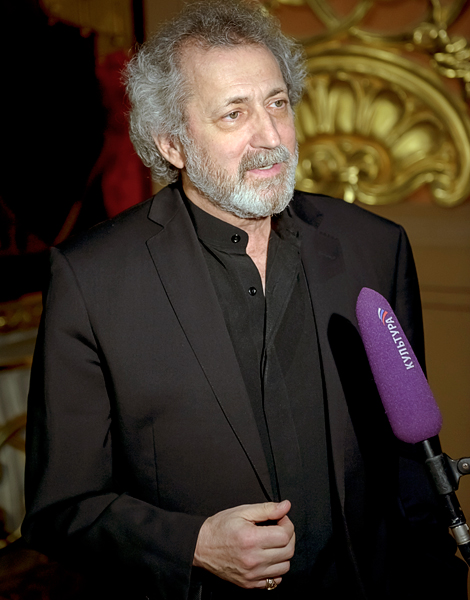
Boris Yakovlevich Eifman[a] (born 22 July 1946) is a Russian choreographer and artistic director. He has done more than fifty ballet productions.

Key Information

Biography

[edit]

Eifman was born in Rubtsovsk, Siberia, where his engineer father had been assigned to work in a tank factory.[1] In 1953, the family moved to Kishinev, Moldavia. Eifman graduated from the Kishinev Ballet School in 1964.[2] He performed as a dancer with the Kishinev Opera and Ballet Theatre; and went on to study choreography at the Leningrad Conservatory, where his teacher was choreographer Georgi Aleksidze. Eifman graduated from the Leningrad Conservatory in 1972. He then became a ballet master at the Vaganova Academy of Russian Ballet, from 1972-1977. In 1977, he received permission to found his own company, originally known as Leningrad Theatre of Contemporary Ballet. The troupe was known by various names, but today its official title is St. Petersburg State Ballet Theatre of Boris Eifman, or simply Eifman Ballet of St. Petersburg when on tour. In addition to choreographing for his own company, Eifman has created ballets for the Maly Theatre of Opera and Ballet, the Kirov Ballet, the Bolshoi Ballet, Les Ballets de Monte Carlo, and New York City Ballet, among others. He has also made dances for film and television.[2]

Eifman's family was required to move from Kharkov to Siberia during World War II. Though conditions in Siberia were hard, the move saved their lives. The Eifmans are Jewish; and the Nazis killed his father's family in Kharkov and Kiev.[3] In Siberia, they lived in a "pit" with six rooms that housed six-ten families. "If the Government did not build real housing it was not because of money, but because people were not treated like people, but like cattle," Eifman says.[3] After the family moved to Moldavia, Eifman began studying ballet and folk dance, from the age of seven, with the Young Pioneers.[3] His parents initially opposed his desire for a dance career, but he began to experiment with choreography as a teenager.

Eifman's interest in dramatic subjects for his choreography places his work in a long-standing Russian tradition. This tradition dates back to the 18th century, and the foundation of the Russian school of ballet by disciples of Jean-Georges Noverre. Eifman has said, "the type of philosophical theater that I am working to create was not born in the Soviet Union...That's an idea that belongs to Noverre."[4]

The choreographer has stated that his work for his own company can be divided into three periods: "the Soviet period, the perestroika era, and the last 10 years."[5] During the first period, he worked mostly without government subsidy and was subject to strict censorship. In spite of these restrictions, however, he won a popular following by choreographing to rock 'n roll music (Pink Floyd) and dared to address controversial themes. The authorities suggested that he emigrate, but he did not wish to leave St. Petersburg.[5] During the second period, which began with his 1987 ballet The Master and Margarita and overlapped with perestroika, Eifman enjoyed more artistic freedom. His company made its first international tour, to Paris, in 1989.[6] The third period began in 1996, when impresario Sergei Danilian approached him leading to the Eifman Ballet's US debut in 1998.[5]The company made their first appearance at the London Coliseum arranged by Gavin Roebuck in 2012.

Works

[edit]
  • Gayané (1972)
  • Firebird (1975)
  • Towards Life
  • The Meetings
  • The Beautiful Impulses of the Soul
  • Only Love (1977)
  • The Song Broken (1977)
  • Double Voice (1977)
  • Firebird (1978)
  • Movement Eternal (1979)
  • Boomerang (1979)
  • The Idiot (1980)[7]
  • Autographs (1981)
  • Day of Madness, or, The Marriage of Figaro (1982)
  • The Legend (1982)
  • Metamorphoses (1983)
  • Twelfth Night (1984)
  • Second Lieutenant Romashov (1985)
  • Intrigues of Love (1986)
  • The Master and Margarita (1987)
  • Adagio (1987)
  • Pinocchio (1989)[8]
  • Les Intrigues de l'Amour (1989)[9]
  • The Passions of Man (1990)
  • Thérèse Raquin, aka The Murderers (1991)[10]
  • Tchaikovsky: the Mystery of Life and Death (1993)[11][12][13][14][15]
  • The Karamazovs (1995)[16][17]
  • Red Giselle (1997)[18][19][20][21][22][23]
  • My Jerusalem (1998)[24][25][26]
  • Requiem (1998)[27][28]
  • Russian Hamlet: the Son of Catherine the Great (1999)[29][30][31][32][33][34][35][36][37][38]
  • Don Juan and Molière (2000)[39][40]
  • Don Quixote or Fantasies of a Madman[41]
  • Who's Who (2003)[42][43][44][45][46]
  • Musagète (2004)[47]
  • Anna Karenina (2005)[48][49][50][51]
  • The Seagull (2007)[52][53][54][55][56][57]
  • Onegin (2009)[58][59][60][61][62][63][64][65]
  • Rodin
  • Up and Down
  • The Pygmalion Effect (2019)[66]

Honours and awards

[edit]

Footnotes

[edit]

References

[edit]

Bibliography

[edit]
[edit]
Revisions and contributorsEdit on WikipediaRead on Wikipedia
from Grokipedia
Boris Eifman is a Russian choreographer known for his dramatic, psychologically intense narrative ballets that blend classical ballet with contemporary movement to explore deep emotional and philosophical themes. He has created more than forty works, many of them full-length productions drawing from major literary sources and historical figures, including Anna Karenina, Red Giselle, Russian Hamlet, and Crime and Punishment. His distinctive style, which he describes as a "dance of emotions" that interweaves classical ballet, modern dance, and ecstatic impulses to reveal characters' inner lives, has established him as one of the most prominent and influential figures in contemporary Russian ballet. Born in 1946 in Siberia, Eifman studied choreography at the Leningrad Conservatory, graduating in 1972. He began his professional career in 1970 as a choreographer at the Vaganova Academy of Russian Ballet, where he created works for student performances and ballet films over the next seven years. In 1977, he founded his own company, originally known as the Leningrad New Ballet and now the St. Petersburg State Academic Ballet Theatre under his directorship, which he has led as artistic director ever since. Eifman views ballet as a profound means of self-expression and a "deeply religious" art form in the broadest sense, dedicated to conveying overwhelming emotions, ideas, and human truths through movement. His company has gained international recognition through extensive touring and performances, earning him titles such as People's Artist of Russia and numerous prestigious awards, including the State Prize of the Russian Federation and France's Ordre des Arts et des Lettres. Critics have praised him as a theatrical innovator whose work bridges tradition and modernity, often highlighting his ability to transform literary and biographical material into vivid, emotionally charged dance dramas.

Early life and education

Birth and family background

Boris Eifman was born on July 22, 1946, in Rubtsovsk, Siberia, in the Soviet Union, where his father—an engineer originally from Kharkov, Ukraine—had been assigned to work in a tank factory as part of the Soviet war effort during World War II. The family had been evacuated to this remote location, enduring difficult living conditions in the harsh Siberian environment. Eifman comes from a Jewish family; his father's entire family perished at the hands of the Nazis in Kharkov and Kiev during the Holocaust. In 1953, following the death of Stalin, his father was permitted to relocate the family to Kishinev (now Chișinău), Moldavia, where they settled after years in Siberia.

Ballet training and studies

Boris Eifman began his formal ballet training at the Choreographic School in Kishinev (now Chișinău), where he enrolled following his family's relocation to the city in 1953. He graduated from the school in 1964. After graduation, Eifman performed as a dancer with the Kishinev Opera and Ballet Theatre. He subsequently advanced his education by studying choreography at the Leningrad Conservatory (now the Saint Petersburg Conservatory) under the guidance of teacher Georgi Aleksidze. Eifman graduated from the Leningrad Conservatory in 1972.

Early career

Dancer and initial choreography

Boris Eifman demonstrated an early aptitude for choreography while training as a ballet student. At the age of 13, he created his first choreographic piece while still attending ballet school. By age 16, he had assembled a small informal company comprising classmates and adult amateurs who participated out of enthusiasm for dance, enabling him to stage his own works. This youthful endeavor was uncommon in the Soviet Union at the time, where teenagers rarely had opportunities to choreograph for public performance. These formative experiences shaped Eifman's enduring artistic vision, particularly his emphasis on dramatic storytelling in ballet drawn from literature and cinema. At age 15, he met choreographer Leonid Jacobson and became deeply influenced by Jacobson's improvisational methods and belief that true choreographers are born rather than trained. Eifman's early experiments as both a young dancer and budding choreographer laid the groundwork for his later professional focus on dramatic, psychologically rich ballets.

Teaching at the Vaganova Academy

Boris Eifman worked as a choreographer at the Vaganova Academy of Russian Ballet from 1970 to 1977. He began creating works there during his studies at the Leningrad Conservatory (graduating in 1972) and continued afterward. In this role, he composed new works for student performances. The position allowed him to develop his choreographic skills within the traditional framework of Russian ballet pedagogy before he pursued independent choreography with his own company.

Founding and leadership of Eifman Ballet

Establishment in 1977

In 1977, Boris Eifman founded the Leningrad New Ballet, marking the creation of his own independent ballet company. The establishment came after he left his teaching position at the Vaganova Academy, allowing him to pursue his own choreographic vision outside the rigid structure of state-supported institutions. The company operated with minimal resources and limited government subsidy in its early years, relying instead on the dedication of its small troupe and earnings from performances. This financial independence came at the cost of constant scrutiny from Soviet authorities, who imposed strict censorship on artistic content and restricted access to Western influences. Despite these constraints, Eifman's early productions began to incorporate contemporary and controversial elements uncommon in Soviet ballet at the time, including the use of rock music by groups such as Pink Floyd to underscore dramatic and psychological narratives. These choices reflected his objective to explore truth-seeking themes and human interiority, setting the stage for the company's distinctive approach even under repressive conditions.

Growth, name changes, and international tours

Following the loosening of cultural restrictions during perestroika and the subsequent collapse of the Soviet Union, Boris Eifman's ballet company gained greater artistic autonomy and began to pursue extensive international activities. In 1989, the company embarked on its first international tour to Paris, France, marking its emergence on the global stage after years of primarily domestic work under Soviet conditions. The company underwent several name changes reflecting its evolving status. It eventually became officially known as the St. Petersburg State Academic Ballet Theatre in Russia, while internationally it is presented as Eifman Ballet of St. Petersburg or simply Eifman Ballet. International expansion accelerated in the late 1990s. In 1998, the company made its U.S. debut at Lincoln Center's New York State Theater, facilitated by producer Sergei Danilian of Ardani Artists Management, who organized the engagement and helped introduce Eifman's work to American audiences. The post-1996 period saw further growth in global touring. In 2012, the company debuted at London's Coliseum, performing to enthusiastic crowds and expanding its reach in Western Europe. Since then, the company has conducted regular international tours, performing in major theaters across Europe, the Americas, and Asia.

Choreographic works

Major productions and periods

Boris Eifman has created more than 50 productions during his career, the majority of them full-length ballets choreographed for his own company after its establishment in 1977. His major works are often grouped into distinct periods reflecting evolving artistic freedoms and thematic emphases: the Soviet period, the perestroika and 1990s era, and the post-1996 period of broader international recognition. In the Soviet period, Eifman established his psychological approach within the constraints of the era through landmark adaptations of Russian literature. The Idiot (1980) draws from Fyodor Dostoevsky's novel to portray the tragic innocence and societal alienation of Prince Myshkin. The Master and Margarita (1987) adapts Mikhail Bulgakov's satirical fantasy, exploring themes of art, love, and moral conflict under oppressive conditions. The perestroika and 1990s period brought greater creative liberty, yielding some of his most iconic full-length ballets. The Karamazovs (1995) interprets Dostoevsky's The Brothers Karamazov, delving into familial turmoil, faith, and existential questions. Red Giselle (1997) reimagines the romantic classic Giselle through the tragic lens of a ballerina's fate in Soviet-era Russia, blending historical drama with ballet tradition. Russian Hamlet (1999) reframes Shakespeare's tragedy in a Russian historical context, emphasizing power struggles and psychological intensity. In the post-1996 period, Eifman focused on international audiences and continued literary adaptations. Anna Karenina (2005) captures the emotional and social tragedy of Leo Tolstoy's heroine. The Seagull (2007) draws from Anton Chekhov's play to examine art, unrequited love, and disillusionment. Onegin (2009) adapts Alexander Pushkin's verse novel, portraying themes of love, regret, and social convention. The Pygmalion Effect (2019) shifts toward contemporary psychological exploration of transformation, identity, and social dynamics. These productions highlight Eifman's ongoing commitment to dramatic narrative and character-driven choreography.

Choreography for other companies and media

Boris Eifman has created choreography for several other companies and media outlets, though the majority of his output has been dedicated to his own Eifman Ballet. Early in his career, Eifman choreographed Gayane for the Maly Opera and Ballet Theatre in 1972, a production that achieved significant success and was later adapted into a widely popular film version. In 1975, he created a version of The Firebird for the Kirov Ballet. During the 1970s, he also produced pieces for numerous television programs—including Rococo Variations—and ice shows. Later, in 2004, Eifman was commissioned by the New York City Ballet to create Musagète, a tribute to George Balanchine commissioned for the Balanchine Centennial, featuring music by Bach and Tchaikovsky and lasting approximately 47 minutes. This work reflected Eifman's admiration for Balanchine's legacy from a Russian perspective, incorporating references to his style and teaching methods.

Artistic style and approach

Psychological and dramatic focus

Boris Eifman has developed a distinctive form of ballet that he describes as "Russian psychological ballet theater," which emphasizes profound psychological depth and dramatic storytelling through movement. He has explained that his primary aspiration is to create "Russian psychological drama," using dance to reveal the emotions driving human actions and the intricate relationships between individuals, rather than limiting choreography to movement synchronized with music. Eifman seeks to "look inside a person" and discover body language capable of conveying the psychology and soul of characters, thereby expanding ballet's expressive range to encompass more complex emotions and inner states. Central to his approach is an exploration of the human psyche and emotional conflict, where narrative emerges from the soul of the characters rather than external plots alone. He focuses on stories of the internal life of man, drawing from universal themes of tragedy, suffering, guilty love, and the mix of tragedy and farce in existence, to create works that probe deep human passions and the secrets within individuals. This psychological orientation distinguishes his ballet theater from pure dance, prioritizing theater that communicates the soul's experiences and demands emotional investment from audiences to achieve catharsis. Even during the Soviet era, Eifman pursued controversial themes that challenged official norms, resulting in severe censorship, accusations of pornography and heresy, suppression of his company, passport withdrawal, and repeated requirements to submit and revise productions before public presentation. Authorities viewed his work as incompatible with approved Soviet styles, branding him a dissident and attempting to force emigration, yet he persisted in addressing the individual trapped within societal constraints and the emotional realities of the human condition.

Use of literature, music, and contemporary elements

Boris Eifman frequently adapts literary classics into his ballets, drawing from major Russian writers such as Fyodor Dostoevsky, Leo Tolstoy, and Mikhail Bulgakov to explore complex human emotions and moral conflicts through movement. These literary sources provide the narrative foundation for his dramatic and psychological approach, allowing him to translate prose into physical expression while preserving the essence of the original texts. During the Soviet period, Eifman incorporated rock music into his choreography, including works set to compositions by Pink Floyd, as a deliberate contrast to conventional classical ballet scores. This use of rock reflected his effort to challenge traditional forms and introduce modern musical influences under restrictive cultural conditions. Eifman integrates contemporary elements into the classical ballet idiom, blending modern sensibilities with established techniques to create a distinctive hybrid style. His approach evolved from the Soviet-era emphasis on rock and bold experimentation to a post-Soviet focus that maintains contemporary flair while centering on literary adaptations, resulting in ballets that merge timeless narratives with innovative movement and music. These elements are applied in his psychologically intense works to heighten emotional impact and dramatic tension.

Awards and recognition

Russian honors

Boris Eifman has been recognized with several high-level Russian state and theatrical honors for his contributions to choreography and the development of contemporary ballet. He was awarded the title of People's Artist of Russia in 1995. In 1999, he received the State Prize of the Russian Federation. He also became a laureate of the State Prize of the Russian Federation in the field of literature and art for 2017. He received the Order "For Merit to the Fatherland", 4th class, in 2003 and 1st class in 2021. In the theater community, Eifman has won Golden Mask awards in 1996 and 1999. He has further received multiple Golden Soffit awards from Saint Petersburg, specifically in 1995, 1996, 1997, 2001, and 2005.

International awards

Boris Eifman has received notable international recognition for his choreography beyond his native Russia. In 1999, he was named Chevalier de l'Ordre des Arts et des Lettres by France. In 2003, Poland awarded him the Commander's Cross with Star of the Order of Merit of the Republic of Poland. In 2006, Eifman received the Prix Benois de la Danse as best choreographer of 2005. These honors reflect the global acclaim his work achieved following the company's international tours beginning in the late 1980s.

References

Add your contribution
Related Hubs
User Avatar
No comments yet.