




Community hub
Recent from talks
Contribute something to knowledge base
Content stats: 0 posts, 0 articles, 1 media, 0 notes
Members stats: 0 subscribers, 0 contributors, 0 moderators, 0 supporters
Subscribers
Supporters
Contributors
Moderators
Chinatown, Boston
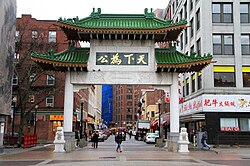
Chinatown, Boston (Cantonese: 唐人街; Jyutping: Tong4jan4gaai1) is a neighborhood located in downtown Boston, Massachusetts, United States. It is the only surviving historic ethnic Chinese enclave in New England since the demise of the Chinatowns in Providence, Rhode Island, and Portland, Maine, after the 1950s. Because of the high population of Asians and Asian Americans living in this area of Boston, there is an abundance of Chinese and Vietnamese restaurants located in Chinatown. It is one of the most densely populated residential areas in Boston and serves as the largest center of its East Asian and Southeast Asian cultural life.
Chinatown borders the Boston Common, Downtown Crossing, the Washington Street Theatre District, Bay Village, the South End, and the Southeast Expressway/Massachusetts Turnpike. Boston's Chinatown is one of the largest Chinatowns outside of New York City.
Because it is a gathering place and home to many immigrants, Chinatown has a diverse culture and population. According to 2020 census data, the total population in Chinatown is 5,460. This is an almost 53% increase since 2000, when there were only 3,559 people. The white population rose 241.7% from 228 in 2000 to 779 in 2010. The Black and African American population rose from 82 in 2000 to 139 in 2010, showing an almost 70% increase. The American Indian population dropped 75% from 2000 to 2010, going from 8 to 2 residents. The Asian population grew about 7.5% from 3,190 in 2000 to 3,416 in 2010. People who identified as another race grew from 18 in 2000 to 30 in 2010, a 66.7% increase. Those who identified as more than one race grew from 32 in 2000 to 77 in 2010, as increase of 140.6%.
With more white residents moving into Chinatown, there is worry about gentrification. For instance, the Asian population dropped to 46% in 2010. Another major concern is that historic towns and places are becoming more touristy and less cultural. Among Boston, New York, and Philadelphia, Boston has shown the highest increase in non-Asian residents moving into non-family shared households, with a 450% increase from 1990 to 2000.
The total number of housing units in Chinatown has increased by 54% from 2000 to 2010. Chinatown went from 1,367 to 2,114 housing units. There has been an almost 50% increase in the occupied housing units in Chinatown from 2000 to 2010, going from 1,327 to 1,982. With the increase in occupied housing units, there has also been a 230% increase in vacant homes, going from 40 in 2000 to 132 in 2010.
According to the 2012-2016 American Community Survey 5-Year Estimates, the largest ancestry groups in ZIP Code 02111 are:
Part of the Chinatown neighborhood occupies a space that was reclaimed by filling in a tidal flat. The newly created area was first settled by Anglo-Bostonians. After residential properties in this area became less desirable due to railway developments, it was settled by a mixed succession of Irish, Jewish, Italian, Lebanese, and Chinese immigrants. Each group replaced the previous one to take advantage of low-cost housing and job opportunities in the area. During the late-nineteenth century, garment manufacturing plants also moved into Chinatown, creating Boston's historic garment district. This district was active until the 1990s.
In 1870, the first Chinese people were brought from San Francisco to break a strike at the Sampson Shoe Factory in North Adams, Massachusetts. The arrival of these Chinese workers were met with much hostility from members of the community. There was ill-intentioned words spread about them that were meant to create a bad image for the Chinese to the rest of the community in Boston. Prior to the immigration of Chinese workers from California in 1870, Boston's Chinese population consisted of tea merchants or servants.
Chinatown, Boston
Chinatown, Boston (Cantonese: 唐人街; Jyutping: Tong4jan4gaai1) is a neighborhood located in downtown Boston, Massachusetts, United States. It is the only surviving historic ethnic Chinese enclave in New England since the demise of the Chinatowns in Providence, Rhode Island, and Portland, Maine, after the 1950s. Because of the high population of Asians and Asian Americans living in this area of Boston, there is an abundance of Chinese and Vietnamese restaurants located in Chinatown. It is one of the most densely populated residential areas in Boston and serves as the largest center of its East Asian and Southeast Asian cultural life.
Chinatown borders the Boston Common, Downtown Crossing, the Washington Street Theatre District, Bay Village, the South End, and the Southeast Expressway/Massachusetts Turnpike. Boston's Chinatown is one of the largest Chinatowns outside of New York City.
Because it is a gathering place and home to many immigrants, Chinatown has a diverse culture and population. According to 2020 census data, the total population in Chinatown is 5,460. This is an almost 53% increase since 2000, when there were only 3,559 people. The white population rose 241.7% from 228 in 2000 to 779 in 2010. The Black and African American population rose from 82 in 2000 to 139 in 2010, showing an almost 70% increase. The American Indian population dropped 75% from 2000 to 2010, going from 8 to 2 residents. The Asian population grew about 7.5% from 3,190 in 2000 to 3,416 in 2010. People who identified as another race grew from 18 in 2000 to 30 in 2010, a 66.7% increase. Those who identified as more than one race grew from 32 in 2000 to 77 in 2010, as increase of 140.6%.
With more white residents moving into Chinatown, there is worry about gentrification. For instance, the Asian population dropped to 46% in 2010. Another major concern is that historic towns and places are becoming more touristy and less cultural. Among Boston, New York, and Philadelphia, Boston has shown the highest increase in non-Asian residents moving into non-family shared households, with a 450% increase from 1990 to 2000.
The total number of housing units in Chinatown has increased by 54% from 2000 to 2010. Chinatown went from 1,367 to 2,114 housing units. There has been an almost 50% increase in the occupied housing units in Chinatown from 2000 to 2010, going from 1,327 to 1,982. With the increase in occupied housing units, there has also been a 230% increase in vacant homes, going from 40 in 2000 to 132 in 2010.
According to the 2012-2016 American Community Survey 5-Year Estimates, the largest ancestry groups in ZIP Code 02111 are:
Part of the Chinatown neighborhood occupies a space that was reclaimed by filling in a tidal flat. The newly created area was first settled by Anglo-Bostonians. After residential properties in this area became less desirable due to railway developments, it was settled by a mixed succession of Irish, Jewish, Italian, Lebanese, and Chinese immigrants. Each group replaced the previous one to take advantage of low-cost housing and job opportunities in the area. During the late-nineteenth century, garment manufacturing plants also moved into Chinatown, creating Boston's historic garment district. This district was active until the 1990s.
In 1870, the first Chinese people were brought from San Francisco to break a strike at the Sampson Shoe Factory in North Adams, Massachusetts. The arrival of these Chinese workers were met with much hostility from members of the community. There was ill-intentioned words spread about them that were meant to create a bad image for the Chinese to the rest of the community in Boston. Prior to the immigration of Chinese workers from California in 1870, Boston's Chinese population consisted of tea merchants or servants.
Recent media
Recent media