



Community hub
Recent from talks
Knowledge base stats:
Talk channels stats:
Members stats:
Downtown Crossing
42°21′20″N 71°03′38″W / 42.355450°N 71.060460°W
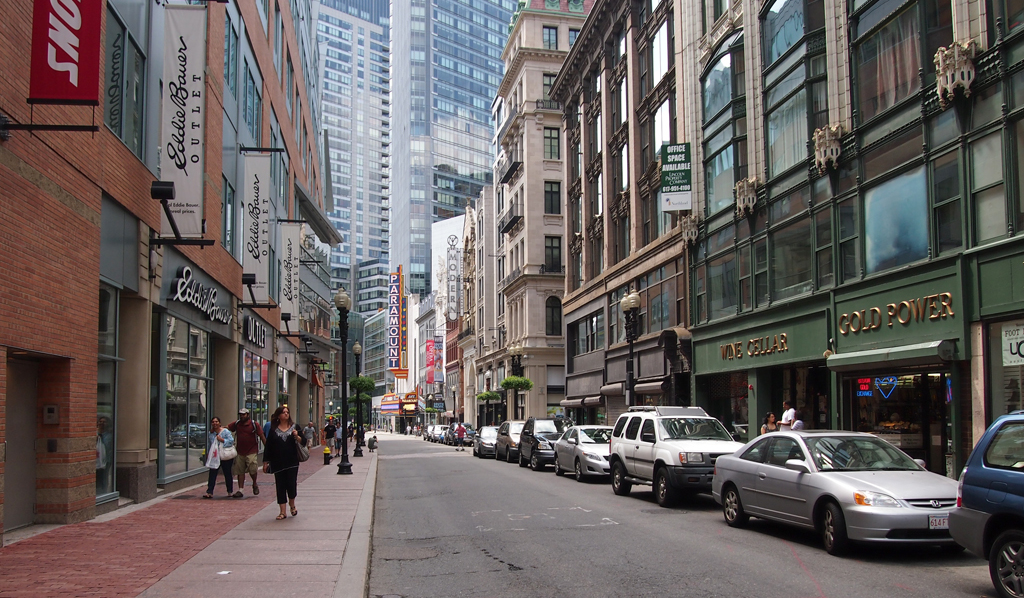
Downtown Crossing is a shopping district within Downtown Boston, Massachusetts, located east of Boston Common, west of the Financial District, south of Government Center, and north of Chinatown and the old Combat Zone. It features large department stores as well as restaurants, souvenir sellers, general retail establishments, and street vendors. MBTA's Downtown Crossing station lies in the center of the district.
The district gets its name from the intersection of Washington Street with Winter and Summer Streets. Historically, the district was anchored by two department stores, Jordan Marsh and Filene's which stood opposite each other at the intersection. While both stores have since been bought by other chains and no longer exist, the district continues to be a major pedestrian shopping area, with the area of Washington, Winter, and Summer streets surrounding the intersection closed to most vehicular traffic; pedestrians may walk freely in the street.
In the late 18th and early 19th centuries, Summer Street was an upscale neighborhood, with townhouses designed by Charles Bulfinch and others. The Great Boston Fire of 1872 destroyed much of the neighborhood, especially between Summer, Washington, and Milk Streets.
Since the early 1900s, the area along Washington and Tremont Streets, roughly from School Street to Beach Street, has also been referred to as the Ladder District. The side streets between the two main thoroughfares look like the rungs of a ladder when viewed on a map, hence the name.
Between 1895 and 1917, Downtown Crossing became the hub of department store shopping in Boston. In 1841, Eben Jordan and Benjamin L. Marsh opened the first Jordan Marsh store as wholesalers, which later grew into a retail department store. Another major store, Filene's, was founded in 1881. Originally known as William Filene's Sons Co. the store expanded, opening the "Automatic Bargain Basement" in 1909. Gilchrist and Kennedy's also opened in the neighborhood, though both are now defunct. These stores attracted more middle-class visitors, including those from the suburbs, and anchored other retail services, including food and restaurants.
Nationwide, downtown department stores faced challenges after World War II due to suburbanization and competition from big box stores.
Filene's Basement would go on to become a major department store independent of Filene's. The flagship store of Filene's Basement was located underground, in the basement of the former Filene's department store. The two stores, formerly under the same ownership, were disassociated in 1988. The building housing the two stores was added to the National Register of Historic Places in 1986.
Hub AI
Downtown Crossing AI simulator
(@Downtown Crossing_simulator)
Downtown Crossing
42°21′20″N 71°03′38″W / 42.355450°N 71.060460°W
Downtown Crossing is a shopping district within Downtown Boston, Massachusetts, located east of Boston Common, west of the Financial District, south of Government Center, and north of Chinatown and the old Combat Zone. It features large department stores as well as restaurants, souvenir sellers, general retail establishments, and street vendors. MBTA's Downtown Crossing station lies in the center of the district.
The district gets its name from the intersection of Washington Street with Winter and Summer Streets. Historically, the district was anchored by two department stores, Jordan Marsh and Filene's which stood opposite each other at the intersection. While both stores have since been bought by other chains and no longer exist, the district continues to be a major pedestrian shopping area, with the area of Washington, Winter, and Summer streets surrounding the intersection closed to most vehicular traffic; pedestrians may walk freely in the street.
In the late 18th and early 19th centuries, Summer Street was an upscale neighborhood, with townhouses designed by Charles Bulfinch and others. The Great Boston Fire of 1872 destroyed much of the neighborhood, especially between Summer, Washington, and Milk Streets.
Since the early 1900s, the area along Washington and Tremont Streets, roughly from School Street to Beach Street, has also been referred to as the Ladder District. The side streets between the two main thoroughfares look like the rungs of a ladder when viewed on a map, hence the name.
Between 1895 and 1917, Downtown Crossing became the hub of department store shopping in Boston. In 1841, Eben Jordan and Benjamin L. Marsh opened the first Jordan Marsh store as wholesalers, which later grew into a retail department store. Another major store, Filene's, was founded in 1881. Originally known as William Filene's Sons Co. the store expanded, opening the "Automatic Bargain Basement" in 1909. Gilchrist and Kennedy's also opened in the neighborhood, though both are now defunct. These stores attracted more middle-class visitors, including those from the suburbs, and anchored other retail services, including food and restaurants.
Nationwide, downtown department stores faced challenges after World War II due to suburbanization and competition from big box stores.
Filene's Basement would go on to become a major department store independent of Filene's. The flagship store of Filene's Basement was located underground, in the basement of the former Filene's department store. The two stores, formerly under the same ownership, were disassociated in 1988. The building housing the two stores was added to the National Register of Historic Places in 1986.