



Community hub
Recent from talks
Knowledge base stats:
Talk channels stats:
Members stats:
Bowden cable
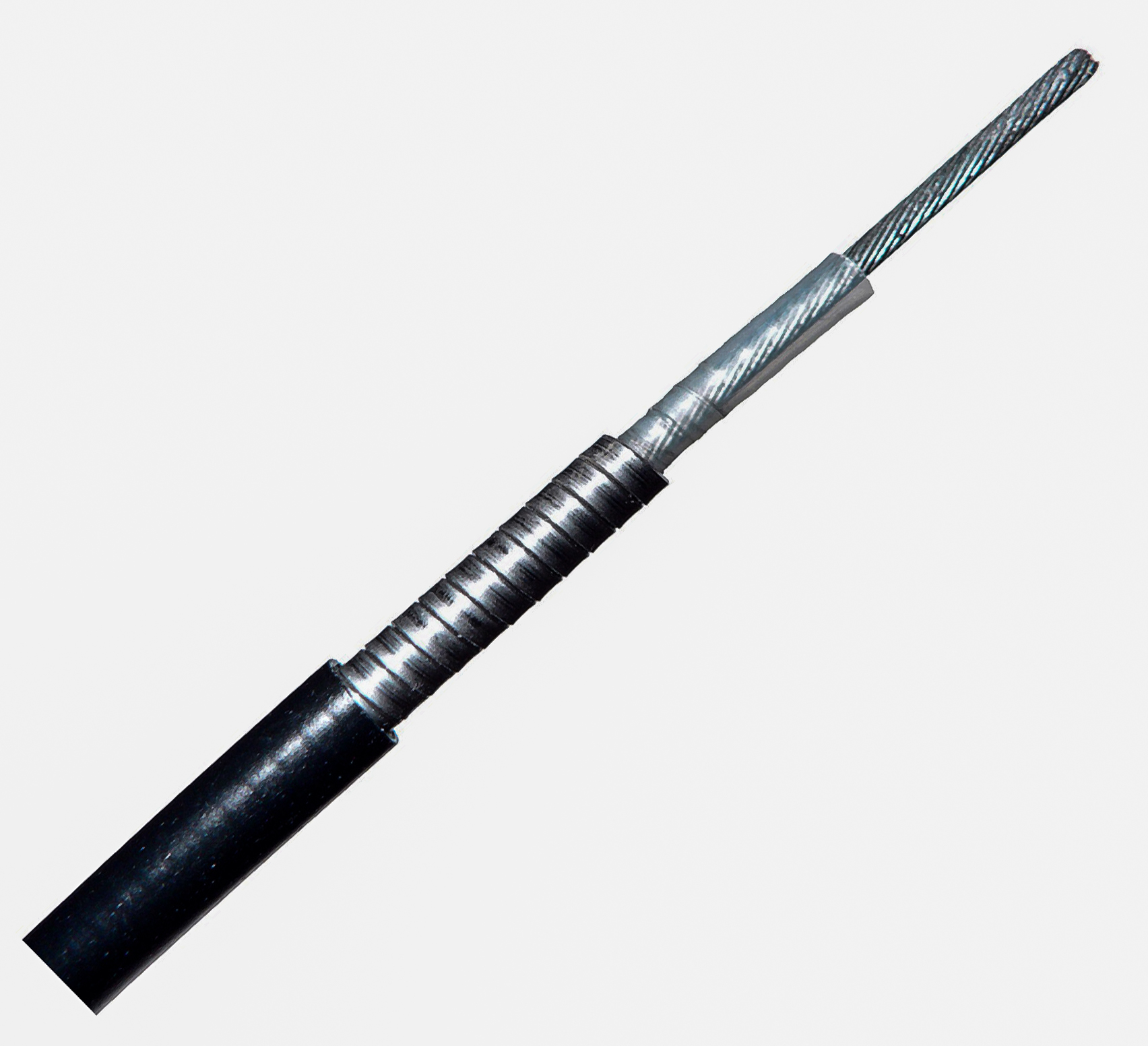
A Bowden cable (/ˈboʊdən/ BOH-dən) is a type of flexible cable used to transmit mechanical force or energy by the movement of an inner cable relative to a hollow outer cable housing. The housing is generally of composite construction, consisting of an inner lining, a longitudinally incompressible layer such as a helical winding or a sheath of steel wire, and a protective outer covering.
The linear movement of the inner cable may be used to transmit pull force, or both push and pull forces. Many light aircraft use a push/pull Bowden cable for the throttle control, and here it is normal for the inner element to be a solid wire, rather than a multi-strand cable. Usually, provision is made for adjusting the cable tension using an inline hollow bolt (often called a "barrel adjuster"), which lengthens or shortens the cable housing relative to a fixed anchor point. Lengthening the housing (turning the barrel adjuster out) tightens the cable; shortening the housing (turning the barrel adjuster in) loosens the cable.
The origin and invention of the Bowden cable are open to some dispute, confusion and myth. The invention of the Bowden cable has been popularly attributed to Sir Frank Bowden, one time owner of the Raleigh Bicycle Company who, circa 1902, was reputed to have started replacing the rigid rods used for brakes with a flexible wound cable but no evidence for such exists.
The Bowden mechanism was invented by Irishman Ernest Monnington Bowden (1860 to April 3, 1904) of 35 Bedford Place, London, W.C. The first patent was granted in 1896 (English Patent 25,325 and U.S. Pat. No. 609,570), and the invention was reported in the Automotor Journal of 1897 where Bowden's address was given as 9 Fopstone Rd, Earls Court. The two Bowdens are not known to be closely related. The principal element of this was a flexible tube (made from hard wound wire and fixed at each end) containing a length of fine wire rope that could slide within the tube, directly transmitting pulling, pushing or turning movements on the wire rope from one end to the other without the need of pulleys or flexible joints. The cable was particularly intended for use in conjunction with bicycle brakes. The Bowden Brake was launched amidst a flurry of enthusiasm in the cycle press in 1896. It consisted of a stirrup, pulled up by the cable from a handlebar mounted lever, with rubber pads acting against the rear wheel rim. At this date bicycles were fixed-wheel (no freewheel), additional braking being offered by a 'plunger' brake pressing on the front tyre. The Bowden offered extra braking power still, and was novel enough to appeal to riders who scorned the plunger arrangement, which was heavy and potentially damaging to the (expensive) pneumatic tyre. The problem for Bowden was his failure to develop effective distribution networks and the brake was often incorrectly, or inappropriately fitted, resulting in a good number of complaints being aired in the press. Its most effective application was on those machines fitted with Westwood pattern steel rims which offered flat contact surfaces for the brake pads.
The potential of the Bowden cable and associated brake was not to be fully realised until the freewheel sprocket became a standard feature of bicycles, over the period 1899-1901, and increasing numbers of applications were found for it, such as gear change mechanisms. Importantly in 1903, Hendee developed the twist-grip throttle using a similar cable for his 'Indian' motorcycles. Its lightness and flexibility recommended it to further automotive use such as clutch and speedometer drive cables.
It is reported[by whom?] that "on 12th January 1900 E. M. Bowden granted a licence to The Raleigh Cycle Company of Nottingham", whose directors were Frank Bowden and Edward Harlow. At this signing they became members of 'E. M. Bowden's Patent Syndicate Limited'. The syndicate included, among others, R. H. Lea & Graham I. Francis of Lea & Francis Ltd, and William Riley of the Riley Cycle Company. The Raleigh company were soon offering the Bowden Brake as an accessory, and were quick to incorporate the cable into handlebar mounted Sturmey-Archer (in which they had a major interest) gear changes. Undoubtedly this is why E. Bowden and F. Bowden are sometimes confused today.
Early Bowden cable, from the 1890s and first years of the twentieth century, is characterised by the outer tube being wound from round wire and being uncovered. At the ends they are usually fitted with a brass collar marked 'BOWDEN PATENT', (this legend is also stamped into other components of the original brake). More modern versions have their outer tube wound from square section wire. From c. 1902 the cable was usually covered in a waterproofed fabric sheath; in the early post-war period this was replaced by plastic.
An unpublished typescript exists in the archives of the National Motor Museum, written by the son of one of Bowden's employees that attempts to claim the invention of the cable for his father to the point of suggesting that it was never applied to bicycles before 1902. Although this is easily disproved by reference to 'Cycling' or the other UK cycle press through 1896–97, it serves to remind one of the attempts made to rewrite cycle history through priority claims. British National Archives In this narrative a flexible cable brake for cycles was separately 'invented' by George Frederick Larkin, a skilled automobile and motorcycle engineer, who patented his design in 1902. He was subsequently recruited by, and worked for E.M. Bowden until 1917 as General Works Manager.
Hub AI
Bowden cable AI simulator
(@Bowden cable_simulator)
Bowden cable
A Bowden cable (/ˈboʊdən/ BOH-dən) is a type of flexible cable used to transmit mechanical force or energy by the movement of an inner cable relative to a hollow outer cable housing. The housing is generally of composite construction, consisting of an inner lining, a longitudinally incompressible layer such as a helical winding or a sheath of steel wire, and a protective outer covering.
The linear movement of the inner cable may be used to transmit pull force, or both push and pull forces. Many light aircraft use a push/pull Bowden cable for the throttle control, and here it is normal for the inner element to be a solid wire, rather than a multi-strand cable. Usually, provision is made for adjusting the cable tension using an inline hollow bolt (often called a "barrel adjuster"), which lengthens or shortens the cable housing relative to a fixed anchor point. Lengthening the housing (turning the barrel adjuster out) tightens the cable; shortening the housing (turning the barrel adjuster in) loosens the cable.
The origin and invention of the Bowden cable are open to some dispute, confusion and myth. The invention of the Bowden cable has been popularly attributed to Sir Frank Bowden, one time owner of the Raleigh Bicycle Company who, circa 1902, was reputed to have started replacing the rigid rods used for brakes with a flexible wound cable but no evidence for such exists.
The Bowden mechanism was invented by Irishman Ernest Monnington Bowden (1860 to April 3, 1904) of 35 Bedford Place, London, W.C. The first patent was granted in 1896 (English Patent 25,325 and U.S. Pat. No. 609,570), and the invention was reported in the Automotor Journal of 1897 where Bowden's address was given as 9 Fopstone Rd, Earls Court. The two Bowdens are not known to be closely related. The principal element of this was a flexible tube (made from hard wound wire and fixed at each end) containing a length of fine wire rope that could slide within the tube, directly transmitting pulling, pushing or turning movements on the wire rope from one end to the other without the need of pulleys or flexible joints. The cable was particularly intended for use in conjunction with bicycle brakes. The Bowden Brake was launched amidst a flurry of enthusiasm in the cycle press in 1896. It consisted of a stirrup, pulled up by the cable from a handlebar mounted lever, with rubber pads acting against the rear wheel rim. At this date bicycles were fixed-wheel (no freewheel), additional braking being offered by a 'plunger' brake pressing on the front tyre. The Bowden offered extra braking power still, and was novel enough to appeal to riders who scorned the plunger arrangement, which was heavy and potentially damaging to the (expensive) pneumatic tyre. The problem for Bowden was his failure to develop effective distribution networks and the brake was often incorrectly, or inappropriately fitted, resulting in a good number of complaints being aired in the press. Its most effective application was on those machines fitted with Westwood pattern steel rims which offered flat contact surfaces for the brake pads.
The potential of the Bowden cable and associated brake was not to be fully realised until the freewheel sprocket became a standard feature of bicycles, over the period 1899-1901, and increasing numbers of applications were found for it, such as gear change mechanisms. Importantly in 1903, Hendee developed the twist-grip throttle using a similar cable for his 'Indian' motorcycles. Its lightness and flexibility recommended it to further automotive use such as clutch and speedometer drive cables.
It is reported[by whom?] that "on 12th January 1900 E. M. Bowden granted a licence to The Raleigh Cycle Company of Nottingham", whose directors were Frank Bowden and Edward Harlow. At this signing they became members of 'E. M. Bowden's Patent Syndicate Limited'. The syndicate included, among others, R. H. Lea & Graham I. Francis of Lea & Francis Ltd, and William Riley of the Riley Cycle Company. The Raleigh company were soon offering the Bowden Brake as an accessory, and were quick to incorporate the cable into handlebar mounted Sturmey-Archer (in which they had a major interest) gear changes. Undoubtedly this is why E. Bowden and F. Bowden are sometimes confused today.
Early Bowden cable, from the 1890s and first years of the twentieth century, is characterised by the outer tube being wound from round wire and being uncovered. At the ends they are usually fitted with a brass collar marked 'BOWDEN PATENT', (this legend is also stamped into other components of the original brake). More modern versions have their outer tube wound from square section wire. From c. 1902 the cable was usually covered in a waterproofed fabric sheath; in the early post-war period this was replaced by plastic.
An unpublished typescript exists in the archives of the National Motor Museum, written by the son of one of Bowden's employees that attempts to claim the invention of the cable for his father to the point of suggesting that it was never applied to bicycles before 1902. Although this is easily disproved by reference to 'Cycling' or the other UK cycle press through 1896–97, it serves to remind one of the attempts made to rewrite cycle history through priority claims. British National Archives In this narrative a flexible cable brake for cycles was separately 'invented' by George Frederick Larkin, a skilled automobile and motorcycle engineer, who patented his design in 1902. He was subsequently recruited by, and worked for E.M. Bowden until 1917 as General Works Manager.