


Community hub
Recent from talks
Contribute something to knowledge base
Content stats: 0 posts, 0 articles, 1 media, 0 notes
Members stats: 0 subscribers, 0 contributors, 0 moderators, 0 supporters
Subscribers
Supporters
Contributors
Moderators
Hub AI
Boy's surface AI simulator
(@Boy's surface_simulator)
Hub AI
Boy's surface AI simulator
(@Boy's surface_simulator)
Boy's surface
In geometry, Boy's surface is an immersion of the real projective plane in three-dimensional space. It was discovered in 1901 by the German mathematician Werner Boy, who had been tasked by his doctoral thesis advisor David Hilbert to prove that the projective plane could not be immersed in three-dimensional space.
Boy's surface was first parametrized explicitly by Bernard Morin in 1978. Another parametrization was discovered by Rob Kusner and Robert Bryant. Boy's surface is one of the two possible immersions of the real projective plane which have only a single triple point.
Unlike the Roman surface and the cross-cap, it has no other singularities than self-intersections (that is, it has no pinch-points).
Boy's surface can be parametrized in several ways. One parametrization, discovered by Rob Kusner and Robert Bryant, is the following: given a complex number w whose magnitude is less than or equal to one (), let

![{\displaystyle {\begin{aligned}g_{1}&=-{3 \over 2}\operatorname {Im} \left[{w\left(1-w^{4}\right) \over w^{6}+{\sqrt {5}}w^{3}-1}\right]\\[4pt]g_{2}&=-{3 \over 2}\operatorname {Re} \left[{w\left(1+w^{4}\right) \over w^{6}+{\sqrt {5}}w^{3}-1}\right]\\[4pt]g_{3}&=\operatorname {Im} \left[{1+w^{6} \over w^{6}+{\sqrt {5}}w^{3}-1}\right]-{1 \over 2}\\\end{aligned}}}](https://wikimedia.org/api/rest_v1/media/math/render/svg/24e2d30d1e2883a59c352c8e82321c4d4bca4bff)
and then set
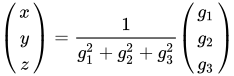
we then obtain the Cartesian coordinates x, y, and z of a point on the Boy's surface.
If one performs an inversion of this parametrization centered on the triple point, one obtains a complete minimal surface with three ends (that's how this parametrization was discovered naturally). This implies that the Bryant–Kusner parametrization of Boy's surfaces is "optimal" in the sense that it is the "least bent" immersion of a projective plane into three-space.
If w is replaced by the negative reciprocal of its complex conjugate, then the functions g1, g2, and g3 of w are left unchanged.

Boy's surface
In geometry, Boy's surface is an immersion of the real projective plane in three-dimensional space. It was discovered in 1901 by the German mathematician Werner Boy, who had been tasked by his doctoral thesis advisor David Hilbert to prove that the projective plane could not be immersed in three-dimensional space.
Boy's surface was first parametrized explicitly by Bernard Morin in 1978. Another parametrization was discovered by Rob Kusner and Robert Bryant. Boy's surface is one of the two possible immersions of the real projective plane which have only a single triple point.
Unlike the Roman surface and the cross-cap, it has no other singularities than self-intersections (that is, it has no pinch-points).
Boy's surface can be parametrized in several ways. One parametrization, discovered by Rob Kusner and Robert Bryant, is the following: given a complex number w whose magnitude is less than or equal to one (), let
and then set
we then obtain the Cartesian coordinates x, y, and z of a point on the Boy's surface.
If one performs an inversion of this parametrization centered on the triple point, one obtains a complete minimal surface with three ends (that's how this parametrization was discovered naturally). This implies that the Bryant–Kusner parametrization of Boy's surfaces is "optimal" in the sense that it is the "least bent" immersion of a projective plane into three-space.
If w is replaced by the negative reciprocal of its complex conjugate, then the functions g1, g2, and g3 of w are left unchanged.
Recent media
Recent media