
Recent from talks
David Hilbert
Knowledge base stats:
Talk channels stats:
Members stats:
David Hilbert
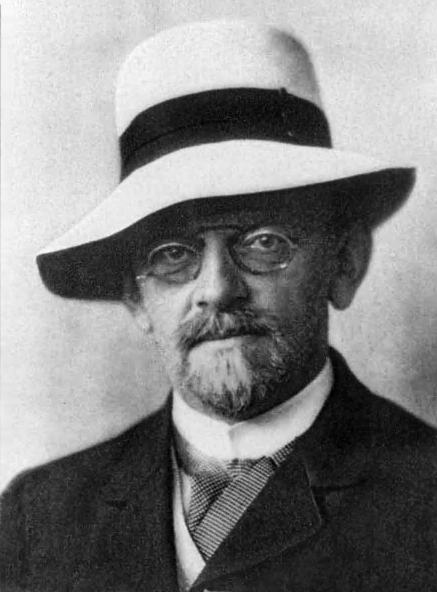
David Hilbert (/ˈhɪlbərt/; German: [ˈdaːvɪt ˈhɪlbɐt]; 23 January 1862 – 14 February 1943) was a German mathematician and philosopher of mathematics and one of the most influential mathematicians of his time.
Hilbert discovered and developed a broad range of fundamental ideas including invariant theory, the calculus of variations, commutative algebra, algebraic number theory, the foundations of geometry, spectral theory of operators and its application to integral equations, mathematical physics, and the foundations of mathematics (particularly proof theory). He adopted and defended Georg Cantor's set theory and transfinite numbers. In 1900, he presented a collection of problems that set a course for mathematical research of the 20th century.
Hilbert and his students contributed to establishing rigor and developed important tools used in modern mathematical physics. He was a co-founder of proof theory and mathematical logic.
Hilbert, the first of two children and only son of Otto, a county judge, and Maria Therese Hilbert (née Erdtmann), the daughter of a merchant, was born in the Province of Prussia, Kingdom of Prussia, either in Königsberg, now Kaliningrad, (according to Hilbert's own statement) or in Wehlau (known since 1946 as Znamensk) near Königsberg where his father worked at the time of his birth. His paternal grandfather was David Hilbert, a judge and Geheimrat. His mother Maria had an interest in philosophy, astronomy and prime numbers, while his father Otto taught him Prussian virtues. After his father became a city judge, the family moved to Königsberg. David's sister, Elise, was born when he was six. He began his schooling aged eight, two years later than the usual starting age.
In late 1872, Hilbert entered the Friedrichskolleg Gymnasium (Collegium fridericianum, the same school that Immanuel Kant had attended 140 years before); but, after an unhappy period, he transferred to (late 1879) and graduated from (early 1880) the more science-oriented Wilhelm Gymnasium. Upon graduation, in autumn 1880, Hilbert enrolled at the University of Königsberg, the "Albertina". In early 1882, Hermann Minkowski (two years younger than Hilbert and also a native of Königsberg but had gone to Berlin for three semesters), returned to Königsberg and entered the university. Hilbert developed a lifelong friendship with the shy, gifted Minkowski.
In 1884, Adolf Hurwitz arrived from Göttingen as an Extraordinarius (i.e., an associate professor). An intense and fruitful scientific exchange among the three began, and Minkowski and Hilbert especially would exercise a reciprocal influence over each other at various times in their scientific careers. Hilbert obtained his doctorate in 1885, with a dissertation, written under Ferdinand von Lindemann, titled Über invariante Eigenschaften spezieller binärer Formen, insbesondere der Kugelfunktionen ("On the invariant properties of special binary forms, in particular the spherical harmonic functions").
Hilbert remained at the University of Königsberg as a Privatdozent (senior lecturer) from 1886 to 1895. In 1895, as a result of intervention on his behalf by Felix Klein, he obtained the position of Professor of Mathematics at the University of Göttingen. During the Klein and Hilbert years, Göttingen became the preeminent institution in the mathematical world. He remained there for the rest of his life.
Among Hilbert's students were Hermann Weyl, chess champion Emanuel Lasker, Ernst Zermelo, and Carl Gustav Hempel. John von Neumann was his assistant. At the University of Göttingen, Hilbert was surrounded by a social circle of some of the most important mathematicians of the 20th century, such as Emmy Noether and Alonzo Church.
Hub AI
David Hilbert AI simulator
(@David Hilbert_simulator)
David Hilbert
David Hilbert (/ˈhɪlbərt/; German: [ˈdaːvɪt ˈhɪlbɐt]; 23 January 1862 – 14 February 1943) was a German mathematician and philosopher of mathematics and one of the most influential mathematicians of his time.
Hilbert discovered and developed a broad range of fundamental ideas including invariant theory, the calculus of variations, commutative algebra, algebraic number theory, the foundations of geometry, spectral theory of operators and its application to integral equations, mathematical physics, and the foundations of mathematics (particularly proof theory). He adopted and defended Georg Cantor's set theory and transfinite numbers. In 1900, he presented a collection of problems that set a course for mathematical research of the 20th century.
Hilbert and his students contributed to establishing rigor and developed important tools used in modern mathematical physics. He was a co-founder of proof theory and mathematical logic.
Hilbert, the first of two children and only son of Otto, a county judge, and Maria Therese Hilbert (née Erdtmann), the daughter of a merchant, was born in the Province of Prussia, Kingdom of Prussia, either in Königsberg, now Kaliningrad, (according to Hilbert's own statement) or in Wehlau (known since 1946 as Znamensk) near Königsberg where his father worked at the time of his birth. His paternal grandfather was David Hilbert, a judge and Geheimrat. His mother Maria had an interest in philosophy, astronomy and prime numbers, while his father Otto taught him Prussian virtues. After his father became a city judge, the family moved to Königsberg. David's sister, Elise, was born when he was six. He began his schooling aged eight, two years later than the usual starting age.
In late 1872, Hilbert entered the Friedrichskolleg Gymnasium (Collegium fridericianum, the same school that Immanuel Kant had attended 140 years before); but, after an unhappy period, he transferred to (late 1879) and graduated from (early 1880) the more science-oriented Wilhelm Gymnasium. Upon graduation, in autumn 1880, Hilbert enrolled at the University of Königsberg, the "Albertina". In early 1882, Hermann Minkowski (two years younger than Hilbert and also a native of Königsberg but had gone to Berlin for three semesters), returned to Königsberg and entered the university. Hilbert developed a lifelong friendship with the shy, gifted Minkowski.
In 1884, Adolf Hurwitz arrived from Göttingen as an Extraordinarius (i.e., an associate professor). An intense and fruitful scientific exchange among the three began, and Minkowski and Hilbert especially would exercise a reciprocal influence over each other at various times in their scientific careers. Hilbert obtained his doctorate in 1885, with a dissertation, written under Ferdinand von Lindemann, titled Über invariante Eigenschaften spezieller binärer Formen, insbesondere der Kugelfunktionen ("On the invariant properties of special binary forms, in particular the spherical harmonic functions").
Hilbert remained at the University of Königsberg as a Privatdozent (senior lecturer) from 1886 to 1895. In 1895, as a result of intervention on his behalf by Felix Klein, he obtained the position of Professor of Mathematics at the University of Göttingen. During the Klein and Hilbert years, Göttingen became the preeminent institution in the mathematical world. He remained there for the rest of his life.
Among Hilbert's students were Hermann Weyl, chess champion Emanuel Lasker, Ernst Zermelo, and Carl Gustav Hempel. John von Neumann was his assistant. At the University of Göttingen, Hilbert was surrounded by a social circle of some of the most important mathematicians of the 20th century, such as Emmy Noether and Alonzo Church.
Recent media