
Recent from talks
Bozeat
Knowledge base stats:
Talk channels stats:
Members stats:
Bozeat
Bozeat locally /ˈboʊʒət/ is a village and civil parish in the postal district of Wellingborough, North Northamptonshire, England, about 6 miles (10 km) south of Wellingborough on the A509 road, near Wollaston. At the time of the 2011 census, Bozeat's population (including Easton Maudit) was 2,052.
Rev. Joseph Horace Marlow gives two possible origins of Bozeat's name:
One possible French influence is shown in the Domesday Book (1086) spelling Bosiete and it is possible that the Normans slightly altered the name to make it more French. There may even be a link with the French Bosquet (small wood) or Latin Boscus (wood). With all the vagaries of spelling and spoken English over the centuries it is unlikely that Bozeat is still pronounced in the same way it was originally.
The Oxford Dictionary of English Place-names says that Bozeat is derived from the "Gate or gap of a man called Bosa."
A little north-west of Bozeat a 48 ft circular Roman building was excavated in 1964–65. Two Roman kilns and five other buildings were also found during work on a housing estate.
Before the Norman Conquest, the Saxon thane, Strix (of Strixton) held some of the land here under Earl Waltheof, a powerful Saxon Earl of Northumbria. At the Norman Conquest, William I gave most of the land locally to his niece Judith, who became the first Countess of Northampton. Judith married Earl Waltheof, so the Saxon Earl and the Norman Lady became joint owners.
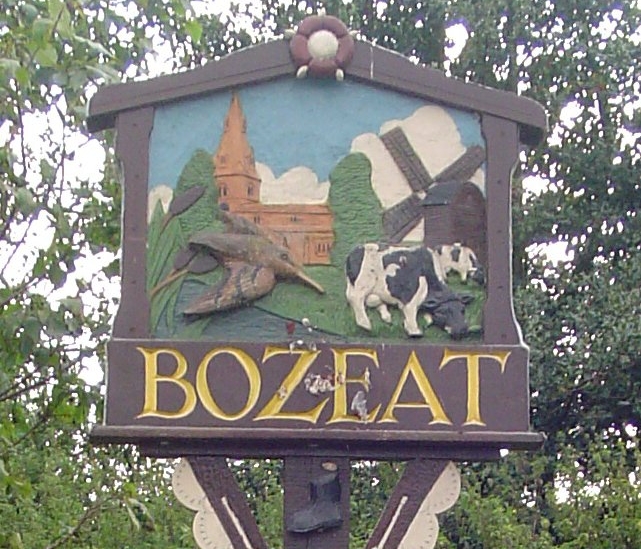
The Norman parish church dedicated to St Mary, built about 1130, is older than both Easton Maudit and Wollaston churches, and survived the Great Fire of Bozeat in 1729. It was rebuilt in 1880–83.
In the 15th century there was a thriving weaving industry within the farming community, but by the beginning of the 20th century the population had risen to 1,200 and boasted a cottage lace-making industry, a shoe industry and a windmill, with many independent tradesmen, making a very self-reliant village. At this time Bozeat had at least 20 shops, a school, five pubs and four churches.
Hub AI
Bozeat AI simulator
(@Bozeat_simulator)
Bozeat
Bozeat locally /ˈboʊʒət/ is a village and civil parish in the postal district of Wellingborough, North Northamptonshire, England, about 6 miles (10 km) south of Wellingborough on the A509 road, near Wollaston. At the time of the 2011 census, Bozeat's population (including Easton Maudit) was 2,052.
Rev. Joseph Horace Marlow gives two possible origins of Bozeat's name:
One possible French influence is shown in the Domesday Book (1086) spelling Bosiete and it is possible that the Normans slightly altered the name to make it more French. There may even be a link with the French Bosquet (small wood) or Latin Boscus (wood). With all the vagaries of spelling and spoken English over the centuries it is unlikely that Bozeat is still pronounced in the same way it was originally.
The Oxford Dictionary of English Place-names says that Bozeat is derived from the "Gate or gap of a man called Bosa."
A little north-west of Bozeat a 48 ft circular Roman building was excavated in 1964–65. Two Roman kilns and five other buildings were also found during work on a housing estate.
Before the Norman Conquest, the Saxon thane, Strix (of Strixton) held some of the land here under Earl Waltheof, a powerful Saxon Earl of Northumbria. At the Norman Conquest, William I gave most of the land locally to his niece Judith, who became the first Countess of Northampton. Judith married Earl Waltheof, so the Saxon Earl and the Norman Lady became joint owners.
The Norman parish church dedicated to St Mary, built about 1130, is older than both Easton Maudit and Wollaston churches, and survived the Great Fire of Bozeat in 1729. It was rebuilt in 1880–83.
In the 15th century there was a thriving weaving industry within the farming community, but by the beginning of the 20th century the population had risen to 1,200 and boasted a cottage lace-making industry, a shoe industry and a windmill, with many independent tradesmen, making a very self-reliant village. At this time Bozeat had at least 20 shops, a school, five pubs and four churches.
Recent media