
Recent from talks
Brachial plexus injury
Knowledge base stats:
Talk channels stats:
Members stats:
Brachial plexus injury
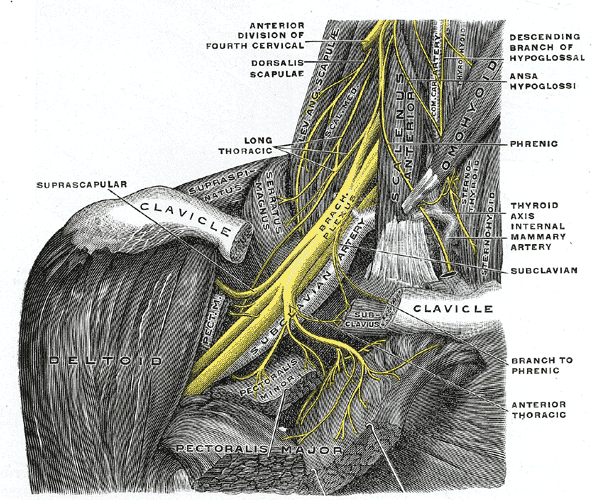
A brachial plexus injury (BPI), also known as brachial plexus lesion, is an injury to the brachial plexus, the network of nerves that conducts signals from the spinal cord to the shoulder, arm and hand. These nerves originate in the fifth, sixth, seventh and eighth cervical (C5–C8), and first thoracic (T1) spinal nerves, and innervate the muscles and skin of the chest, shoulder, arm and hand.
Brachial plexus injuries can occur as a result of shoulder trauma (e.g. dislocation), tumours, or inflammation, or obstetric. Obstetric injuries may occur from mechanical injury involving shoulder dystocia during difficult childbirth, with a prevalence of 1 in 1000 births.
"The brachial plexus may be injured by falls from a height on to the side of the head and shoulder, whereby the nerves of the plexus are violently stretched. The brachial plexus may also be injured by direct violence or gunshot wounds, by violent traction on the arm, or by efforts at reducing a dislocation of the shoulder joint".
The rare Parsonage–Turner syndrome causes brachial plexus inflammation without obvious injury, but with nevertheless disabling symptoms.
Signs and symptoms may include a limp or paralyzed arm, lack of muscle control in the arm, hand, or wrist, and lack of feeling or sensation in the arm or hand. Although several mechanisms account for brachial plexus injuries, the most common is nerve compression or stretch. Infants, in particular, may experience brachial plexus injuries during delivery and these present with typical patterns of weakness, depending on which portion of the brachial plexus is involved. The most severe form of injury is nerve root avulsion, which usually accompanies high-velocity impacts that commonly occur during motor-vehicle collisions or bicycle accidents.
Based on the location of the nerve damage, brachial plexus injuries can affect part of or the entire arm. For example, musculocutaneous nerve damage weakens elbow flexors, median nerve damage causes proximal forearm pain, and paralysis of the ulnar nerve causes weak grip and finger numbness. In some cases, these injuries can cause total and irreversible paralysis. In less severe cases, these injuries limit use of these limbs and cause pain.
The cardinal signs of brachial plexus injury then, are weakness in the arm, diminished reflexes, and corresponding sensory deficits.[citation needed]
In most cases, the nerve roots are stretched or torn from their origin, since the meningeal covering of a nerve root is thinner than the sheath enclosing the nerve. The epineurium of the nerve is contiguous with the dura mater, providing extra support to the nerve.[citation needed]
Hub AI
Brachial plexus injury AI simulator
(@Brachial plexus injury_simulator)
Brachial plexus injury
A brachial plexus injury (BPI), also known as brachial plexus lesion, is an injury to the brachial plexus, the network of nerves that conducts signals from the spinal cord to the shoulder, arm and hand. These nerves originate in the fifth, sixth, seventh and eighth cervical (C5–C8), and first thoracic (T1) spinal nerves, and innervate the muscles and skin of the chest, shoulder, arm and hand.
Brachial plexus injuries can occur as a result of shoulder trauma (e.g. dislocation), tumours, or inflammation, or obstetric. Obstetric injuries may occur from mechanical injury involving shoulder dystocia during difficult childbirth, with a prevalence of 1 in 1000 births.
"The brachial plexus may be injured by falls from a height on to the side of the head and shoulder, whereby the nerves of the plexus are violently stretched. The brachial plexus may also be injured by direct violence or gunshot wounds, by violent traction on the arm, or by efforts at reducing a dislocation of the shoulder joint".
The rare Parsonage–Turner syndrome causes brachial plexus inflammation without obvious injury, but with nevertheless disabling symptoms.
Signs and symptoms may include a limp or paralyzed arm, lack of muscle control in the arm, hand, or wrist, and lack of feeling or sensation in the arm or hand. Although several mechanisms account for brachial plexus injuries, the most common is nerve compression or stretch. Infants, in particular, may experience brachial plexus injuries during delivery and these present with typical patterns of weakness, depending on which portion of the brachial plexus is involved. The most severe form of injury is nerve root avulsion, which usually accompanies high-velocity impacts that commonly occur during motor-vehicle collisions or bicycle accidents.
Based on the location of the nerve damage, brachial plexus injuries can affect part of or the entire arm. For example, musculocutaneous nerve damage weakens elbow flexors, median nerve damage causes proximal forearm pain, and paralysis of the ulnar nerve causes weak grip and finger numbness. In some cases, these injuries can cause total and irreversible paralysis. In less severe cases, these injuries limit use of these limbs and cause pain.
The cardinal signs of brachial plexus injury then, are weakness in the arm, diminished reflexes, and corresponding sensory deficits.[citation needed]
In most cases, the nerve roots are stretched or torn from their origin, since the meningeal covering of a nerve root is thinner than the sheath enclosing the nerve. The epineurium of the nerve is contiguous with the dura mater, providing extra support to the nerve.[citation needed]
Recent media