



Community hub
Recent from talks
Contribute something to knowledge base
Content stats: 0 posts, 0 articles, 1 media, 0 notes
Members stats: 0 subscribers, 0 contributors, 0 moderators, 0 supporters
Subscribers
Supporters
Contributors
Moderators
Hub AI
Brain tumor AI simulator
(@Brain tumor_simulator)
Hub AI
Brain tumor AI simulator
(@Brain tumor_simulator)
Brain tumor
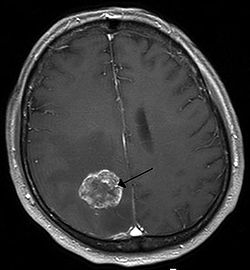
A brain tumor (sometimes referred to as brain cancer) occurs when a group of cells within the brain turn cancerous and grow out of control, creating a mass. There are two main types of tumors: malignant (cancerous) tumors and benign (non-cancerous) tumors. These can be further classified as primary tumors, which start within the brain, and secondary tumors, which most commonly have spread from tumors located outside the brain, known as brain metastasis tumors. All types of brain tumors may produce symptoms that vary depending on the size of the tumor and the part of the brain that is involved. Where symptoms exist, they may include headaches, seizures, problems with vision, vomiting and mental changes. Other symptoms may include difficulty walking, speaking, with sensations, or unconsciousness.
The cause of most brain tumors is unknown, though up to 4% of brain cancers may be caused by CT scan radiation. Uncommon risk factors include exposure to vinyl chloride, Epstein–Barr virus, ionizing radiation, and inherited syndromes such as neurofibromatosis, tuberous sclerosis, and von Hippel-Lindau Disease. Studies on mobile phone exposure have not shown a clear risk. The most common types of primary tumors in adults are meningiomas (usually benign) and astrocytomas such as glioblastomas. In children, the most common type is a malignant medulloblastoma. Diagnosis is usually by medical examination along with computed tomography (CT) or magnetic resonance imaging (MRI). The result is then often confirmed by a biopsy. Based on the findings, the tumors are divided into different grades of severity.
Treatment may include some combination of surgery, radiation therapy and chemotherapy. If seizures occur, anticonvulsant medication may be needed. Dexamethasone and furosemide are medications that may be used to decrease swelling around the tumor. Some tumors grow gradually, requiring only monitoring and possibly needing no further intervention. Treatments that use a person's immune system are being studied. Outcomes for malignant tumors vary considerably depending on the type of tumor and how far it has spread at diagnosis. Although benign tumors only grow in one area, they may still be life-threatening depending on their size and location. Malignant glioblastomas usually have very poor outcomes, while benign meningiomas usually have good outcomes. The average five-year survival rate for all (malignant) brain cancers in the United States is 33%.
Secondary, or metastatic, brain tumors are about four times as common as primary brain tumors, with about half of metastases coming from lung cancer. Primary brain tumors occur in around 250,000 people a year globally, and make up less than 2% of cancers. In children younger than 15, brain tumors are second only to acute lymphoblastic leukemia as the most common form of cancer. In New South Wales, Australia in 2005, the average lifetime economic cost of a case of brain cancer was AU$1.9 million, the greatest of any type of cancer.
The signs and symptoms of brain tumors are broad. People may experience symptoms regardless of whether the tumor is benign (not cancerous) or cancerous. Primary and secondary brain tumors present with similar symptoms, depending on the location, size, and rate of growth of the tumor. For example, larger tumors in the frontal lobe can cause changes in the ability to think. However, a smaller tumor in an area such as Wernicke's area (small area responsible for language comprehension) can result in a greater loss of function.
Headaches as a result of raised intracranial pressure can be an early symptom of brain cancer. However, isolated headache without other symptoms is rare, and other symptoms including visual abnormalities may occur before headaches become common. Certain warning signs for headache exist which make the headache more likely to be associated with brain cancer. These are defined as "abnormal neurological examination, headache worsened by Valsalva maneuver, headache causing awakening from sleep, new headache in the older population, progressively worsening headache, atypical headache features, or patients who do not fulfill the strict definition of migraine". Other associated signs are headaches that are worse in the morning or that subside after vomiting.
The brain is divided into lobes and each lobe or area has its own function. A tumour in any of these lobes may affect the area's performance. The symptoms experienced are often linked to the location of the tumour, but each person may experience something different.
A person's personality may be altered due to the tumor damaging lobes of the brain. Since the frontal, temporal, and parietal lobes control inhibition, emotions, mood, judgement, reasoning, and behavior, a tumor in those regions can cause inappropriate social behavior, temper tantrums, laughing at things which merit no laughter, and even psychological symptoms such as depression and anxiety. More research is needed into the effectiveness and safety of medication for depression in people with brain tumors.
Brain tumor
A brain tumor (sometimes referred to as brain cancer) occurs when a group of cells within the brain turn cancerous and grow out of control, creating a mass. There are two main types of tumors: malignant (cancerous) tumors and benign (non-cancerous) tumors. These can be further classified as primary tumors, which start within the brain, and secondary tumors, which most commonly have spread from tumors located outside the brain, known as brain metastasis tumors. All types of brain tumors may produce symptoms that vary depending on the size of the tumor and the part of the brain that is involved. Where symptoms exist, they may include headaches, seizures, problems with vision, vomiting and mental changes. Other symptoms may include difficulty walking, speaking, with sensations, or unconsciousness.
The cause of most brain tumors is unknown, though up to 4% of brain cancers may be caused by CT scan radiation. Uncommon risk factors include exposure to vinyl chloride, Epstein–Barr virus, ionizing radiation, and inherited syndromes such as neurofibromatosis, tuberous sclerosis, and von Hippel-Lindau Disease. Studies on mobile phone exposure have not shown a clear risk. The most common types of primary tumors in adults are meningiomas (usually benign) and astrocytomas such as glioblastomas. In children, the most common type is a malignant medulloblastoma. Diagnosis is usually by medical examination along with computed tomography (CT) or magnetic resonance imaging (MRI). The result is then often confirmed by a biopsy. Based on the findings, the tumors are divided into different grades of severity.
Treatment may include some combination of surgery, radiation therapy and chemotherapy. If seizures occur, anticonvulsant medication may be needed. Dexamethasone and furosemide are medications that may be used to decrease swelling around the tumor. Some tumors grow gradually, requiring only monitoring and possibly needing no further intervention. Treatments that use a person's immune system are being studied. Outcomes for malignant tumors vary considerably depending on the type of tumor and how far it has spread at diagnosis. Although benign tumors only grow in one area, they may still be life-threatening depending on their size and location. Malignant glioblastomas usually have very poor outcomes, while benign meningiomas usually have good outcomes. The average five-year survival rate for all (malignant) brain cancers in the United States is 33%.
Secondary, or metastatic, brain tumors are about four times as common as primary brain tumors, with about half of metastases coming from lung cancer. Primary brain tumors occur in around 250,000 people a year globally, and make up less than 2% of cancers. In children younger than 15, brain tumors are second only to acute lymphoblastic leukemia as the most common form of cancer. In New South Wales, Australia in 2005, the average lifetime economic cost of a case of brain cancer was AU$1.9 million, the greatest of any type of cancer.
The signs and symptoms of brain tumors are broad. People may experience symptoms regardless of whether the tumor is benign (not cancerous) or cancerous. Primary and secondary brain tumors present with similar symptoms, depending on the location, size, and rate of growth of the tumor. For example, larger tumors in the frontal lobe can cause changes in the ability to think. However, a smaller tumor in an area such as Wernicke's area (small area responsible for language comprehension) can result in a greater loss of function.
Headaches as a result of raised intracranial pressure can be an early symptom of brain cancer. However, isolated headache without other symptoms is rare, and other symptoms including visual abnormalities may occur before headaches become common. Certain warning signs for headache exist which make the headache more likely to be associated with brain cancer. These are defined as "abnormal neurological examination, headache worsened by Valsalva maneuver, headache causing awakening from sleep, new headache in the older population, progressively worsening headache, atypical headache features, or patients who do not fulfill the strict definition of migraine". Other associated signs are headaches that are worse in the morning or that subside after vomiting.
The brain is divided into lobes and each lobe or area has its own function. A tumour in any of these lobes may affect the area's performance. The symptoms experienced are often linked to the location of the tumour, but each person may experience something different.
A person's personality may be altered due to the tumor damaging lobes of the brain. Since the frontal, temporal, and parietal lobes control inhibition, emotions, mood, judgement, reasoning, and behavior, a tumor in those regions can cause inappropriate social behavior, temper tantrums, laughing at things which merit no laughter, and even psychological symptoms such as depression and anxiety. More research is needed into the effectiveness and safety of medication for depression in people with brain tumors.
Recent media
Recent media