


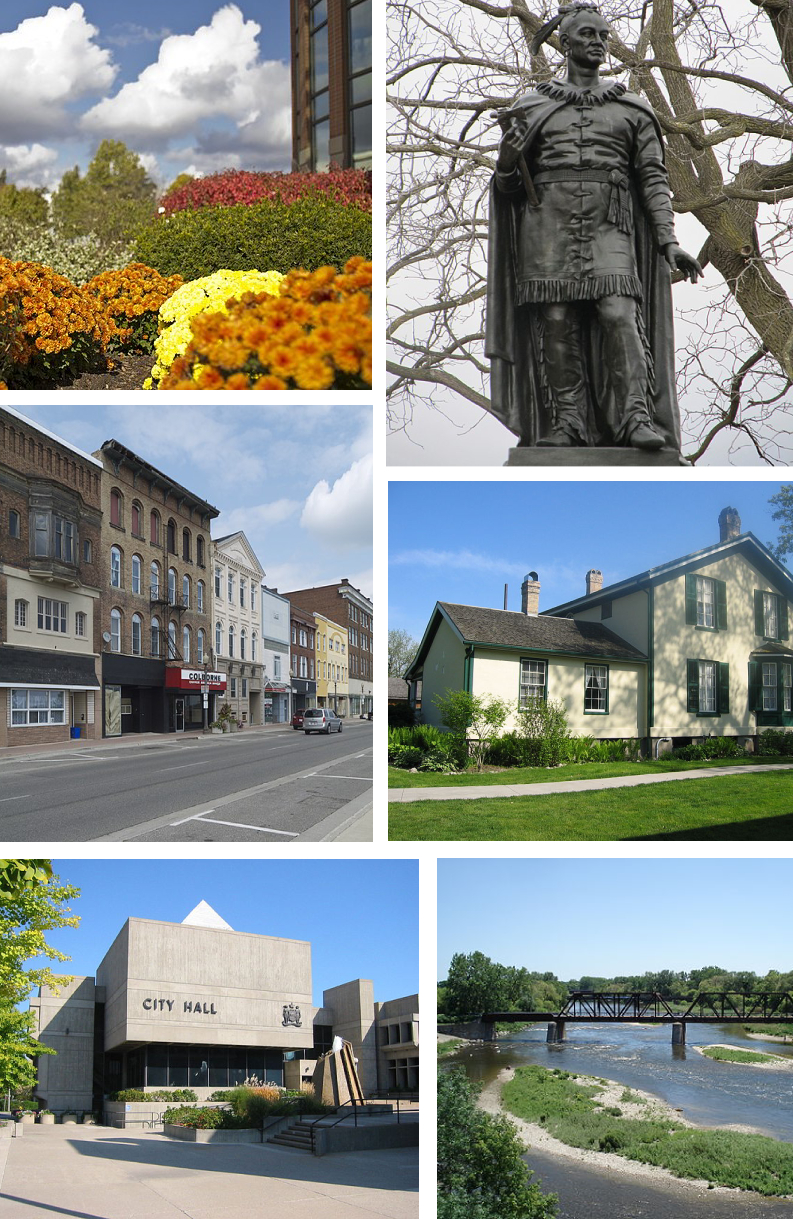

Community hub
Brantford
View on Wikipedia
Brantford (2021 population: 104,688[2]) is a city in Ontario, Canada, founded on the Grand River in Southwestern Ontario. It is surrounded by Brant County but is politically separate with a municipal government of its own that is fully independent of the county's municipal government.[5][6][7]
Key Information


Brantford is situated on the Haldimand Tract,[8][9] and is named after Joseph Brant, a Mohawk leader, soldier, farmer and slave owner.[10] Brant was an important Loyalist leader during the American Revolutionary War and later, after the Haudenosaunee moved to the Brantford area in Upper Canada. Many of his descendants and other First Nations people live on the nearby Six Nations of the Grand River reserve south of Brantford; it is the most populous reserve in Canada.
Brantford is known as the "Telephone City" because the city's famous resident, Alexander Graham Bell, invented the first telephone at his father's homestead, Melville House, now the Bell Homestead, located in Tutela Heights south of the city. Brantford is also known as the birthplace and hometown of Wayne Gretzky and Phil Hartman.
History
[edit]
The Iroquoian-speaking Attawandaron, known in English as the Neutral Nation, lived in the Grand River valley area before the 17th century; their main village and seat of the chief, Kandoucho, was identified by 19th-century historians as having been located on the Grand River where present-day Brantford developed. This community, like the rest of their settlements, was destroyed when the Iroquois declared war in 1650 over the fur trade and exterminated the Neutral nation.[11]
In 1784, Captain Joseph Brant and the Mohawk people of the Iroquois Confederacy left New York State for Canada.[12][13] As a reward for their loyalty to the British Crown, they were given a large land grant, referred to as the Haldimand Tract, on the Grand River. The original Mohawk settlement was on the south edge of the present-day city at a location favourable for landing canoes. Brant's crossing (or fording) of the river gave the original name to the area: Brant's ford The Glebe Farm Indian Reserve exists at the original site today.
The area began to grow from a small settlement in the 1820s as the Hamilton and London Road was improved. By the 1830s, Brantford became a stop on the Underground Railroad, and a sizable number of runaway African-Americans settled in the town.[14] From the 1830s to the 1860s – several hundred people of African descent settled in the area around Murray Street, and in Cainsville. In Brantford, they established their own school and church, now known as the S.R. Drake Memorial Church.[15] In 1846, it is estimated 2000 residents lived in the city's core while 5199 lived in the outlying rural areas.[16] There were eight churches in Brantford at this time – Episcopal, Presbyterian, Catholic, two Methodist, Baptist, Congregational, and one for the African-Canadian residents.[16]
By 1847, Europeans began to settle further up the river at a ford in the Grand River and named their village Brantford.[17] The population increased after 1848 when river navigation to Brantford was opened and again in 1854 with the arrival of the railway to Brantford.
Because of the ease of navigation from new roads and the Grand River, several manufacturing companies could be found in the town by 1869.[18] Some of these factories included Brantford Engine Works, Victoria Foundry and Britannia Foundry.[18] Several major farm implement manufacturers, starting with Cockshutt and Harris, opened for business in the 1870s.
The history of the Brantford region from 1793 to 1920 is described at length in the book At The Forks of The Grand.[19]
In the late 19th and early 20th centuries, the Canadian government encouraged the education of First Nations children at residential schools, which were intended to teach them English and European-Canadian ways and assimilate them into the majority cultures. Such institutions in or near Brantford included the Thomas Indian School, Mohawk Institute Residential School (also known as Mohawk Manual Labour School and Mush Hole Indian Residential School), and the Haudenosaunee boarding school. Decades later and particularly since the late 20th century, numerous scholarly and artistic works have explored the detrimental effects of the schools in destroying Native cultures. Examples include Ronald James Douglas' graduate thesis titled Documenting Ethnic Cleansing in North America: Creating Unseen Tears,[20] and the Legacy of Hope Foundation's online media collection: "Where are the Children? Healing the Legacy of the Residential Schools".[21]
In June 1945, Brantford became the first city in Canada to fluoridate its water supply.[22][23]
Brantford generated controversy in 2010 when its city council expropriated and demolished 41 historic downtown buildings on the south side of its main street, Colborne Street. The buildings constituted one of the longest blocks of pre-Confederation architecture in Canada and included one of Ontario's first grocery stores and an early 1890s office of the Bell Telephone Company of Canada. The decision was widely criticized by Ontario's heritage preservation community, however, the city argued it was needed for downtown renewal.[24][25]
Historical plaques and memorials
[edit]Plaques and monuments erected by the provincial and federal governments provide additional glimpses into the early history of the area around Brantford.[26]
The famed Mohawk Chief Joseph Brant (Thayendanega) led his people from the Mohawk Valley of New York State to Upper Canada after being allied with the British during the American Revolution, where they lost their land holdings. A group of 400 settled in 1788 on the Grand River at Mohawk Village which would later become Brantford.[26] Nearly a century later (1886), the Joseph Brant Memorial would be erected in Burlington, Ontario in honour of Brant and the Six Nations Confederacy.[27]
The Mohawk Chapel, built by the British Crown in 1785 for the Mohawk and Iroquois people (Six Nations of the Grand River), was dedicated in 1788 as a reminder of the original agreements made with the British during the American Revolution.[26] In 1904 the chapel received Royal status by King Edward VII in memory of the longstanding alliance. Her Majesty's Royal Chapel of the Mohawks is an important reminder of the original agreements made with Queen Anne in 1710. It is still in use today as one of two royal Chapels in Canada and the oldest Protestant Church in the province. Joseph Brant and his son John Brant are buried here.[28]
Chief John Brant (Mohawk leader) (Ahyonwaeghs) was one of the sons of Joseph Brant.[29] He fought with the British during the War of 1812 and later worked to improve the welfare of the First Nations. He was involved in building schools and improving the welfare of his people. Brant initiated the opening of schools and, from 1828, served as the first native Superintendent of the Six Nations.[26] Chief Brant was elected to the Legislative Assembly of Upper Canada for Haldimand in 1830 and was the first aboriginal Canadian in Parliament.[30]
The stone and brick Brant County Courthouse was built on land purchased from the Six Nations in 1852. The structure housed courtrooms, county offices, a law library and a jail. During additions in the 1880s, the Greek Revival style, with Doric columns, was retained.[26]
Among the most famed residents were Alexander Graham Bell and his family, who arrived in mid 1870 from Scotland while Bell was suffering from tuberculosis. They lived with Bell's father and mother, who had settled in a farmhouse on Tutela Heights (named after the First Nations tribe of the area[31] and later absorbed into Brantford.) Then called Melville House, it is now a museum, the Bell Homestead National Historic Site. This was the site of the invention of the telephone in 1874 and ongoing trials in 1876. The Bell Memorial, also known as the Bell Monument, was commissioned to commemorate Bell's invention of the telephone in Brantford; it is also one of the National Historic Sites of Canada.
Invention of the telephone
[edit]
Some articles suggest that the telephone was invented in Boston, where Alexander Graham Bell did a great deal of work on the development of the device.[32] However, Bell confirmed Brantford as the birthplace of the device in a 1906 speech: "the telephone problem was solved, and it was solved at my father's home".[33] At the unveiling of the Bell Memorial on 24 October 1917, Bell reminded the attendees that "Brantford is right in claiming the invention of the telephone here... [which was] conceived in Brantford in 1874 and born in Boston in 1875" and that "the first transmission to a distance was made between Brantford and Paris" (on 3 August 1876).[34][35] As well, the second successful voice transmission (over a distance of 6 km; 4 miles) was also made in the area, on 4 August 1876, between the telegraph office in Brantford, Ontario and Bell's father's homestead over makeshift wires.[36][37]
Canada's first telephone factory, created by James Cowherd, was located in Brantford and operated from about 1879 until Cowherd's death in 1881.[38][39] The first telephone business office which opened in 1877, not far from the Bell Homestead, was located in what is now Brantford.[26] The combination of events has led to Brantford calling itself "The Telephone City".
Law and government
[edit] | This section needs to be updated. The reason given is: the 2025 elections are missing. (July 2025) |
Brantford is located within the County of Brant; however, it is a single-tier municipality, politically separate from the county.[5][6][7] Ontario's Municipal Act, 2001 defines single-tier municipalities as "a municipality, other than an upper-tier municipality, that does not form part of an upper-tier municipality for municipal purposes."[40] Single-tier municipalities provide for all local government services.[41]
| Year | Liberal | Conservative | New Democratic | Green | |||||
|---|---|---|---|---|---|---|---|---|---|
| 2021 | 29% | 13,409 | 38% | 17,655 | 21% | 9,956 | 3% | 1,226 | |
| 2019 | 31% | 14,977 | 38% | 18,058 | 22% | 10,280 | 7% | 2,747 | |
| Year | PC | New Democratic | Liberal | Green | |||||
|---|---|---|---|---|---|---|---|---|---|
| 2022 | 43% | 13,926 | 30% | 9,773 | 13% | 4,252 | 7% | 2,158 | |
| 2018 | 39% | 16,473 | 44% | 18,560 | 10% | 4,032 | 4% | 1,860 | |
At the federal and provincial levels of government, Brantford is part of the Brant riding.
Brantford City Council is the municipal governing body. As of October 22, 2018, the mayor is Kevin Davis.
Safety
[edit]Brantford's economy was hit hard in the 1980s when farm equipment manufacturers Massey Ferguson and White Farm Equipment closed their local plants.[44] By the end of 1981, the city's unemployment rate reached 22%.[44] As with other small Ontario cities hit by the decline of manufacturing, the community struggled with an increase in social problems.[44]
In more recent times, the city was hit hard by the opioid crisis. In 2018, Brantford had the highest rate of emergency department visits for overdose of any city in Ontario.[45][46] In 2018, Brantford police reported an overall crime rate of 6,533 incidents per 100,000 population, 59% higher than in Ontario (4,113) and 19% higher than in Canada (5,488).[47] The same year, Maclean's magazine ranked Brantford as having a higher rate of crime severity than most of the province.[48]
Economy
[edit]The electric telephone was invented here leading to the establishment of Canada's first telephone factory here in the 1870s. Brantford developed as an important Canadian industrial centre for the first half of the 20th century, and it was once the third-ranked Canadian city in terms of the cash value of manufactured goods exported.
The city developed at the deepest navigable point of the Grand River. Because of existing networks, it became a railroad hub of Southern Ontario. The combination of water and rail helped Brantford develop from a farming community into an industrial city with many blue-collar jobs based on the agriculture implementation industry. Major companies included S.C. Johnson Wax, Massey-Harris, Verity Plow, and the Cockshutt Plow Company. This industry, more than any other, provided the well-paying and steady employment that allowed Brantford to sustain economic growth through most of the 20th century.
By the 1980s and 1990s, Brantford's economy was in steady decline due to changes in heavy industry and its restructuring. Numerous companies suffered bankruptcies, such as White Farm Equipment, Massey Ferguson (and its successor, Massey Combines Corporation), Koering-Waterous, Harding Carpets, and other manufacturers. The bankruptcies and closures of the businesses left thousands of people unemployed. As a consequence, it became one of the most economically depressed areas in the country, leaving a negative impact on the once-vibrant downtown.
An economic revival was prompted by the completion of the Brantford-to-Ancaster section of Highway 403 in 1997, bringing companies easy access to Hamilton and Toronto and completing a direct route from Detroit to Buffalo. In 2004 Procter & Gamble and Ferrero SpA chose to locate in the city. Though Wescast Industries, Inc. recently closed its local foundry, its corporate headquarters will remain in Brantford. SC Johnson Canada has their headquarters and a manufacturing plant in Brantford, connected to the Canadian National network. Other companies that have their headquarters here include Gunther Mele and GreenMantra Technologies. On February 16, 2005, Brant, including Brantford, was added to the Greater Golden Horseshoe along with Haldimand and Northumberland counties. In 2017, Japanese manufacturer Mitsui High-tec opened a factory to produce motor cores for electric and hybrid vehicles in Brantford.[49][50]
In February 2019, Brantford's unemployment rate stood at 4.6% – lower than Ontario's rate of 5.6%.[51]
Climate
[edit]Brantford has a humid continental climate (Dfb) with Summer Temps rising well above 30 °C and Winter well below -30 °C, Snow usually falls from October–April.
| Climate data for Brantford (1981−2010 normals, extremes 1960–present) | |||||||||||||
|---|---|---|---|---|---|---|---|---|---|---|---|---|---|
| Month | Jan | Feb | Mar | Apr | May | Jun | Jul | Aug | Sep | Oct | Nov | Dec | Year |
| Record high °C (°F) | 17.0 (62.6) |
16.5 (61.7) |
25.5 (77.9) |
30.5 (86.9) |
34.0 (93.2) |
35.5 (95.9) |
38.5 (101.3) |
36.5 (97.7) |
34.4 (93.9) |
30.0 (86.0) |
25.0 (77.0) |
20.5 (68.9) |
38.5 (101.3) |
| Mean daily maximum °C (°F) | −1.6 (29.1) |
0.3 (32.5) |
5.1 (41.2) |
12.4 (54.3) |
19.3 (66.7) |
24.6 (76.3) |
27.2 (81.0) |
25.8 (78.4) |
21.7 (71.1) |
14.5 (58.1) |
7.9 (46.2) |
1.4 (34.5) |
13.2 (55.8) |
| Daily mean °C (°F) | −6.0 (21.2) |
−4.3 (24.3) |
0.3 (32.5) |
7.0 (44.6) |
13.5 (56.3) |
18.7 (65.7) |
21.3 (70.3) |
20.2 (68.4) |
16.0 (60.8) |
9.3 (48.7) |
3.8 (38.8) |
−2.5 (27.5) |
8.1 (46.6) |
| Mean daily minimum °C (°F) | −10.4 (13.3) |
−8.9 (16.0) |
−4.5 (23.9) |
1.5 (34.7) |
7.5 (45.5) |
12.7 (54.9) |
15.4 (59.7) |
14.6 (58.3) |
10.1 (50.2) |
3.9 (39.0) |
−0.3 (31.5) |
−6.3 (20.7) |
3.0 (37.4) |
| Record low °C (°F) | −33.9 (−29.0) |
−34.4 (−29.9) |
−30.0 (−22.0) |
−16.1 (3.0) |
−4.4 (24.1) |
−1.7 (28.9) |
3.3 (37.9) |
1.1 (34.0) |
−4.5 (23.9) |
−11.1 (12.0) |
−18.9 (−2.0) |
−30.0 (−22.0) |
−34.4 (−29.9) |
| Average precipitation mm (inches) | 54.7 (2.15) |
51.5 (2.03) |
59.1 (2.33) |
68.9 (2.71) |
81.1 (3.19) |
75.9 (2.99) |
95.0 (3.74) |
75.0 (2.95) |
86.6 (3.41) |
70.1 (2.76) |
84.4 (3.32) |
65.1 (2.56) |
867.3 (34.15) |
| Average rainfall mm (inches) | 27.6 (1.09) |
30.4 (1.20) |
43.5 (1.71) |
65.3 (2.57) |
81.1 (3.19) |
75.9 (2.99) |
95.0 (3.74) |
75.0 (2.95) |
86.6 (3.41) |
70.1 (2.76) |
78.3 (3.08) |
40.8 (1.61) |
769.6 (30.30) |
| Average snowfall cm (inches) | 27.1 (10.7) |
21.9 (8.6) |
15.6 (6.1) |
3.6 (1.4) |
0.0 (0.0) |
0.0 (0.0) |
0.0 (0.0) |
0.0 (0.0) |
0.0 (0.0) |
0.0 (0.0) |
6.1 (2.4) |
24.2 (9.5) |
98.4 (38.7) |
| Average precipitation days (≥ 0.2 mm) | 11.3 | 9.5 | 11.1 | 12.2 | 12.4 | 10.4 | 10.4 | 10.5 | 10.6 | 12.2 | 13.2 | 12.0 | 135.6 |
| Average rainy days (≥ 0.2 mm) | 4.5 | 4.7 | 8.1 | 11.6 | 12.4 | 10.4 | 10.4 | 10.5 | 10.6 | 12.2 | 11.8 | 7.0 | 114.0 |
| Average snowy days (≥ 0.2 cm) | 7.0 | 5.4 | 3.7 | 0.92 | 0.0 | 0.0 | 0.0 | 0.0 | 0.0 | 0.0 | 1.5 | 5.8 | 24.4 |
| Source: Environment Canada[52] | |||||||||||||
*Note Not All Sources Are The Same*
Demographics
[edit]| Year | Pop. | ±% |
|---|---|---|
| 1841 | 2,000 | — |
| 1871 | 8,107 | +305.3% |
| 1881 | 9,616 | +18.6% |
| 1891 | 12,753 | +32.6% |
| 1901 | 16,619 | +30.3% |
| 1911 | 23,132 | +39.2% |
| 1921 | 29,440 | +27.3% |
| 1931 | 30,107 | +2.3% |
| 1941 | 31,622 | +5.0% |
| 1951 | 36,727 | +16.1% |
| 1961 | 55,201 | +50.3% |
| 1971 | 64,421 | +16.7% |
| 1981 | 74,315 | +15.4% |
| 1991 | 81,997 | +10.3% |
| 1996 | 84,764 | +3.4% |
| 2001 | 86,417 | +2.0% |
| 2006 | 90,192 | +4.4% |
| 2011 | 93,650 | +3.8% |
| 2016 | 98,563 | +5.2% |
| 2021 | 104,688 | +6.2% |
| [53] | ||
In the 2021 Census of Population conducted by Statistics Canada, Brantford had a population of 104,688 living in 41,673 of its 43,269 total private dwellings, a change of 6.2% from its 2016 population of 98,563. With a land area of 98.65 km2 (38.09 sq mi), it had a population density of 1,061.2/km2 (2,748.5/sq mi) in 2021.[54]
At the census metropolitan area (CMA) level in the 2021 census, the Brantford CMA had a population of 144,162 living in 56,003 of its 58,047 total private dwellings, a change of 7.4% from its 2016 population of 134,203. With a land area of 1,074 km2 (415 sq mi), it had a population density of 134.2/km2 (347.7/sq mi) in 2021.[55]
Ethnicity
[edit]103,210 people gave their ethnic background on the 2021 census,[56] up from 95,780 on the 2016 census.[57] Brantford has the highest proportion of Indigenous people (Status Indians) in Southern Ontario, outside of an Indian reserve.[58]
| Panethnic group |
2021[56] | 2016[59] | 2011[60] | 2006[61] | 2001[62] | |||||
|---|---|---|---|---|---|---|---|---|---|---|
| Pop. | % | Pop. | % | Pop. | % | Pop. | % | Pop. | % | |
| European[a] | 82,015 | 79.46% | 80,945 | 84.51% | 81,035 | 88.11% | 79,205 | 89.15% | 78,115 | 91.77% |
| South Asian | 6,070 | 5.88% | 3,115 | 3.25% | 1,640 | 1.78% | 1,660 | 1.87% | 1,245 | 1.46% |
| Indigenous | 5,415 | 5.25% | 5,395 | 5.63% | 4,090 | 4.45% | 3,440 | 3.87% | 2,475 | 2.91% |
| African | 3,570 | 3.46% | 2,015 | 2.1% | 1,550 | 1.69% | 1,580 | 1.78% | 1,110 | 1.3% |
| Southeast Asian[b] | 2,385 | 2.31% | 1,805 | 1.88% | 1,190 | 1.29% | 1,195 | 1.35% | 1,045 | 1.23% |
| East Asian[c] | 1,020 | 0.99% | 1,065 | 1.11% | 1,090 | 1.19% | 940 | 1.06% | 670 | 0.79% |
| Middle Eastern[d] | 910 | 0.88% | 490 | 0.51% | 655 | 0.71% | 115 | 0.13% | 140 | 0.16% |
| Latin American | 905 | 0.88% | 445 | 0.46% | 365 | 0.4% | 360 | 0.41% | 140 | 0.16% |
| Other[e] | 920 | 0.89% | 510 | 0.53% | 355 | 0.39% | 245 | 0.28% | 190 | 0.22% |
| Total responses | 103,210 | 98.59% | 95,780 | 98.24% | 91,975 | 98.21% | 88,845 | 98.51% | 85,125 | 98.5% |
| Total population | 104,688 | 100% | 97,496 | 100% | 93,650 | 100% | 90,192 | 100% | 86,417 | 100% |
- Note: Totals greater than 100% due to multiple origin responses.
Religion
[edit]In 2021,[63] 51.8% of residents were Christian, down from 64.8% in 2011.[64] 22.2% of residents were Catholic, 17.6% were Protestant, and 7.7% were Christian not otherwise specified. All other Christian denominations and Christian-related traditions accounted for 4.1% of the population. 40.4% of residents had no religion, up from 31.6% in 2011. All other religions and spiritual traditions make up 8.1% of the population. The largest non-Christian religions were Sikhism (2.6%), Islam (2.0%), Hinduism (1.7%) and Buddhism (0.5%).
Film and television
[edit]Brantford has been used as a filming location for TV and films.
- The television series Murdoch Mysteries has used the Carnegie Building, now part of Wilfrid Laurier University's Brantford campus, as the courthouse.[65] The interior of the Sanderson Centre for the Performing Arts has also been featured in the series.[65][66] In addition, Victoria Park and many of the older homes along Dalhousie and George streets have been used for shot locations.[66]
- The television series The Boys third season was partially filmed in Brantford during the spring of 2021.[67]
- The television series The Handmaid's Tale had several locations filmed in Brantford during 2018, 2020 and 2022.[68]
- Several movies have had scenes shot at the Brantford Airport, including Welcome to Mooseport and Where the Truth Lies. Many Mayday episodes have also been filmed there.[citation needed]
- An episode of Due South, "Dr. Long Ball", was filmed at Arnold Anderson Stadium in Cockshutt Park.
- Brantford's downtown provided locations for Weirdsville and Silent Hill (both 2006). Many area residents[69] observed that little work had to be done to make downtown look decayed and haunted.
- Brantford's Sanderson Centre for the Performing Arts was used as "The Rose" mainstage theatre of the "New Burbage Festival" in the series Slings & Arrows.[citation needed]
Education
[edit]Statistics from the Federal 2021 Census indicated that 57.2% of Brantford's adult residents (ages 25 to 64) had earned either a post-secondary certificate, diploma, or university degree,[2] compared to 67.8% for the whole of Ontario.[70]
Universities and colleges
[edit]
Several post-secondary institutions have facilities in Brantford.
- Laurier Brantford, a campus of Wilfrid Laurier University, offers a variety of programs at their downtown campus.[71] The 2013–14 enrollment is 2,800 full-time students.
- The Faculty of Liberal Arts includes Contemporary Studies, Journalism, History, English, Youth and Children's Studies, Human Rights and Human Diversity, Languages at Brantford and Law and Society programs. The Faculty of Human and Social Sciences includes Criminology, Health Studies, Psychology and Leadership.
- The Faculty of Social Work includes the Bachelor of Social Work.
- The Faculty of Graduate and Post-Doctoral Studies includes Social Justice and Community Engagement (MA) and Criminology (MA)
- The School of Business and Economics includes Business Technology Management.
- Six Nations Polytechnic operates out of the former Mohawk College campus.[72] The school offers various 2-year college programs from their campus in Brantford. They also have a campus on the nearby Six Nations of the Grand River, catering to mostly university programs.[73]
- Nipissing University, in partnership with Laurier Brantford, offers the Concurrent Education program in Brantford. In five years, students earn an Honours Bachelor of Arts in Society, Culture & Environment from Laurier Brantford and a Bachelor of Education from Nipissing University.[74] During the 2013–14 academic year there were 70 full-time and 100 part-time students in the program.
- Conestoga College offers academic programming in Brantford's downtown core in partnership with Wilfrid Laurier University and its Laurier Brantford campus. Conestoga College offers diplomas in Business and Health Office Administration, a graduate certificate in Human Resources Management, and a certificate in Medical Office Practice in Brantford.[75] This program has 120 full-time students in the 2013–14 academic year.
- Mohawk College had a satellite campus; however, the college ceased operations in Brantford and transferred the property to Six Nations Polytechnic at the end of the 2013–14 academic year.[76]
Secondary schools
[edit]Public education in the area is managed by the Grand Erie District School Board, and Catholic education is managed by the Brant Haldimand Norfolk Catholic District School Board.
- Assumption College School (Catholic)
- Brantford Collegiate Institute – successor to Brantford Grammar School (c. 1852) and Brantford High School (c. 1871).
- North Park Collegiate & Vocational School
- Pauline Johnson Collegiate & Vocational School
- St. John's College (Catholic)
- Tollgate Technological Skills Centre (formerly known as Herman E. Fawcett)
- Grand Erie Learning Alternatives (GELA)
Elementary schools
[edit]Public education in the area is managed by the Grand Erie District School Board, and Catholic education is managed by the Brant Haldimand Norfolk Catholic District School Board and the Conseil Scolaire de District Catholique Centre-Sud.[citation needed]
Other
[edit]- The W. Ross Macdonald School for blind and deafblind students is located in Brantford.
- The Mohawk Institute Residential School, a Canadian Indian residential school, was located in Brantford. It was closed after emphasis on educating children in their home communities and encouraging their own cultures, in part because of reporting of abuses at such facilities.
- Braemar House School is a private elementary school in Brantford offering diverse Montessori and Elementary School curricula.
Media
[edit]Online
[edit]BTOWN is a free alternative online magazine which highlights people, projects and events in the Brantford area.[77]
The Brantford Expositor, started in 1852, is published by Sun Media Corp. six days a week (excluding Sundays).
The Brant News was a weekly paper, delivered Thursdays until 2018; it publishes breaking news online at their website,[78] and is published by Metroland Media Group.
The Two Row Times, a Free weekly paper started in 2013, is published on Wednesdays, delivered to every reservation in Ontario and globally online at their website,[79] published by Garlow Media.
BScene, a Free community paper founded in 2014, is published monthly and distributed locally throughout Brantford and Brant County via local businesses and community centers, It can also be viewed online at their website.[80] Independently published.
Radio
[edit]- AM 1380 – CKPC (AM), religious
- FM 92.1 – CKPC-FM, adult contemporary
- FM 93.9 – CFWC-FM, country music
Television
[edit]Brantford's only local television service comes from Rogers TV (cable 20), a local community channel on Rogers Cable. Otherwise, Brantford is served by stations from Toronto, Hamilton and Kitchener.
Transportation
[edit]Air
[edit]Brantford Municipal Airport is located west of the city. It hosts an annual air show featuring the Snowbirds. The John C. Munro Hamilton International Airport in Hamilton is located about 35 km (20 miles) east of Brantford. Toronto Pearson International Airport is located in Mississauga, about 100 km (60 miles) northeast of Brantford.
Rail
[edit]Brantford station is located just north of downtown Brantford. Via Rail has daily passenger trains on the Quebec City-Windsor Corridor. Trains also stop at Union Station in Toronto.
Street rail began in Brantford in 1886 with horse-drawn carriages; by 1893, this system had been converted to electric. The City of Brantford took over these operations in 1914. Around 1936, it began to replace the electric street car system with gas-run buses, and by the end of 1939, the changeover was complete.[81]
Bus
[edit]- Brantford Transit serves the city with nine regular routes operating on a half-hour schedule from the downtown Transit Terminal on Darling Street, with additional school service.
- GO bus service between downtown Brantford and Aldershot GO Station in Burlington, stopping at McMaster University.
- An on-demand service, Brant eRide, provides service to Paris, St. George, and Burford.
Provincial highways
[edit]- Highway 403, East to Hamilton, West to Woodstock.
- Highway 24, North to Cambridge, South to Simcoe.
Cycling
[edit]As of 2022[update], there are at least 18 km (11 mi) of bikeways in Brantford.[82] There are some planned street redesigns which include protected bike lanes and multi-use trails, which as of 2022[update] are in the public consultation phase.[83]
Some former rail lines serving Brantford have been converted to rail trails, which allow for intercommunity cycling connections to the north, south, and east. This includes the SC Johnson Trail to Paris (with further connections north to Cambridge and beyond)[84] and the Hamilton to Brantford Rail Trail, which provides a connection east to Hamilton through Dundas and Jerseyville.[85] Twin rail trails, the LE&N Trail and TH&B Trail, connect south to Mount Pleasant, where they connect further south ultimately to Port Dover.[86]
Culture and entertainment
[edit]
Local museums include the Bell Homestead, Woodland Cultural Centre,[87] Brant Museum and Archives,[88] Canadian Military Heritage Museum[89] and the Personal Computer Museum.
Annual events include the "Brantford International Villages Festival" in July;[90] the "Brantford Kinsmen Annual Ribfest" in August;[91] the "Chili Willy Cook-Off" in February; the "Frosty Fest", a Church festival held in winter;[92]
The Bell Summer Theatre Festival,[93] takes place from Canada Day to Labour Day at the Bell Homestead
Brantford is the home of several theatre groups including Brant Theatre Workshops,[94] Dufferin Players, His Majesty's players, ICHTHYS Theatre, Stage 88, Theatre Brantford and Whimsical Players.
Brantford has a casino, Elements Casino Brantford. The Sanderson Centre for the Performing Arts is a local performance venue.[95]
Sports, teams and tournaments
[edit]The YMCA in Brantford organized individual and team sports, led by J. Howard Crocker from 1908 to 1911.[96] This included intercity basketball competitions,[97] a junior ice hockey league,[98] and a junior baseball league.[99] There was also an annual racewalking event sponsored by the Brantford Expositor,[100] and the Brantford-to-Hamilton marathon race.[101] In 1910, Brantford hosted the YMCA national athletics championships.[102]
Current intercounty or major teams
[edit]- Brantford Red Sox of the Intercounty Baseball League who play at Arnold Anderson Stadium.
- Brantford Jr. Red Sox of the Junior Intercounty Baseball League who also play at Arnold Anderson Stadium.
- Brantford Bulldogs of the Ontario Hockey League who also play at the TD Civic Centre.
- Brantford Bandits of the Greater Ontario Junior Hockey League who play at the Wayne Gretzky Sports Centre.
- Brantford Harlequins of the Ontario Rugby Union.
Defunct teams
[edit]- Brantford Alexanders (1976 to 1978), a former team of the Senior Ontario Hockey Association who played at the Brantford Civic Centre. Won 1978 Allan Cup.
- Brantford Motts Clamatos. Won 1987 Allan Cup.
- Brantford Golden Eagles of the Greater Ontario Junior Hockey League, moved in 2012 to become Caledonia Corvairs.
- Brantford Alexanders (1978 to 1984), a former team of the Ontario Hockey League who played at the Brantford Civic Centre. They are now the Erie Otters.
- Brantford Smoke (1991–1998) of the CoHL, Colonial Hockey League who played at the Brantford Civic Centre. The team moved to Asheville in 1998.
- Brantford Blaze of the Canadian National Basketball League played only a few exhibition games in 2003–04.
- Brantford Blast of the Allan Cup Hockey League who played at the Brantford Civic Centre.
- Brantford 99ers of the Ontario Junior Hockey League who played at the Wayne Gretzky Sports Centre.
- Brantford Galaxy SC of the Canadian Soccer League who played at Lion's Park.
Events
[edit]- The Wayne Gretzky International Hockey Tournament,[103] is held in Brantford annually.
- Brantford hosted and won the 2008 Allan Cup, which celebrated the 100th anniversary of the event.[104]
- The city served as the pre-season camp and facility for the Pittsburgh Penguins during the late 1960s, hosting the franchise's first preseason training camp and its first preseason exhibition game.[105]
- The Walter Gretzky Street Hockey Tournament, which celebrated its 10th anniversary in 2016, is held in Brantford annually. In 2010, the tournament was recognized and established a Guinness World Record for the largest Street Hockey Tournament in the world, with 205 teams and just over 2,096 participants.
Notable people
[edit]Twin towns – sister cities
[edit]Brantford is twinned with:
 Ostrów Wielkopolski, Poland[106]
 Kamianets-Podilskyi, Ukraine[107]


See also
[edit]Notes
[edit]- ^ Statistic includes all persons that did not make up part of a visible minority or an indigenous identity.
- ^ Statistic includes total responses of "Filipino" and "Southeast Asian" under visible minority section on census.
- ^ Statistic includes total responses of "Chinese", "Korean", and "Japanese" under visible minority section on census.
- ^ Statistic includes total responses of "West Asian" and "Arab" under visible minority section on census.
- ^ Statistic includes total responses of "Visible minority, n.i.e." and "Multiple visible minorities" under visible minority section on census.
References
[edit]- ^ "Brantford". Geographical Names Data Base. Natural Resources Canada.
- ^ a b c "Brantford Census Profile, 2021 Census of Population". Statistics Canada. February 9, 2022. Archived from the original on February 22, 2022. Retrieved February 22, 2022.
- ^ "Brantford Ontario [Census metropolitan area] Census Profile, 2021 Census of Population". Statistics Canada. February 9, 2022. Archived from the original on February 22, 2022. Retrieved February 22, 2022.
- ^ "Statistics Canada. Table 36-10-0468-01 Gross domestic product (GDP) at basic prices, by census metropolitan area (CMA) (x 1,000,000)". Statistics Canada.
- ^ a b "Proposed Boundary Adjustment". Brant.ca. Archived from the original on April 7, 2017. Retrieved April 6, 2017.
- ^ a b "Members of Council". Brantford.ca. March 21, 2019. Archived from the original on February 13, 2011. Retrieved March 13, 2011.
- ^ a b "Councillors and Wards – County of Brant". Brant.ca. Archived from the original on April 2, 2018. Retrieved December 31, 2018.
- ^ "Haldimand Tract". Grand River Country. Archived from the original on July 9, 2019. Retrieved June 3, 2021.
- ^ Filice, Michelle (December 16, 2020). "Haldimand Proclamation". The Canadian Encyclopedia. Historica Canada. Archived from the original on August 5, 2019. Retrieved June 5, 2021.
- ^ "Sophia Burthen Pooley: Part of the Family?". Ontario Ministry of Government and Consumer Services. Archived from the original on July 15, 2021. Retrieved July 15, 2021.
- ^ Reville, F. Douglas. The History of the County of Brant Archived 2010-02-15 at the Wayback Machine, Brantford: Hurley Printing Company, vol. 1, pp. 15–20, 1920.
- ^ "Joseph Brant (Thayendanegea) | The Canadian Encyclopedia". www.thecanadianencyclopedia.ca. Archived from the original on June 5, 2021. Retrieved June 5, 2021.
- ^ "Mohawk Language in the Workplace" (PDF). Six Nations Polytechnic. Six Nations Polytechnic University. Retrieved January 21, 2024.
- ^ "- Grand River Branch – United Empire Loyalists' Association of Canada". www.grandriveruel.ca. Archived from the original on November 27, 2020. Retrieved February 11, 2019.
- ^ "Lieuxpatrimoniaux.ca – HistoricPlaces.ca". www.historicplaces.ca. Archived from the original on February 12, 2019. Retrieved February 11, 2019.
- ^ a b Smith, Wm. H. (1846). SMITH'S CANADIAN GAZETTEER – STATISTICAL AND GENERAL INFORMATION RESPECTING ALL PARTS OF THE UPPER PROVINCE, OR CANADA WEST. Toronto: H. & W. ROWSELL. p. 19.
- ^ "Brantford Facts". Brantford.ca. Archived from the original on June 2, 2016. Retrieved May 5, 2016.
- ^ a b Henry McEvoy (October 21, 1869). The Province of Ontario Gazetteer and Directory: Containing Concise ... Robertson & Cook. ISBN 9780665094125. Retrieved October 21, 2017 – via Internet Archive.
{{cite book}}: ISBN / Date incompatibility (help) - ^ Smith, Donald Alexander; (Ont.), Paris Public Library Board (October 21, 2017). At the Forks of the Grand. Brant County Library. ISBN 9780969124511. Archived from the original on August 14, 2022. Retrieved October 16, 2020 – via Google Books.
- ^ Douglas, Ronald James (2010). "Documenting ethnic cleansing in North America: Creating unseen tears (AAT 1482210)". ProQuest 757916758.
- ^ Legacy of Hope Foundation. "Healing the Legacy of the Residential Schools". Where Are the Children?. Archived from the original on December 5, 2012. Retrieved December 4, 2012.
- ^ Chris Purdy (March 10, 2016). "The great debate to fluoridate (or not)". Hamilton Spectator. Archived from the original on March 1, 2019. Retrieved February 28, 2019.
- ^ Madeline Smith; Andrew Jeffery (January 14, 2019). "Windsor, Ont. flips back to fluoride — why that's unlikely to change minds in Calgary". Toronto Star. Archived from the original on March 1, 2019. Retrieved February 28, 2019.
- ^ Blaze Carlson, Katherine (June 8, 2010). "Ontario city to demolish historic street, despite Ottawa's objection". Toronto Sun. Archived from the original on February 8, 2022. Retrieved February 8, 2022.
- ^ Wilkes, Jim (June 8, 2010). "Demolition of historic buildings begins in Brantford". The Toronto Star. Archived from the original on February 8, 2022. Retrieved February 8, 2022.
- ^ a b c d e f Cook, Wayne. "Historical Plaques of Brant County". Archived from the original on March 26, 2017. Retrieved April 7, 2017.
- ^ "Thayendanega (Joseph Brant) Historical Plaque". ontarioplaques.com. Archived from the original on August 21, 2021. Retrieved April 7, 2017.
- ^ "History". Mohawk Chapel. 2011. Archived from the original on January 30, 2017. Retrieved April 7, 2017.
- ^ "War of 1812". Eighteentwelve.ca. Archived from the original on October 13, 2018. Retrieved December 7, 2018.
- ^ "Ahyouwaighs, Chief of the Six Nations 1838". vitacollections.ca. Archived from the original on April 8, 2017. Retrieved April 7, 2017.
- ^ Patten, William; Bell, Alexander Melville. Pioneering The Telephone In Canada Archived 2016-01-01 at the Wayback Machine, Montreal: Herald Press, 1926, pg.7. (Note: Patten's full name as published is William Patten, not Gulielmus Patten as stated at Google Books)
- ^ Haughton, Robert N. E. "Alexander Graham Bell and the Invention of the Telephone". Telecommunications.ca. The Telecommunications Mosaic: An Introduction to the Information Age. Archived from the original on July 25, 2016. Retrieved April 7, 2017.
- ^ Reville, F. Douglas (1920). History of the County of Brant (PDF). Brantford, Ontario: Hurley. p. 315. Archived (PDF) from the original on April 12, 2019. Retrieved April 6, 2017.
- ^ "The Unveiling of the Bell Memorial" (PDF). Brantford.library.on.ca. Archived from the original (PDF) on February 23, 2017. Retrieved October 21, 2017.
- ^ Reville, F. Douglas. History of the County of Brant Vol. 1. Brantford, ON: Brant Historical Society, Hurley Printing, 1920/. PDF pp. 187–197, or document pp. 308–322. (PDF)
- ^ "Alexander Graham Bell & Brantford". Brantford.ca. Archived from the original on April 7, 2017. Retrieved April 6, 2017.
- ^ MacLeod, Elizabeth (1999). Alexander Graham Bell: An Inventive Life. Toronto, Ontario: Kids Can Press. p. 14 to 19. ISBN 1-55074-456-9
- ^ "Evolution of Telecommunications". Virtualmuseum.ca. Archived from the original on March 4, 2017. Retrieved April 6, 2017.
- ^ Murray, Robert P. (October 21, 2017). The Early Development of Radio in Canada, 1901–1930: An Illustrated History of Canada's Radio Pioneers, Broadcast Receiver Manufacturers, and Their Products. Sonoran Publishing. ISBN 9781886606203. Archived from the original on October 11, 2021. Retrieved October 21, 2017 – via Google Books.
- ^ "Law Document English View". July 24, 2014. Archived from the original on March 30, 2015. Retrieved February 21, 2014.
- ^ "AMO – Ontario Municipalities". Amo.on.ca. Archived from the original on October 22, 2017. Retrieved October 21, 2017.
- ^ "Official Voting Results Raw Data (poll by poll results in Brantford)". Elections Canada. April 7, 2022. Retrieved March 15, 2023.
- ^ "Official Voting Results by polling station (poll by poll results in Brantford)". Election Ontario. Retrieved March 15, 2023.
- ^ a b c Freeze, Jason (October 25, 2018). "Brantford in the 1980s – Part 4". BScene. Archived from the original on July 15, 2021. Retrieved July 15, 2021.
- ^ Gee, Marcus (February 24, 2019). "In Brantford's opioid nightmare, a community sees more hopeful days ahead". Globe and Mail. Archived from the original on July 15, 2021. Retrieved July 15, 2021.
- ^ "Brantford struggles to deal with opioid crisis and homelessness". NorthbayNipissing.com. Archived from the original on July 15, 2021. Retrieved July 15, 2021.
- ^ Government of Canada, Statistics Canada. "Safe Cities profile series: Key indicators by census metropolitan area – Brantford, Ontario". www150.statcan.gc.ca. Archived from the original on August 14, 2022. Retrieved July 15, 2021.
- ^ "Canada's Most Dangerous Places 2018: Explore the data". Macleans.ca. Maclean's magazine. Archived from the original on July 15, 2021. Retrieved July 15, 2021.
- ^ Dyment, Ben (March 22, 2016). "Brantford to be location of new hybrid car plant". CBC News. Retrieved September 11, 2025.
- ^ "Ontario Welcomes $102 Million Investment in Growing Electric Vehicle Sector". news.ontario.ca. Office of the Premier of Ontario. June 29, 2023. Retrieved September 11, 2025.
- ^ Canada, Government of Canada, Statistics. "CANSIM – 282-0135 – Labour force survey estimates (LFS), by census metropolitan area based on 2011 Census boundaries, 3-month moving average, seasonally adjusted and unadjusted". 5.statcan.gc.ca. Archived from the original on May 17, 2017. Retrieved January 7, 2017.
{{cite web}}: CS1 maint: multiple names: authors list (link) - ^ "Brantford MOE". Canadian Climate Normals 1981–2010. Environment Canada. September 25, 2013. Archived from the original on April 13, 2014. Retrieved April 9, 2014.
- ^ "File Not Found". 12.statcan.gc.ca. Archived from the original on September 23, 2018. Retrieved October 21, 2017.
- ^ "Population and dwelling counts: Canada, provinces and territories, census divisions and census subdivisions (municipalities), Ontario". Statistics Canada. February 9, 2022. Archived from the original on May 12, 2022. Retrieved March 27, 2022.
- ^ "Population and dwelling counts: Canada, provinces and territories, census metropolitan areas and census agglomerations". Statistics Canada. February 9, 2022. Archived from the original on March 27, 2022. Retrieved March 28, 2022.
- ^ a b Government of Canada, Statistics Canada (October 26, 2022). "Census Profile, 2021 Census of Population". www12.statcan.gc.ca. Retrieved January 15, 2023.
- ^ "Brantford (City) community profile". 2016 Census data. Statistics Canada. Archived from the original on January 11, 2018. Retrieved February 21, 2013.
- ^ "Census Mapper (Status Indians)". Census Mapper. Archived from the original on October 13, 2018. Retrieved October 12, 2018.
- ^ Government of Canada, Statistics Canada (October 27, 2021). "Census Profile, 2016 Census". www12.statcan.gc.ca. Retrieved January 15, 2023.
- ^ Government of Canada, Statistics Canada (November 27, 2015). "NHS Profile". www12.statcan.gc.ca. Retrieved January 15, 2023.
- ^ Government of Canada, Statistics Canada (August 20, 2019). "2006 Community Profiles". www12.statcan.gc.ca. Retrieved January 15, 2023.
- ^ Government of Canada, Statistics Canada (July 2, 2019). "2001 Community Profiles". www12.statcan.gc.ca. Retrieved January 15, 2023.
- ^ "2021 Census Profile- Brantford, City". Statistics Canada. February 9, 2022.
- ^ "NHS Profile, Brantford, CY, Ontario, 2011". Statistics Canada. May 8, 2013.
- ^ a b Ruby, Michelle (August 28, 2012). "Murdoch Mysteries filming in Brantford". The Expositor. Archived from the original on February 26, 2014. Retrieved February 21, 2014.
- ^ a b Ruby, Michelle (October 1, 2013). "No mystery Murdoch is popular". The Expositor. Archived from the original on February 26, 2014. Retrieved February 21, 2014.
- ^ "Filming Notice – April 13–17, 2021". City of Brantford. April 13, 2021. Archived from the original on June 24, 2021. Retrieved June 16, 2021.
- ^ Ruby, Michelle (March 4, 2021). "Brantford has starring role in a record number of film productions in 2020". Brantford Expositor. Archived from the original on June 9, 2021. Retrieved June 16, 2021.
- ^ "A Walk On The South Side" Archived 2011-07-06 at the Wayback Machine, Brantford Expositor, 10 June 2010
- ^ "Ontario Census Profile, 2021 Census of Population". Statistics Canada. February 9, 2022. Retrieved April 27, 2025.
- ^ "Wilfrid Laurier University – Laurier Brantford – Academic Information/Advising". Wlu.ca. Archived from the original on February 21, 2014.
- ^ "Mohawk set to transfer Brantford campus to Six Nations Polytechnic". CBC News. August 31, 2013. Archived from the original on August 12, 2020. Retrieved December 2, 2018.
- ^ "Programs & Courses". Six Nations Polytechnic. November 29, 2016. Archived from the original on September 1, 2018. Retrieved October 2, 2018.
- ^ "Brantford Campus : Nipissing University". Nipissingu.ca. Archived from the original on April 8, 2018. Retrieved February 21, 2014.
- ^ "Brantford Campus – Conestoga College". Conestogac.on.ca. Archived from the original on March 4, 2016. Retrieved February 21, 2014.
- ^ "Mohawk College to expand Hamilton programs for Brantford students" Archived 2014-02-25 at the Wayback Machine, Mohawk Matters
- ^ "BTOWN // Brantford, ON // Publication Highlighting Our Amazing City". The BTOWN. Retrieved January 13, 2023.
- ^ "Brantford-Brant News – Latest Daily Breaking News Stories – BrantNews.com". BrantNews.com. Archived from the original on July 10, 2010. Retrieved July 14, 2010.
- ^ "Homepage". December 22, 2013. Archived from the original on February 20, 2014. Retrieved March 10, 2014.
- ^ "BScene". BScene. Archived from the original on February 27, 2015. Retrieved March 12, 2015.
- ^ Brantford, Ontario Principal System Archived 2012-03-09 at the Wayback Machine, Canadian Street Railways. 31-Mar-2011.
- ^ "Bike and Trail Maps". City of Brantford. June 25, 2020. Archived from the original on May 23, 2022. Retrieved May 23, 2022.
- ^ "Bike Lanes". City of Brantford. March 7, 2022. Archived from the original on May 23, 2022. Retrieved May 23, 2022.
- ^ "SC Johnson Trail". Grand River Conservation Authority. February 18, 2022. Archived from the original on May 23, 2022. Retrieved May 23, 2022.
- ^ "Brantford to Hamilton Rail Trail". Grand River Conservation Authority. July 18, 2022. Archived from the original on May 24, 2022. Retrieved May 23, 2022.
- ^ "Other trails". Grand River Conservation Authority. December 17, 2021. Archived from the original on May 23, 2022. Retrieved May 23, 2022.
- ^ "Woodland Cultural Centre". Woodland Cultural Centre. Archived from the original on August 22, 2017. Retrieved August 22, 2017.
- ^ "Brant Historical Society". Brant Historical Society. Archived from the original on October 1, 2007. Retrieved September 21, 2007.
- ^ "The Canadian Military Museum". Archived from the original on November 9, 2016. Retrieved November 9, 2016.
- ^ Committee, The Brantford International Villages. "International Villages Cultural Festival – (Brantford International Villages Festival) – 44th Cultural Exchange: July 5th–8th, 2017". Brantfordvillages.ca. Archived from the original on May 30, 2012. Retrieved April 14, 2012.
- ^ "Brantford Kinsmen Ribfest". Brantfordribfest.ca. Archived from the original on May 3, 2022. Retrieved February 20, 2015.
- ^ "Frosty Fest celebrates winter". Brantford Expositor. Archived from the original on November 9, 2016. Retrieved November 9, 2016.
- ^ "Brant Theatre Workshops :: Bell Summer Festival". branttheatre.com. Archived from the original on March 16, 2017. Retrieved March 15, 2017.
- ^ "Brant Theatre Workshops :: Home". branttheatre.com. Archived from the original on December 17, 2014. Retrieved March 15, 2017.
- ^ SandersonCentre. "Home". Sandersoncentre.ca. Archived from the original on October 22, 2013. Retrieved February 21, 2014.
- ^ Henderson, Jim (September 22, 1956). "Retire at 60? No, Sir! Dr. J. Howard Crocker Carved a Second Career". Brantford Expositor. Brantford, Ontario. p. 18. Archived from the original on April 18, 2023. Retrieved May 28, 2023.
- ^ "Brantford Players Lost in Basketball at Hamilton by 39–12". Brantford Expositor. Brantford, Ontario. January 19, 1909. p. 5. Archived from the original on April 26, 2023. Retrieved May 28, 2023.
- ^ "Notes of Sport". Brantford Expositor. Brantford, Ontario. December 22, 1908. p. 3. Archived from the original on April 20, 2023. Retrieved May 28, 2023.
- ^ "A Junior League". Brantford Expositor. Brantford, Ontario. April 13, 1909. p. 3. Archived from the original on April 27, 2023. Retrieved May 28, 2023.; "City News". Brantford Expositor. Brantford, Ontario. May 4, 1909. p. 2. Archived from the original on April 27, 2023. Retrieved May 28, 2023.
- ^ "Rules for Walking Race". Brantford Expositor. Brantford, Ontario. April 16, 1910. p. 5. Archived from the original on April 20, 2023. Retrieved May 28, 2023.; "Ready For Walking Race". Brantford Expositor. Brantford, Ontario. May 21, 1910. p. 11. Archived from the original on December 29, 2022. Retrieved May 28, 2023.; "The Expositor Race for all Walkers". Brantford Expositor. Brantford, Ontario. April 10, 1911. p. 5. Archived from the original on April 21, 2023. Retrieved May 28, 2023.
- ^ "Athletics". Brantford Expositor. Brantford, Ontario. April 19, 1910. p. 3. Archived from the original on April 28, 2023. Retrieved May 28, 2023.
- ^ "Entries For Y.M.C.A. Sports". Brantford Expositor. Brantford, Ontario. September 16, 1910. p. 2. Archived from the original on April 26, 2023. Retrieved May 28, 2023.
- ^ "Wayne Gretzky International Hockey Tournament". brantfordminorhockey.com. Brantford Minor Hockey Association. Retrieved September 17, 2025.
- ^ "Brantford Blast 2008 Allan Cup Champions". Allan Cup 2008. Archived from the original on March 15, 2016. Retrieved November 18, 2016.
- ^ "Pittsburgh Penguins Start With Many Goalies On Team". Observer-Reporter. September 13, 1967. Archived from the original on March 18, 2021. Retrieved January 26, 2012.
- ^ Ball, Vincent (May 30, 2009). "City gets a twin". Brantford Expositor. Archived from the original on July 23, 2012. Retrieved February 24, 2012.
- ^ "Brantford signs twinning agreement with Ukrainian city". Kitchener. April 4, 2022. Archived from the original on April 27, 2022. Retrieved April 29, 2022.
External links
[edit]


Subdivisions of Ontario | |
|---|---|
| Counties | |
| Districts | |
| Regional municipalities | |
| Single-tier municipalities | |
| Separated municipalities | |
| Regions | |


Great Lakes megalopolis as defined by the RPA | ||
|---|---|---|
Includes all metropolitan areas that have a population of 150,000 or greater according to the most recent national census. | ||
| Great Lakes region cities |  | |
| Surrounding cities |
| |
| Cities of states south of region | ||
| Other metro-regions | ||
| International | |
|---|---|
| National | |
| Geographic | |
| Other | |

Brantford
View on GrokipediaGeography
Location and Physical Features
Brantford is situated in southwestern Ontario, Canada, within the Greater Golden Horseshoe region, approximately 104 kilometres southwest of Toronto along the Grand River.[9] The city's geographic coordinates are approximately 43.17°N latitude and 80.25°W longitude.[10] It serves as the seat of Brant County while being administratively independent, surrounded by rural and agricultural lands.[11] The municipality encompasses a land area of 72.44 square kilometres.[12] Its terrain is predominantly flat, characteristic of the surrounding lowlands, with elevations averaging around 200 to 248 metres above sea level, rising to a high point of 267 metres in some areas.[13] [14] [15] Steep slopes and erosion hazards occur along riverbanks, necessitating geotechnical assessments for stability.[11] The Grand River, a Canadian Heritage River spanning about 270 kilometres, forms the core physical feature, bisecting the city and influencing its hydrology, ecology, and development.[16] It serves as the sole source of municipal drinking water, supports biodiversity in its watershed, and features floodplains managed through conservation policies, including dike protections and restrictions in flood-prone zones.[11] These natural elements shape urban planning, with trails and promenades enhancing access while mitigating risks from flooding and erosion.[11]Climate and Environmental Conditions
Brantford experiences a warm-summer humid continental climate (Köppen Dfb), characterized by four distinct seasons with cold, snowy winters and warm, humid summers.[17] Average annual temperatures range from a January mean of -5.5°C to a July mean of 21.5°C, based on 1981–2010 normals from the nearby Brantford MOE station.[18] Precipitation totals approximately 945 mm annually, distributed relatively evenly but with peaks in summer thunderstorms and fall rains; September averages the highest monthly rainfall at about 95 mm, while February sees the lowest at around 50 mm.[19]| Month | Mean High (°C) | Mean Low (°C) | Precipitation (mm) |
|---|---|---|---|
| January | -1.2 | -10.8 | 52 |
| July | 27.2 | 15.8 | 85 |
| Annual Avg | 13.5 (high) / 3.5 (low) | 945 |
History
Indigenous Foundations and Early European Contact
The Grand River valley, encompassing the site of present-day Brantford, served as the core territory of the Neutral Nation, an Iroquoian-speaking confederacy that maintained neutrality amid conflicts between the Huron and Haudenosaunee during the early 17th century. Jesuit records from the 1630s and 1640s describe their agricultural villages and trade networks, with an estimated population of around 12,000 individuals supporting a dense settlement pattern in the floodplain.[28] Archaeological evidence confirms longhouse structures and maize-based economies characteristic of Iroquoian societies in the region prior to widespread European influence.[29] By the early 1650s, the Neutral Nation suffered near-total destruction at the hands of the Haudenosaunee Confederacy during the Beaver Wars, driven by competition for fur trade pelts and territorial control. Survivors were largely absorbed into Haudenosaunee communities or scattered, leaving the area depopulated for over a century.[29] This collapse eliminated the Neutral as a distinct political entity, reshaping indigenous demographics in southern Ontario through conquest and assimilation rather than disease alone, as contemporaneous accounts emphasize military campaigns over epidemics in their downfall.[30] Initial European contact occurred through sporadic French expeditions amid the fur trade era. Sulpician missionaries François Dollier de Casson and René de Bréhant de Galinée traversed southern Ontario, including portions of the Grand River watershed, in 1669–1670, documenting indigenous routes and erecting crosses to claim territory for France while seeking a western passage.[31] These visits involved limited interactions with remnant or neighboring groups, focused on mapping and evangelism, but yielded no permanent settlements due to the region's instability post-Neutral dispersal.[32] Significant re-indigenization followed the American Revolutionary War, when Mohawk leader Joseph Brant (Thayendanegea), having allied with the British, relocated loyalist Haudenosaunee bands to the Grand River under the Haldimand Proclamation of October 25, 1784. Issued by Governor Frederick Haldimand, this grant allocated approximately 950,000 acres—six miles on each side of the river from its source to Lake Erie—to the Six Nations as compensation for wartime losses and confiscated lands in the Mohawk Valley.[32] Brant selected a ford crossing site for the principal Mohawk Village, establishing governance structures, a chapel, and farmlands that formed the nucleus of what became Brantford, named in his honor.[33] This resettlement integrated British administrative oversight with Haudenosaunee customs, marking a pivotal fusion of indigenous continuity and colonial land policy.[34]19th-Century Settlement and Incorporation
European settlement in the area now known as Brantford began in the early 19th century, centered around a ford in the Grand River adjacent to lands granted to Mohawk leader Joseph Brant in 1784 for the Six Nations.[35] Initially called Brant's Ford, the site attracted pioneers due to its strategic river crossing and proximity to indigenous communities, with an inn established there by 1805.[36] The first documented white settler in Brantford Township was John File, who cleared land in a forested region previously used as a hunting ground by the Six Nations.[37] Settlement accelerated in the 1820s as immigrants from Britain, Ireland, Scotland, and the United States, including United Empire Loyalists, arrived, establishing mills, stores, and farms that supported population growth.[38] By the 1830s, Brantford had developed into a frontier village with a mix of rowdy and industrious elements, fostering basic infrastructure like sawmills and general stores operated by early entrepreneurs such as Thomas Perrin, who opened the first store in 1835.[39] [37] The community's expansion necessitated formal governance, leading to incorporation as a town on July 28, 1847, via a special Act of the Province of Canada's legislature, with an estimated population of about 3,000 and an initial voters' list of 328 male inhabitants.[39] The first town council meeting convened on September 9, 1847, marking the establishment of local administration to manage services and development.[39] Continued economic and demographic growth, driven by agricultural and early manufacturing activities, culminated in Brantford's elevation to city status on May 31, 1877.[40] This incorporation reflected the town's maturation into a regional hub within the newly formed County of Brant, established in 1852 from portions of Wentworth and Oxford counties.[41]Invention of the Telephone and Industrial Rise
Alexander Graham Bell conceived the fundamental idea for the telephone during a visit to his family's homestead in Brantford, Ontario, in the summer of 1874. While resting at a favorite spot along the Grand River, Bell envisioned transmitting speech electrically, drawing on his studies of sound and the human ear.[42] [43] This conceptual breakthrough occurred at Tutelo Heights, near the Bell family property two miles south of Brantford, though practical development and the first transmission of speech took place in Boston in 1875, with the U.S. patent granted on March 7, 1876.[44] [5] On August 10, 1876, Bell conducted the world's first long-distance telephone call from Brantford to Paris, Ontario, approximately six miles away, using equipment at a local telegraph office.[45] [46] This demonstration, along with Bell's own statements crediting Brantford for the invention's inception, earned the city its enduring nickname, "The Telephone City."[47] The association with this transformative technology fostered local pride and symbolic prestige, indirectly supporting Brantford's emergence as an innovation hub, though the direct economic impact stemmed more from manufacturing diversification than telephony production itself.[35] Brantford's industrial ascent accelerated in the mid-19th century, facilitated by navigable access to the Grand River and improved road networks that enabled raw material transport and market expansion.[47] By the 1870s, the city hosted burgeoning factories focused on agricultural implements, capitalizing on regional farming demands; key firms included A. Harris, Son & Co., which by the late 19th century became a leading producer of farm machinery before merging with the Massey Company in 1891.[48] The Goold Bicycle Company, established in 1887 by W.J. Knowles and Edward L. Goold, exemplified diversification into consumer goods, producing high-quality bicycles that bolstered the local economy.[49] By the end of the 19th century, Brantford's economy was tightly linked to modern agricultural equipment manufacturing, with community growth intertwined to rising demand for such implements.[50] The "Telephone City" moniker, amplified by events like the 1917 unveiling of the Bell Memorial, enhanced branding that attracted investors and skilled workers, contributing to sustained industrial momentum into the early 20th century.[51] [38]20th-Century Expansion, Wars, and Economic Shifts
In the early 20th century, Brantford solidified its position as a manufacturing powerhouse, ranking third in Canada for exported industrial output behind only Montreal and Toronto by 1900, driven by sectors like farm machinery, textiles, and metalworking.[52] The city's population stood at around 25,000 prior to World War I, reflecting steady urban expansion fueled by immigration and industrial employment, with a notably multicultural composition including significant Eastern European communities.[53] [54] Infrastructure development continued, supported by ten railway companies operating between 1851 and 1911, which facilitated goods transport and further economic integration.[35] World War I initially strained the local economy, with industries like Massey-Harris facing export disruptions to Europe and rising unemployment in 1914–1915, but government war contracts soon revitalized factories such as Cockshutt Plow Company and Slingsby Mills, creating labor shortages and drawing women into the workforce in unprecedented numbers.[53] Approximately 500 local men enlisted by November 1914, with conscription implemented in 1917 amid declining voluntary recruitment; the city contributed over $1.2 million (equivalent to about $22 million in modern terms) to the war effort.[53] The 1918 Spanish flu pandemic hit hard, infecting 2,500 residents and causing over 250 deaths, while fiscal constraints limited civic improvements like road and utility expansions.[53] Post-war, Brantford's Industrial Commission aggressively recruited new firms, spurring a boom in the 1920s as European reconstruction demand revived exports.[55] During World War II, manufacturers like Cockshutt reduced farm equipment production by 75% to prioritize military output, sustaining employment but redirecting industrial capacity.[56] Mid-century growth peaked with territorial expansion in 1955, incorporating adjacent areas to accommodate suburban development and a burgeoning postwar population.[57] Brantford's economy thrived on heavy industry through the 1960s and 1970s, with firms like Massey-Ferguson employing thousands in tractor and machinery production.[58] By the 1980s, structural changes in global trade and industry led to sharp economic contraction; closures of key plants, including Massey-Ferguson and White Farm Equipment, eliminated thousands of jobs as competition from imports intensified under agreements like the Canada-U.S. Free Trade Agreement.[58] [59] Unemployment surged, reaching 24% by late 1988 following the loss of major employers like Verity and Mohawk, exacerbating urban decay across abandoned industrial sites spanning over 88 acres.[60] The 1990–1992 recession amplified these pressures, with factors including post-Cold War military spending cuts and tight monetary policies contributing to prolonged stagnation in manufacturing.[61] This shift prompted a gradual pivot toward services, though recovery remained uneven into the decade's end.[35]Post-2000 Revitalization and Modern Challenges
In the early 2000s, Brantford pursued revitalization through educational expansion, with Wilfrid Laurier University establishing its Brantford campus in 1999, which by 2025 had contributed to academic, social, and economic impacts including increased downtown foot traffic and cultural programming.[62] This initiative helped counter the manufacturing decline of prior decades by attracting over 3,000 students annually and fostering a post-secondary hub that supported local businesses and reduced vacancy rates in the core.[63] Complementing this, the city adopted a Downtown Master Plan emphasizing infrastructure upgrades and public realm improvements, with over $20 million invested in core revitalization by the mid-2010s to enhance pedestrian amenities and heritage preservation.[64] By the 2020s, these efforts accelerated with the $50 million Downtown Revitalization Project, launched in 2025, focusing on replacing aging water mains, sewers, and roads along key arteries like Colborne Street while adding street furniture, wayfinding signage, and wider sidewalks to create a more accessible urban center.[65][66] Phase 1 construction, commencing October 8, 2025, targets completion by August 2026 and aims to integrate public art and green spaces, building on prior community improvement plans that incentivized residential and commercial development in the downtown area.[67] Economic development strategies emphasized diversification into logistics, advanced manufacturing, and tourism, yielding strong growth in 2024 through business relocations and a 6.21% population increase from 2016 to 2021, reaching 104,688 residents.[68][69] Despite these advances, Brantford faces ongoing challenges from its manufacturing heritage, ranking fifth among Canadian cities vulnerable to U.S. tariffs imposed in early 2025, which disrupted export flows and heightened uncertainty for local firms reliant on cross-border trade.[70] The city's economy, while resilient with reported gains in investment and employment through 2024, contends with legacy effects of 1980s-1990s plant closures that led to persistent pockets of unemployment and urban decay, prompting continued advocacy for domestic supply chain support in the 2023 Economic Development Strategy.[71][72] Population projections to 163,000 by 2041 underscore infrastructure strains, including housing demand and service expansion needs amid slower short-term growth rates influenced by regional economic pressures.[8]Government and Public Administration
Municipal Structure and Governance
Brantford functions as a single-tier municipality under Ontario's Municipal Act, 2001, maintaining full independence from the surrounding Brant County despite geographic encirclement, with authority over local services including planning, public works, and taxation.[73] The elected City Council holds legislative powers, setting policy through bylaws and budgets, while delegating operational implementation to appointed administrators. Council meetings occur regularly, with public input facilitated via delegations to standing committees that review and recommend on matters such as development, finance, and community services prior to full council deliberation.[74] The council comprises six members: a mayor elected at large and one councillor per each of the city's five wards, with boundaries redrawn periodically to reflect population changes. Members serve four-year terms, with the current 2022–2026 council elected on October 24, 2022. Mayor Kevin Davis, the 50th in the city's history, has held office since his initial election on October 22, 2018, and re-election in 2022, chairing council and representing the city in regional and provincial forums.[75][74] Ward councillors focus on localized issues, with council decisions requiring a majority vote and the mayor holding a tie-breaking role. Day-to-day governance is directed by the Chief Administrative Officer (CAO), who leads an executive team including four commissioners overseeing departmental clusters: Community Development (encompassing planning and engineering), Community Services and Social Development (including housing and recreation), Corporate Services (finance, human resources, and IT), and Public Works (infrastructure, parks, and transit). The current CAO, Michael Bradley, assumed the role on October 17, 2024, bringing prior municipal experience from Brantford and other jurisdictions.[76] This structure ensures council's policy directives are executed efficiently, with accountability maintained through annual reports and performance metrics aligned to strategic plans.[77]Electoral Representation
At the municipal level, Brantford elects a mayor and ten ward councillors every four years under Ontario's Municipal Elections Act, with the mayor elected city-wide and councillors representing single-member wards defined by population and geographic boundaries to ensure localized representation. The current council, serving the 2022–2026 term, was elected on October 24, 2022, following a first-past-the-post system. Mayor Kevin Davis, a former lawyer, won re-election with approximately 52% of the vote, defeating challengers including former councillor Dave Wrobel.[75] [74] In the Legislative Assembly of Ontario, Brantford constitutes the core urban portion of the Brantford—Brant provincial electoral district, which elects one Member of Provincial Parliament (MPP) via first-past-the-post in elections held at least every four years or earlier if called. The riding boundaries, last redrawn in 2018, encompass Brantford and surrounding rural areas in Brant County. Will Bouma of the Progressive Conservative Party has represented the district since 2018, securing re-election for a third term on February 27, 2025, with 44.17% of the vote against New Democrat and Liberal opponents. Bouma serves as Government Caucus Chair and Parliamentary Assistant to the Minister of Indigenous Affairs.[78] [79] [80] Federally, Brantford lies primarily within the Brantford—Brant South—Six Nations electoral district in the House of Commons of Canada, which elects one Member of Parliament (MP) under a first-past-the-post system, with boundaries adjusted after the 2022 redistribution to include Six Nations territory. Larry Brock, a Conservative and former Crown attorney, has held the seat since 2021, winning re-election on April 28, 2025, against Liberal and NDP candidates. Brock serves as Shadow Minister for Justice and Vice-Chair of the Standing Committee on Justice and Human Rights.) [81]Law Enforcement and Crime Statistics
The Brantford Police Service (BPS) is the primary law enforcement agency responsible for policing the City of Brantford, Ontario, serving a population of approximately 104,000 residents.[82] The service operates under the oversight of the Brantford Police Services Board, which includes municipal council appointees and community members, ensuring civilian governance as mandated by Ontario's Police Services Act.[83] In June 2025, the board restructured leadership by creating a second deputy chief position to enhance operational efficiency, appointing two deputy chiefs to support the chief of police.[84] BPS is organized into five main branches managed by inspectors: Human Resources (recruiting, wellness, diversity initiatives); Administrative Support (finance, IT, records management, handling over 21,000 evidence items in 2023); Community Safety and Crime Prevention (school programs reaching 1,140 students, Mobile Crisis Response Team managing 340 calls in 2023); Operations (uniform patrol responding to 57,644 calls in 2023, Traffic Unit, Emergency Response Team with 299 callouts in 2023, and K-9 Unit); and Criminal Investigative Support (Major Crime, Child Abuse, Drug and Firearm Enforcement units).[85] Specialized enhancements include 12-hour shifts for investigators implemented in 2023 for 24/7 coverage and expanded School Resource Officer programs in high schools.[85] In 2024, BPS handled 55,213 calls for service, including 18,341 via 9-1-1, with an average response time under 8 seconds.[86] Crime in Brantford has shown a mixed trajectory, with the overall reported crime rate reaching a seven-year low in 2024 despite a 3% year-over-year increase from 2023.[87] [88] The city's Crime Severity Index (CSI), which weights incidents by seriousness, stood at 70.7 in 2024—a 1% decline from 2023 and 5.5% below the five-year average—positioning it between Ontario's provincial CSI of 60.7 and Canada's national figure of 77.9.[88] Violent crimes trended downward overall, though specific categories like firearm discharges rose annually; property crimes, including break and enters, declined sharply (38% from 2020 levels), while motor vehicle thefts remained elevated at 332 incidents in 2024, 41% above the provincial average.[88] [87]| Crime Type | 2024 Incidents | Trend vs. 5-Year Average |
|---|---|---|
| Homicide | 2 | Below average (3.6/year); both intimate partner-related[88] |
| Sexual Assault | 129 | Down 22%[88] |
| Assault | 809 | Below average (895)[88] |
| Robbery | 49 | Down 14%; slight rise from 2023[88] |
| Break and Enter | 333 | Down 38% from 2020[88] |
| Motor Vehicle Theft | 332 | 41% above provincial avg.[88] [87] |
| Fraud | 485 | Consistent with provincial avg.[88] |
| Impaired Driving | 150 | Above provincial avg.; increased in 2024[88] |
Economy
Historical Industrial Base
Brantford's industrial foundation emerged in the mid-19th century with the establishment of small-scale manufacturing tied to agricultural and domestic needs. The city's first documented industry was a foundry founded by Philip C. Van Brocklin in 1844, which produced plows, stoves, and fireplace accessories to support local pioneers.[89] By the 1850s, additional ventures included foundries, stoneware factories, and stove works, capitalizing on the Grand River's water power and proximity to rail lines for raw material access.[60] The 1870s marked a pivotal expansion in heavy manufacturing, particularly farm implements, as Brantford transitioned from artisanal production to mechanized factories. Alanson Harris relocated his farm implement operations to Brantford in 1872, establishing a key player in plow and harvester production that later contributed to the Massey-Harris conglomerate.[90] Similarly, the Cockshutt Plow Company opened in the same decade, focusing on agricultural machinery and solidifying the sector's dominance.[91] These firms benefited from tariff protections and export markets, employing hundreds and driving population growth through job creation. By the early 20th century, Brantford ranked third in Canada for manufacturing output, with over 45 factories supporting a population of 16,685 in 1901.[52] Farm implement and machinery production remained the largest employers, supplemented by woodworking mills, foundries, woollen and cotton textile operations, and tanneries.[52] Diversification included specialty goods like stoneware from the Brantford Stoneware Manufacturing Company, which adapted production techniques through the 1880s and 1890s to meet evolving demands for earthenware and Rockingham-glazed items.[92] World War I further boosted the base, with factories converting to shell production; by mid-1915, Brantford contributed to Canada's 247 firms manufacturing munitions, leveraging established metalworking expertise.[93] This era established Brantford as an agricultural machinery hub, though over-reliance on a few sectors foreshadowed later vulnerabilities.[36]Current Sectors and Employment
Brantford's economy emphasizes manufacturing as a primary sector, complemented by logistics, health care, education, and retail trade. The local workforce comprises approximately 77,000 individuals, with an average unemployment rate of 5.4% in 2024, outperforming the Ontario provincial rate of 7.0%.[94] In the Brantford Census Metropolitan Area (CMA), the labour force totals 89,000 as of February 2025, reflecting access to a broader regional talent pool.[95] Employment growth in 2024 was supported by gains in construction and manufacturing, particularly in trades, transport, and equipment operation roles.[96] Advanced manufacturing dominates industrial activity, including machinery, plastics, and electronics production, with recent investments bolstering the sector. Food and beverage processing stands out, employing around 2,300 workers across at least 20 firms and supporting Ontario's agri-food supply chain.[97] The Ferrero Group, Brantford's largest employer, operates a major facility focused on confectionery manufacturing and announced a $445 million expansion in April 2025 to enhance production capacity.[98] Other notable manufacturers include Mitsui High-tec (Canada) Inc. for electronics components and new entrants like P&G/DHL for distribution, Ingenia Polymers for plastics, and Apex Chain and Cable for industrial products, contributing to job creation amid industrial diversification.[7][99] Logistics and warehousing have expanded due to Brantford's strategic location near major highways and rail lines, facilitating distribution for consumer goods and e-commerce. Health care and social assistance, anchored by Brantford General Hospital, provide stable public-sector employment, while education at institutions like Nipissing University Brantford Campus supports administrative and academic roles. Retail, hospitality, and professional services round out the employment base, with year-over-year national gains in December 2024 extending to local service-oriented positions.[100] Overall, December 2024 saw Brantford's unemployment dip to 4.8%, below provincial (7.5%) and national (6.7%) averages, signaling resilience despite moderating provincial job growth.[101]Economic Policies and Growth Initiatives
The City of Brantford adopted a comprehensive Economic Development Strategy for 2024-2031 in early 2024, outlining seven goals to foster sustainable growth amid population expansion from 93,500 in 2011 to over 110,000 by 2023.[72] [102] This strategy emphasizes transforming downtown into a vibrant destination through placemaking and residential development priorities, enhancing investment readiness via a business concierge program and industrial land investments, and integrating economic efforts with transit and active transportation planning.[72] [102] Key initiatives target sectors like advanced manufacturing, creative industries, agri-food, and tourism, with 65 actions including a foreign direct investment (FDI) strategy, regional alliances for resilience, and a local vendor portal to bolster supply chains.[72] In 2024, these efforts yielded $132 million in business investments and 712,582 square feet of new or expanded manufacturing space, alongside tourism boosts such as 81 sport events and a 25% rise in Sanderson Centre attendance.[68] Policies also promote creative industries by updating the Municipal Cultural Plan and streamlining event approvals, while forging partnerships with post-secondary institutions to address skills gaps and support startups by 2031.[72] [102] To counter external risks, including U.S. tariffs imposed on Canadian goods in early 2025, the city amended its procurement bylaw in February 2025 to prioritize "Canada First" sourcing, aiming to protect local manufacturing and enhance economic self-reliance.[103] [104] Tourism policies include a five-year strategy and reinvestment of $616,976 from a new Municipal Accommodation Tax into events like the Brantford Beats & Eats festival, driving hotel occupancy and visitor spending.[68] Broader resilience measures align with environmental targets, such as 30% greenhouse gas reductions by 2030 and net-zero by 2050, integrated into business attraction efforts.[72] Annual strategy reviews ensure adaptability, with quarterly progress updates starting in Q1 2024.[102]Demographics and Social Composition
Population Growth and Trends
The population of Brantford, Ontario, has demonstrated consistent growth since the early 2000s, reflecting broader trends in Southern Ontario's suburban expansion and economic revitalization. Statistics Canada recorded the city's population at 86,417 in the 2001 census, rising to 90,192 by 2006 (a 4.4% increase), 93,650 in 2011 (3.8% growth), 98,563 in 2016 (5.2% growth), and 104,688 in 2021 (6.2% growth).[105][1] This cumulative increase of over 21% from 2001 to 2021 equates to an average annual growth rate of approximately 1.0%, outpacing some comparable mid-sized Ontario municipalities but remaining below high-growth areas like those in the Greater Toronto Area.[106]| Census Year | Population | % Change from Previous Census |
|---|---|---|
| 2001 | 86,417 | - |
| 2006 | 90,192 | +4.4% |
| 2011 | 93,650 | +3.8% |
| 2016 | 98,563 | +5.2% |
| 2021 | 104,688 | +6.2% |
Ethnic and Cultural Diversity
According to the 2021 Canadian Census, 15.5% of Brantford's population of 104,688 individuals were immigrants, reflecting a historical pattern of settlement that accelerated in the late 19th and early 20th centuries with waves of European laborers drawn to the city's industrial base.[109] Visible minorities accounted for 15.2% of residents, a proportion lower than Ontario's provincial average of 34.3% but indicative of recent diversification, with approximately 2% of the population having immigrated in the five years preceding the census.[109] [110] [111] Indigenous peoples, primarily from the Haudenosaunee (Iroquois) Confederacy, comprised 5.2% of the population, bolstered by Brantford's location adjacent to the Six Nations of the Grand River reserve, Canada's largest First Nations community with over 27,000 residents.[109] [112] Historical Black communities trace back to the 1830s–1860s, when freedom-seekers via the Underground Railroad established settlements in areas like Cainsville and Murray Street, contributing to early cultural pluralism alongside Polish immigrants who formed a major presence from the late 19th century onward, supporting industries like manufacturing.[113] [114] The city's multiculturalism is evident in its support for diverse languages, cultural events, and religious institutions, including mosques, gurdwaras, and synagogues, alongside Christian denominations, fostering integration amid ongoing immigration from South Asia, the Philippines, and Latin America as primary visible minority sources in recent decades.[115] [116]Religious and Linguistic Profiles
In the 2021 Census, 51.8% of Brantford's population in private households (53,420 out of 103,205) identified as Christian, making it the largest religious group. Roman Catholics formed the plurality at 22.2% (22,950 persons), followed by Christian not otherwise specified at 7.7% (7,990), Anglicans at 5.2% (5,375), United Church adherents at 4.7% (4,805), Baptists at 2.8% (2,885), and Presbyterians at 1.7% (1,710), with smaller denominations including Pentecostals and other Charismatics (1,565), other Christian and related traditions (2,785), Lutherans (650), Reformed (810), Orthodox Christians (725), Methodists and Wesleyans (280), Jehovah's Witnesses (550), Latter-day Saints (210), and Anabaptists (125).[117] No religion and secular perspectives accounted for 40.4% (41,700 persons), reflecting a trend of secularization observed across smaller Ontario cities. Minority faiths included Sikhs at 2.6% (2,665), Muslims at 2.0% (2,060), Hindus at 1.7% (1,725), Buddhists at 0.5% (480), those following traditional North American Indigenous spirituality at 0.3% (315), other religions and spiritualities at 0.7% (720), and Jews at 0.1% (120).[117]| Religious Group | Number | Percentage |
|---|---|---|
| Christian (total) | 53,420 | 51.8% |
| - Catholic | 22,950 | 22.2% |
| - No religion/secular | 41,700 | 40.4% |
| - Sikh | 2,665 | 2.6% |
| - Muslim | 2,060 | 2.0% |
| - Hindu | 1,725 | 1.7% |
| - Other/Indigenous spirituality/Buddhist/Jewish | 1,635 | 1.6% (combined) |
Socioeconomic Indicators and Immigration Impacts
As of the 2021 Census, Brantford's median total income for individuals aged 15 and over was $38,000, lower than the Ontario provincial median of $41,000.[106] Average employment income stood at $45,020, approximately 17% below the Ontario average of $54,047.[120] Household after-tax income averaged $79,900 in 2020, reflecting a reliance on manufacturing and service sectors with variable wages.[121] The low-income rate was higher in Brantford than in the surrounding County of Brant, at around 12.4% for unemployment in 2021, compared to 8.8% county-wide, though post-pandemic recovery improved this to 4.3% by December 2023 and 5.7% by June 2024.[109][122][123] Educational attainment contributes to these outcomes: approximately 53.8% employment rate among the working-age population in 2021, with higher unemployment linked to skill mismatches in a transitioning economy.[121] Poverty indicators show disproportionate effects on certain groups, including Indigenous populations, though Brantford-specific child poverty data aligns with provincial trends where rates exceed 15% in some metrics.[124] Housing affordability remains a concern, with rising costs amid population growth; the city identified needs for diverse options in its 2023 assessment, as renter prevalence is higher in Brantford (around 35%) than in the county.[117]| Indicator | Brantford (2021/Recent) | Ontario Comparison |
|---|---|---|
| Median Individual Income | $38,000 (2020) | $41,000 |
| Average Employment Income | $45,020 (2021) | $54,047 |
| Unemployment Rate | 12.4% (2021); 5.7% (June 2024) | 5.7% (2023 provincial avg.) |
| Low-Income Prevalence | Higher than county avg. (~9.5% regional) | Provincial baseline |