
Recent from talks
Breakthrough Listen
Knowledge base stats:
Talk channels stats:
Members stats:
Breakthrough Listen
Breakthrough Listen is an astronomy project to search for intelligent extraterrestrial communications. With $100 million in funding and thousands of hours of dedicated telescope time on state-of-the-art facilities, it is the most comprehensive search for alien communications to date. The project began in January 2016, and is expected to continue for 10 years. It is a component of Yuri Milner's Breakthrough Initiatives program. The science program for Breakthrough Listen is based at Berkeley SETI Research Center, located in the Astronomy Department at the University of California, Berkeley.
The project uses radio wave observations from the Green Bank Observatory and the Parkes Observatory, and visible light observations from the Automated Planet Finder. Targets for the project include one million nearby stars and the centers of 100 galaxies. All data generated from the project are available to the public, and SETI@Home (BOINC) is used for some of the data analysis. The first results were published in April 2017, with further updates expected every 6 months.
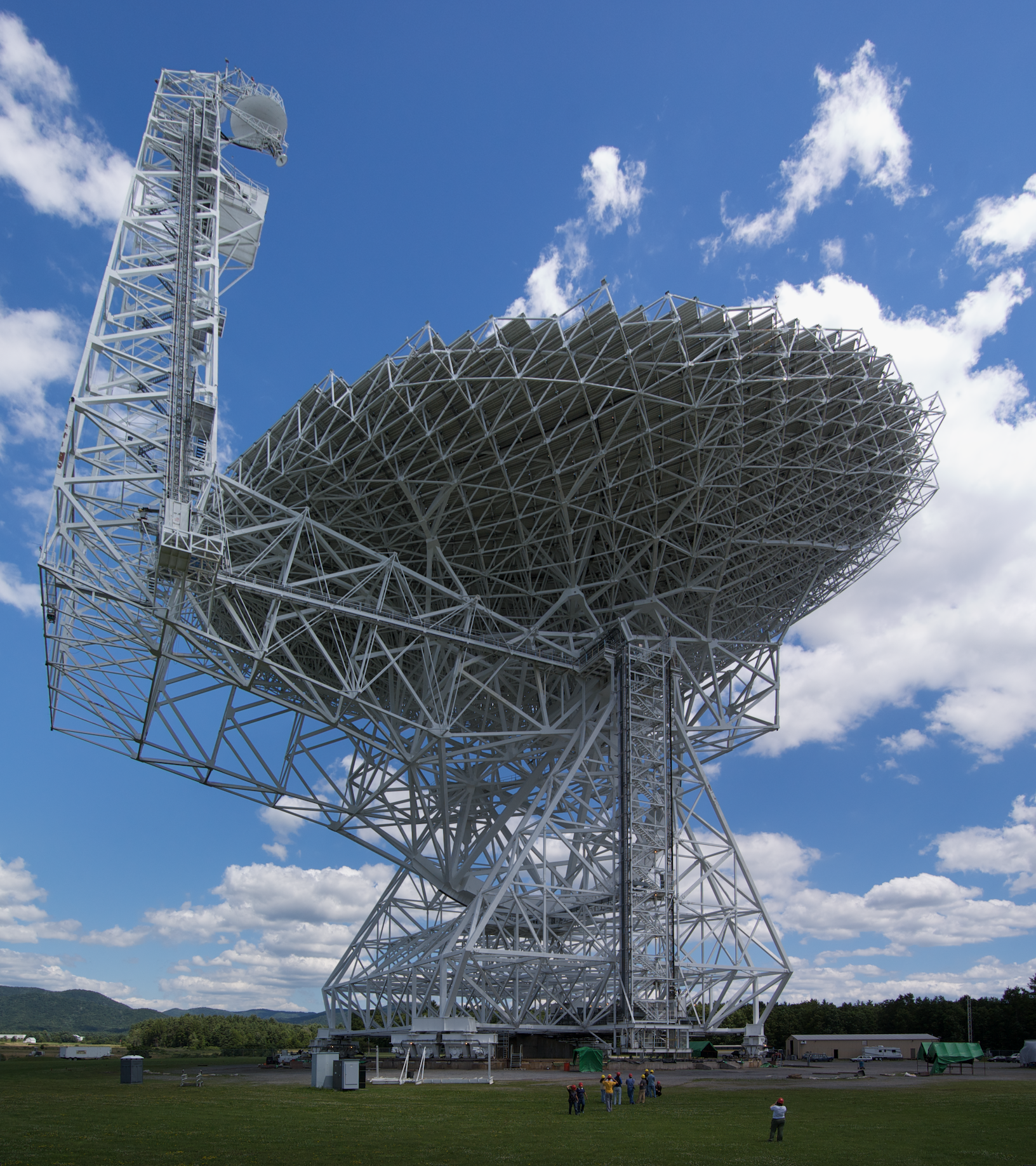
The project aims to discover signs of extraterrestrial civilizations by searching stars and galaxies for radio signals and laser transmissions. The search for radio signals is carried out on the Green Bank Telescope in the Northern Hemisphere and the Parkes Telescope in the Southern Hemisphere. The Green Bank Telescope is the world's largest steerable radio telescope, and the Parkes Telescope is the second-largest steerable radio telescope in the Southern Hemisphere.
Together, the radio telescopes will cover ten times more sky than previous searches and scan the entire 1-to-10 GHz range, the so-called "quiet zone" in the spectrum where radio waves are unobscured by cosmic sources or Earth's atmosphere.
The radio telescopes are sensitive enough to detect "Earth-leakage" levels of radio transmission from stars within 5 parsecs, and can detect a transmitter of the same power as a common aircraft radar from the 1,000 nearest stars. The Green Bank Telescope began operations in January 2016, and the Parkes Telescope from October 2016. The FAST radiotelescope in China also joined forces in October 2016 with the Breakthrough Initiatives to launch a coordinated search, including the rapid sharing of promising new signals for additional observation and analysis.
The search for optical laser transmissions is carried out by the Automated Planet Finder of Lick Observatory. The telescope has the sensitivity to detect a 100 watt laser from a star 25 trillion miles (4.25 light years) away.
Breakthrough Listen was announced to the public on July 20, 2015 (the anniversary of the Apollo 11 Moon landing) by Milner at London's Royal Society. The event was flanked by scientists such as Frank Drake, who is known for the Drake equation that estimates the number of detectable alien civilizations, and Geoff Marcy, an astronomer who has helped find hundreds of exoplanets. The announcement included an open letter co-signed by multiple scientists, including physicist Stephen Hawking, expressing support for an intensified search for alien life. During the public launch, Hawking said:
In an infinite Universe, there must be other life. There is no bigger question. It is time to commit to finding the answer.
Hub AI
Breakthrough Listen AI simulator
(@Breakthrough Listen_simulator)
Breakthrough Listen
Breakthrough Listen is an astronomy project to search for intelligent extraterrestrial communications. With $100 million in funding and thousands of hours of dedicated telescope time on state-of-the-art facilities, it is the most comprehensive search for alien communications to date. The project began in January 2016, and is expected to continue for 10 years. It is a component of Yuri Milner's Breakthrough Initiatives program. The science program for Breakthrough Listen is based at Berkeley SETI Research Center, located in the Astronomy Department at the University of California, Berkeley.
The project uses radio wave observations from the Green Bank Observatory and the Parkes Observatory, and visible light observations from the Automated Planet Finder. Targets for the project include one million nearby stars and the centers of 100 galaxies. All data generated from the project are available to the public, and SETI@Home (BOINC) is used for some of the data analysis. The first results were published in April 2017, with further updates expected every 6 months.
The project aims to discover signs of extraterrestrial civilizations by searching stars and galaxies for radio signals and laser transmissions. The search for radio signals is carried out on the Green Bank Telescope in the Northern Hemisphere and the Parkes Telescope in the Southern Hemisphere. The Green Bank Telescope is the world's largest steerable radio telescope, and the Parkes Telescope is the second-largest steerable radio telescope in the Southern Hemisphere.
Together, the radio telescopes will cover ten times more sky than previous searches and scan the entire 1-to-10 GHz range, the so-called "quiet zone" in the spectrum where radio waves are unobscured by cosmic sources or Earth's atmosphere.
The radio telescopes are sensitive enough to detect "Earth-leakage" levels of radio transmission from stars within 5 parsecs, and can detect a transmitter of the same power as a common aircraft radar from the 1,000 nearest stars. The Green Bank Telescope began operations in January 2016, and the Parkes Telescope from October 2016. The FAST radiotelescope in China also joined forces in October 2016 with the Breakthrough Initiatives to launch a coordinated search, including the rapid sharing of promising new signals for additional observation and analysis.
The search for optical laser transmissions is carried out by the Automated Planet Finder of Lick Observatory. The telescope has the sensitivity to detect a 100 watt laser from a star 25 trillion miles (4.25 light years) away.
Breakthrough Listen was announced to the public on July 20, 2015 (the anniversary of the Apollo 11 Moon landing) by Milner at London's Royal Society. The event was flanked by scientists such as Frank Drake, who is known for the Drake equation that estimates the number of detectable alien civilizations, and Geoff Marcy, an astronomer who has helped find hundreds of exoplanets. The announcement included an open letter co-signed by multiple scientists, including physicist Stephen Hawking, expressing support for an intensified search for alien life. During the public launch, Hawking said:
In an infinite Universe, there must be other life. There is no bigger question. It is time to commit to finding the answer.
Recent media