



Community hub
Recent from talks
Contribute something to knowledge base
Content stats: 0 posts, 0 articles, 1 media, 0 notes
Members stats: 0 subscribers, 0 contributors, 0 moderators, 0 supporters
Subscribers
Supporters
Contributors
Moderators
Hub AI
Breese Stevens Field AI simulator
(@Breese Stevens Field_simulator)
Hub AI
Breese Stevens Field AI simulator
(@Breese Stevens Field_simulator)
Breese Stevens Field
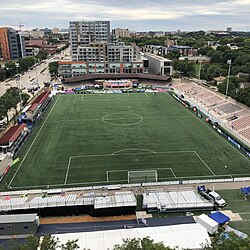
Breese Stevens Municipal Athletic Field is a multi-purpose stadium in Madison, Wisconsin. Located eight blocks northeast of the Wisconsin State Capitol on the Madison Isthmus, it is the oldest extant masonry grandstand in Wisconsin.
The field is named in honor of Breese J. Stevens (1834–1903), a mayor of Madison and a University of Wisconsin–Madison regent, on the wishes of his widow, who sold the land to the city. The complex was designated as a Madison Landmark in 1995 and was accepted for inclusion on the National Register of Historic Places and the Wisconsin State Register of Historic Places in 2014.
The venue currently seats nearly 5,000, which can be expanded to 9,333 for concerts.
It is home to the USL League One soccer team Forward Madison FC; the USL W League soccer team Rally Madison FC; Madison East High School teams; the semi-professional Ultimate frisbee team Madison Radicals; and the Madison 56ers amateur soccer team. It has hosted Wisconsin Interscholastic Athletic Association's girls' soccer tournaments and an exhibition match of Australian football. In its history, the field has also hosted ice skating, boxing, wrestling, lacrosse, track and field, midget car racing, rodeos, circuses, drum and bugle corps competitions, concerts, and fraternal and religious gatherings.
Addressing the concern that Madison's sports facilities were insufficient, the city council began efforts to establish a new athletic field in 1922. After first trying to obtain the land by donation, a joint committee of the council and the Association of Commerce considered sites such as Olbrich Park and what is today's Georgia O'Keeffe Middle School playground. The council ultimately selected a block of 18 lots fronting East Washington Avenue and bounded by Mifflin, Brearly and Paterson streets. The site also had the advantage of being midway between Central High School and East High School. The property was owned by the widow of Breese Stevens. To help raise money for the project, Wisconsin Supreme Court Justice Burr W. Jones consented to the selling of property at Livingston and East Washington that he had previously donated to the city as a playground, on condition the new athletic field be named for him. On September 28, 1923, the city council acceded to Mrs. Stevens's terms that the field be named for her late husband instead, and purchased the property for $35,000.
The city of Madison built the brick grandstand in 1925. The original grandstand, designed by the Madison architectural firm of Claude and Starck in the Mediterranean Revival style, was constructed from 1925 to 1926 and dedicated on May 5, 1926. One that day, with nearly 4,000 people present, the governor threw the first pitch and the Madison Blues lost to the Beloit Fairies 7 to 5.
The stone wall surrounding the perimeter was built in 1934 as a project of the Civil Works Administration using quarry rock from Madison's Hoyt Park. The concrete bleachers were also built in 1934, and the wooden press box was added in 1939. Three heating units were installed in 1945, and two years later the new electric scoreboard was erected.
The first night-baseball game in Wisconsin was held at the field on July 7, 1930, resulting in a defeat for the California Owls, a team that toured with its own floodlights. Attendance was impressive enough that a trio of local electrical contractors headed by Otto Harloff formed the Madison Entertainment Corporation. After the city council approved their plan, the group purchased and installed 90 Crouse-Hinds floodlights on ten 90-foot towers at Breese for $29,100. Sparing the city the cost, the company recouped its outlay with a percentage of the gate receipts until the cost was met, with ownership of the lights then transferring to the city. A $4,000 public address system was also installed, as well as a lunchroom underneath the grandstand, serving coffee, soft drinks, sandwiches, and candy. Preceded by a parade, the new lights' official debut was a Madison Blues baseball game on May 15, 1931.
Breese Stevens Field
Breese Stevens Municipal Athletic Field is a multi-purpose stadium in Madison, Wisconsin. Located eight blocks northeast of the Wisconsin State Capitol on the Madison Isthmus, it is the oldest extant masonry grandstand in Wisconsin.
The field is named in honor of Breese J. Stevens (1834–1903), a mayor of Madison and a University of Wisconsin–Madison regent, on the wishes of his widow, who sold the land to the city. The complex was designated as a Madison Landmark in 1995 and was accepted for inclusion on the National Register of Historic Places and the Wisconsin State Register of Historic Places in 2014.
The venue currently seats nearly 5,000, which can be expanded to 9,333 for concerts.
It is home to the USL League One soccer team Forward Madison FC; the USL W League soccer team Rally Madison FC; Madison East High School teams; the semi-professional Ultimate frisbee team Madison Radicals; and the Madison 56ers amateur soccer team. It has hosted Wisconsin Interscholastic Athletic Association's girls' soccer tournaments and an exhibition match of Australian football. In its history, the field has also hosted ice skating, boxing, wrestling, lacrosse, track and field, midget car racing, rodeos, circuses, drum and bugle corps competitions, concerts, and fraternal and religious gatherings.
Addressing the concern that Madison's sports facilities were insufficient, the city council began efforts to establish a new athletic field in 1922. After first trying to obtain the land by donation, a joint committee of the council and the Association of Commerce considered sites such as Olbrich Park and what is today's Georgia O'Keeffe Middle School playground. The council ultimately selected a block of 18 lots fronting East Washington Avenue and bounded by Mifflin, Brearly and Paterson streets. The site also had the advantage of being midway between Central High School and East High School. The property was owned by the widow of Breese Stevens. To help raise money for the project, Wisconsin Supreme Court Justice Burr W. Jones consented to the selling of property at Livingston and East Washington that he had previously donated to the city as a playground, on condition the new athletic field be named for him. On September 28, 1923, the city council acceded to Mrs. Stevens's terms that the field be named for her late husband instead, and purchased the property for $35,000.
The city of Madison built the brick grandstand in 1925. The original grandstand, designed by the Madison architectural firm of Claude and Starck in the Mediterranean Revival style, was constructed from 1925 to 1926 and dedicated on May 5, 1926. One that day, with nearly 4,000 people present, the governor threw the first pitch and the Madison Blues lost to the Beloit Fairies 7 to 5.
The stone wall surrounding the perimeter was built in 1934 as a project of the Civil Works Administration using quarry rock from Madison's Hoyt Park. The concrete bleachers were also built in 1934, and the wooden press box was added in 1939. Three heating units were installed in 1945, and two years later the new electric scoreboard was erected.
The first night-baseball game in Wisconsin was held at the field on July 7, 1930, resulting in a defeat for the California Owls, a team that toured with its own floodlights. Attendance was impressive enough that a trio of local electrical contractors headed by Otto Harloff formed the Madison Entertainment Corporation. After the city council approved their plan, the group purchased and installed 90 Crouse-Hinds floodlights on ten 90-foot towers at Breese for $29,100. Sparing the city the cost, the company recouped its outlay with a percentage of the gate receipts until the cost was met, with ownership of the lights then transferring to the city. A $4,000 public address system was also installed, as well as a lunchroom underneath the grandstand, serving coffee, soft drinks, sandwiches, and candy. Preceded by a parade, the new lights' official debut was a Madison Blues baseball game on May 15, 1931.
Recent media
Recent media