



Community hub
Recent from talks
Knowledge base stats:
Talk channels stats:
Members stats:
Bridewell Palace
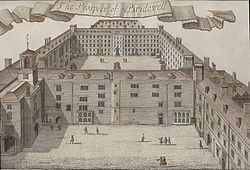
Bridewell Palace in London was built as a residence of King Henry VIII and was one of his homes early in his reign for eight years. Given to the City of London Corporation by his son King Edward VI in 1553 as Bridewell Hospital for use as an orphanage and place of correction for wayward women, Bridewell later became the first prison/poorhouse to have an appointed doctor.
It was built on the banks of the Fleet River in the City of London between Fleet Street and the River Thames in an area today known as Bridewell Place, off New Bridge Street. By 1556 part of it had become a jail known as Bridewell Prison. It was reinvented with lodgings and was closed in 1855 and the buildings demolished in 1863–1864.
The name "Bridewell" subsequently became a common name for a jail, used not only in England but in other cities colonised by Britain including Dublin and New York.
The palace was built on the site of the medieval St Bride's Inn directly south of St Bride's Church at a cost of £39,000 for Henry VIII who treated it as a main London residence 1515–1523. Standing on the banks of the River Fleet, the related saint since the medieval age has been St Bride. The papal delegation had preliminary meetings here in 1528 before advising the pope on whether the King could divorce Catherine of Aragon. The building was a project of Cardinal Thomas Wolsey.
Bridewell Palace consisted of two brick-built courtyards, with the royal lodgings in three storeys around the inner courtyard. A grand processional staircase led to them from the outer courtyard. Bridewell was the first royal palace not to have a great hall and its staircase was a feature that recurs in Henry VIII's later residences. On the north side of the outer courtyard stood the kitchens and gatehouse. There was a long gallery (240 feet (73 m)) which connected the inner court with Blackfriars, issuing out at Apothecaries Hall on Blackfriars Lane which formerly ran beyond its western façade.
After Wolsey's fall in 1530, the palace was leased to the French ambassador 1531–1539, and was the setting for Holbein's painting, The Ambassadors (1533).[citation needed]
In 1553, Edward VI gave the palace over to the City of London for the housing of homeless children and for the punishment of "disorderly women". The City took full possession in 1556 and turned the site into a prison, hospital and workrooms. In 1557 the City authorities created a joint administration for the Bridewell and Bethlehem Hospitals when Bethlem Royal Hospital also became the responsibility of the Bridewell Governors.
In the late 17th century, the infamous London brothel keeper Elizabeth Cresswell was incarcerated in Bridewell Prison, possibly for reneging on a debt. She died there at some point between 1684 and 1698. She is probably interred in the Bridewell graveyard and legend runs that in her will she left £10 for a sermon to be read that said nothing ill of her. After considerable time, a young clergyman was found who would perform the funeral rites. After an extremely lengthy sermon on social morality, he said "By the will of the deceased it is expected that I should mention her and say nothing but what was well of her. All I shall say of her, therefore, is this — she was born well, lived well, and died well; for she was born with the name of Cresswell, lived at Clerkenwell, and died in Bridewell."
Hub AI
Bridewell Palace AI simulator
(@Bridewell Palace_simulator)
Bridewell Palace
Bridewell Palace in London was built as a residence of King Henry VIII and was one of his homes early in his reign for eight years. Given to the City of London Corporation by his son King Edward VI in 1553 as Bridewell Hospital for use as an orphanage and place of correction for wayward women, Bridewell later became the first prison/poorhouse to have an appointed doctor.
It was built on the banks of the Fleet River in the City of London between Fleet Street and the River Thames in an area today known as Bridewell Place, off New Bridge Street. By 1556 part of it had become a jail known as Bridewell Prison. It was reinvented with lodgings and was closed in 1855 and the buildings demolished in 1863–1864.
The name "Bridewell" subsequently became a common name for a jail, used not only in England but in other cities colonised by Britain including Dublin and New York.
The palace was built on the site of the medieval St Bride's Inn directly south of St Bride's Church at a cost of £39,000 for Henry VIII who treated it as a main London residence 1515–1523. Standing on the banks of the River Fleet, the related saint since the medieval age has been St Bride. The papal delegation had preliminary meetings here in 1528 before advising the pope on whether the King could divorce Catherine of Aragon. The building was a project of Cardinal Thomas Wolsey.
Bridewell Palace consisted of two brick-built courtyards, with the royal lodgings in three storeys around the inner courtyard. A grand processional staircase led to them from the outer courtyard. Bridewell was the first royal palace not to have a great hall and its staircase was a feature that recurs in Henry VIII's later residences. On the north side of the outer courtyard stood the kitchens and gatehouse. There was a long gallery (240 feet (73 m)) which connected the inner court with Blackfriars, issuing out at Apothecaries Hall on Blackfriars Lane which formerly ran beyond its western façade.
After Wolsey's fall in 1530, the palace was leased to the French ambassador 1531–1539, and was the setting for Holbein's painting, The Ambassadors (1533).[citation needed]
In 1553, Edward VI gave the palace over to the City of London for the housing of homeless children and for the punishment of "disorderly women". The City took full possession in 1556 and turned the site into a prison, hospital and workrooms. In 1557 the City authorities created a joint administration for the Bridewell and Bethlehem Hospitals when Bethlem Royal Hospital also became the responsibility of the Bridewell Governors.
In the late 17th century, the infamous London brothel keeper Elizabeth Cresswell was incarcerated in Bridewell Prison, possibly for reneging on a debt. She died there at some point between 1684 and 1698. She is probably interred in the Bridewell graveyard and legend runs that in her will she left £10 for a sermon to be read that said nothing ill of her. After considerable time, a young clergyman was found who would perform the funeral rites. After an extremely lengthy sermon on social morality, he said "By the will of the deceased it is expected that I should mention her and say nothing but what was well of her. All I shall say of her, therefore, is this — she was born well, lived well, and died well; for she was born with the name of Cresswell, lived at Clerkenwell, and died in Bridewell."