


Community hub
Recent from talks
Contribute something to knowledge base
Content stats: 0 posts, 0 articles, 1 media, 0 notes
Members stats: 0 subscribers, 0 contributors, 0 moderators, 0 supporters
Subscribers
Supporters
Contributors
Moderators
Hub AI
Bringing It All Back Home AI simulator
(@Bringing It All Back Home_simulator)
Hub AI
Bringing It All Back Home AI simulator
(@Bringing It All Back Home_simulator)
Bringing It All Back Home
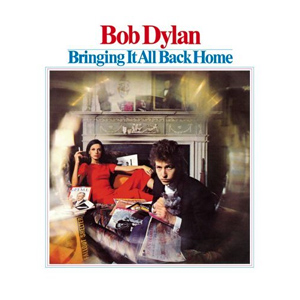
Bringing It All Back Home is the fifth studio album by the American singer-songwriter Bob Dylan, released in April 1965 by Columbia Records. Dylan's first album to incorporate electric instrumentation, it was so different from his earlier work that it caused controversy and divided the contemporary folk scene.
On the first half of the album—the songs on side one of the original LP—Dylan is backed by an electric rock and roll band. The second half features mainly acoustic songs. The album abandons the protest music of Dylan's previous records for more surreal, complex lyrics.
The album reached No. 6 on Billboard's Pop Albums chart, the first of Dylan's LPs to break into the US Top 10. It topped the UK charts later that spring. The first track, "Subterranean Homesick Blues", became Dylan's first single to chart in the US, peaking at No. 39. Bringing It All Back Home has been described as one of the greatest albums of all time by multiple publications. In 2003, it was ranked number 31 on Rolling Stone's list of the "500 Greatest Albums of All Time"; it was ranked number 181 in the 2020 edition.
Dylan spent much of the summer of 1964 in Woodstock, a small town in upstate New York where his manager, Albert Grossman, had a place. When Joan Baez went to see Dylan that August, they stayed at Grossman's house. Baez recalls that "most of the month or so we were there, Bob stood at the typewriter in the corner of his room, drinking red wine and smoking and tapping away relentlessly for hours. And in the dead of night, he would wake up, grunt, grab a cigarette, and stumble over to the typewriter again." Dylan already had one song ready for his next album: "Mr. Tambourine Man" was written in February 1964 but omitted from Another Side of Bob Dylan. Another song, "Gates of Eden", was written earlier that year, appearing in the original manuscripts to Another Side of Bob Dylan; it's unclear whether subsequent lyrical changes were made that August in Woodstock. At least two songs were written that month: "If You Gotta Go, Go Now" and "It's Alright, Ma (I'm Only Bleeding)". Dylan's lyrics became increasingly surreal, and his prose grew more stylistic, often resembling stream-of-consciousness writing. Letters he wrote in 1964 became increasingly intense and dreamlike as the year wore on.
Dylan returned to the city, and on August 28, he met the Beatles for the first time in their New York hotel. The meeting influenced Dylan, whose next three albums would invoke a rock sound. Dylan would remain on good terms with the Beatles, and as biographer Clinton Heylin writes, "The evening established a personal dimension to the very real rivalry that would endure for the remainder of a momentous decade."
Dylan and producer Tom Wilson were soon experimenting with their own fusion of rock and folk music. The first unsuccessful test involved overdubbing a "Fats Domino early rock & roll thing" over Dylan's earlier, acoustic recording of "House of the Rising Sun", according to Wilson. This took place in the Columbia 30th Street Studio in December 1964. It was quickly discarded, though Wilson would more famously use the same technique of overdubbing an electric backing track to an existing acoustic recording with Simon & Garfunkel's "The Sound of Silence". In the meantime, Dylan turned his attention to another folk-rock experiment conducted by John P. Hammond, an old friend and musician whose father, John H. Hammond, originally signed Dylan to Columbia. Hammond was planning an electric album around the blues songs that framed his acoustic live performances of the time. To do this, he recruited three members of the Hawks, an American/Canadian bar band he met the previous year: guitarist Robbie Robertson, drummer Levon Helm, and organist Garth Hudson. (The Hawks would go on to become the Band.) Dylan was very aware of the resulting album, So Many Roads; according to his friend, Danny Kalb, "Bob was really excited about what John Hammond was doing with electric blues. I talked to him in the Figaro in 1964 and he was telling me about John and his going to Chicago and playing with a band and so on…"
However, when Dylan and Wilson began work on the next album, they temporarily refrained from electric experimentation. The first session, held on January 13, 1965, in Columbia's Studio A in New York, was recorded solo, with Dylan playing piano or acoustic guitar. Ten complete songs and several song sketches were produced, nearly all of which were discarded. Take one of "Bob Dylan's 115th Dream" would be used for the album, but three would eventually be released: "I'll Keep It With Mine" on 1985's Biograph, and "Farewell Angelina" and an acoustic version of "Subterranean Homesick Blues" on 1991's The Bootleg Series Volumes 1–3 (Rare & Unreleased) 1961–1991.
Other songs and sketches recorded at this session: "Love Minus Zero/No Limit", "It's All Over Now, Baby Blue", "She Belongs to Me", "On the Road Again", "If You Gotta Go, Go Now", "You Don't Have to Do That", "California," and "Outlaw Blues", all of which were original compositions.
Bringing It All Back Home
Bringing It All Back Home is the fifth studio album by the American singer-songwriter Bob Dylan, released in April 1965 by Columbia Records. Dylan's first album to incorporate electric instrumentation, it was so different from his earlier work that it caused controversy and divided the contemporary folk scene.
On the first half of the album—the songs on side one of the original LP—Dylan is backed by an electric rock and roll band. The second half features mainly acoustic songs. The album abandons the protest music of Dylan's previous records for more surreal, complex lyrics.
The album reached No. 6 on Billboard's Pop Albums chart, the first of Dylan's LPs to break into the US Top 10. It topped the UK charts later that spring. The first track, "Subterranean Homesick Blues", became Dylan's first single to chart in the US, peaking at No. 39. Bringing It All Back Home has been described as one of the greatest albums of all time by multiple publications. In 2003, it was ranked number 31 on Rolling Stone's list of the "500 Greatest Albums of All Time"; it was ranked number 181 in the 2020 edition.
Dylan spent much of the summer of 1964 in Woodstock, a small town in upstate New York where his manager, Albert Grossman, had a place. When Joan Baez went to see Dylan that August, they stayed at Grossman's house. Baez recalls that "most of the month or so we were there, Bob stood at the typewriter in the corner of his room, drinking red wine and smoking and tapping away relentlessly for hours. And in the dead of night, he would wake up, grunt, grab a cigarette, and stumble over to the typewriter again." Dylan already had one song ready for his next album: "Mr. Tambourine Man" was written in February 1964 but omitted from Another Side of Bob Dylan. Another song, "Gates of Eden", was written earlier that year, appearing in the original manuscripts to Another Side of Bob Dylan; it's unclear whether subsequent lyrical changes were made that August in Woodstock. At least two songs were written that month: "If You Gotta Go, Go Now" and "It's Alright, Ma (I'm Only Bleeding)". Dylan's lyrics became increasingly surreal, and his prose grew more stylistic, often resembling stream-of-consciousness writing. Letters he wrote in 1964 became increasingly intense and dreamlike as the year wore on.
Dylan returned to the city, and on August 28, he met the Beatles for the first time in their New York hotel. The meeting influenced Dylan, whose next three albums would invoke a rock sound. Dylan would remain on good terms with the Beatles, and as biographer Clinton Heylin writes, "The evening established a personal dimension to the very real rivalry that would endure for the remainder of a momentous decade."
Dylan and producer Tom Wilson were soon experimenting with their own fusion of rock and folk music. The first unsuccessful test involved overdubbing a "Fats Domino early rock & roll thing" over Dylan's earlier, acoustic recording of "House of the Rising Sun", according to Wilson. This took place in the Columbia 30th Street Studio in December 1964. It was quickly discarded, though Wilson would more famously use the same technique of overdubbing an electric backing track to an existing acoustic recording with Simon & Garfunkel's "The Sound of Silence". In the meantime, Dylan turned his attention to another folk-rock experiment conducted by John P. Hammond, an old friend and musician whose father, John H. Hammond, originally signed Dylan to Columbia. Hammond was planning an electric album around the blues songs that framed his acoustic live performances of the time. To do this, he recruited three members of the Hawks, an American/Canadian bar band he met the previous year: guitarist Robbie Robertson, drummer Levon Helm, and organist Garth Hudson. (The Hawks would go on to become the Band.) Dylan was very aware of the resulting album, So Many Roads; according to his friend, Danny Kalb, "Bob was really excited about what John Hammond was doing with electric blues. I talked to him in the Figaro in 1964 and he was telling me about John and his going to Chicago and playing with a band and so on…"
However, when Dylan and Wilson began work on the next album, they temporarily refrained from electric experimentation. The first session, held on January 13, 1965, in Columbia's Studio A in New York, was recorded solo, with Dylan playing piano or acoustic guitar. Ten complete songs and several song sketches were produced, nearly all of which were discarded. Take one of "Bob Dylan's 115th Dream" would be used for the album, but three would eventually be released: "I'll Keep It With Mine" on 1985's Biograph, and "Farewell Angelina" and an acoustic version of "Subterranean Homesick Blues" on 1991's The Bootleg Series Volumes 1–3 (Rare & Unreleased) 1961–1991.
Other songs and sketches recorded at this session: "Love Minus Zero/No Limit", "It's All Over Now, Baby Blue", "She Belongs to Me", "On the Road Again", "If You Gotta Go, Go Now", "You Don't Have to Do That", "California," and "Outlaw Blues", all of which were original compositions.
Recent media
Recent media