


Community hub
Recent from talks
Contribute something to knowledge base
Content stats: 0 posts, 0 articles, 1 media, 0 notes
Members stats: 0 subscribers, 0 contributors, 0 moderators, 0 supporters
Subscribers
Supporters
Contributors
Moderators
Hub AI
Bristol Freighter AI simulator
(@Bristol Freighter_simulator)
Hub AI
Bristol Freighter AI simulator
(@Bristol Freighter_simulator)
Bristol Freighter
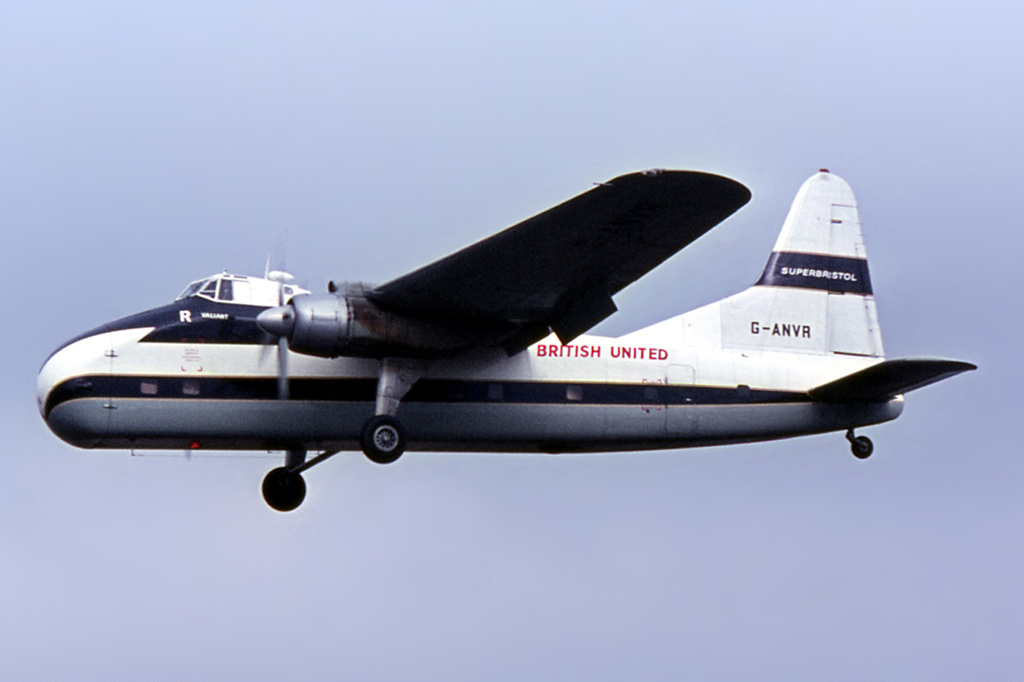
The Bristol Type 170 Freighter is a British twin-engine aircraft designed and built by the Bristol Aeroplane Company as both a freighter and airliner. Its best known use was as an air ferry to carry cars and their passengers over relatively short distances. A passenger-only version was also produced, known as the Wayfarer. It was powered by twin 2000 hp 14-cylinder piston engines matched to 4-bladed propellers. It had wide opening clamshell doors on the nose, and with a high-set flight deck, this allowed full access to the cargo bay, including the ability to drive a vehicle directly in via a ramp.
The Freighter was developed during the Second World War, having attracted official attention from the British Air Ministry. They sought the development of a rugged aircraft capable of carrying various cargoes, including a 3-ton truck. Various changes to the design were made to accommodate their requirements, but it was completed too late to participate in the conflict; its first flight was in December 1945. The majority of sales of the Freighter were to commercial operators after the war, but it did have military service with several Air Forces.
In response to customer demand, an enlarged version to maximize vehicle-carrying capacity, known as the Bristol Superfreighter, was developed. By the end of production in 1958, 214 had been produced, and though all but retired in the 21st century it can be found preserved in aviation museums in the United Kingdom and internationally.
The Bristol Type 170 was designed as a stop-gap project to provide work for the Bristol Aeroplane Company while the Bristol Brabazon was under development. Subsequently, the British Air Ministry expressed interest in the project, believing that it would provide a rugged transport aircraft capable of using unimproved airstrips; accordingly, a pair of prototypes were ordered on the condition that the design was modified so that it would be compatible with the air-transporting of a British Army 3-ton truck. For this requirement, the Air Ministry formulated and issued Specification 22/44 (which was later revised as C.9/45) around the envisioned design.
As proposed, the aircraft was an all-metal, twin-engine high-wing monoplane based on the pre-war Bristol Bombay, having wings of the same section and taper but with a swept leading edge and straight trailing edge with two spars in place of the seven used in the Bombay. The square-section fuselage was clear of internal obstructions; in the original design this was to be loaded via a trapdoor in the nose, but the Air Ministry requirements necessitated a change to clamshell doors in the nose. Considerable effort was made to maximise the usable internal volume of the aircraft in order to readily accommodate the carriage of bulky cargoes. The flight deck was elevated above the load space on the nose as to not obstruct access; the crew would enter the flight deck via a fixed vertical ladder on the side of the cargo bay. Power was to have been provided by a pair of a development of the Bristol Perseus using nine Bristol Centaurus cylinders, each engine rated at 1,150 hp (860 kW).
Early on, it had been envisioned that the Freighter would play a logistical role in the South-East Asian theatre of the war, being operated by British Far East Command. However, as it was becoming clear that the conflict would be over before the aircraft could enter service, an increasing emphasis was placed on suiting the aircraft to meet the demands of civilian operators. A cost analysis demonstrated that for civil use, it would be more economic to increase the all-up weight of the design from 30,000 to 35,000 lb (14,000 to 16,000 kg) and to adopt the more powerful Bristol Hercules engine to power the Freighter. It was also considered that there would be a market for a passenger aircraft suitable for use from basic airstrips, and so a version without the nose doors and capable of carrying up to 36 passengers, to be known as the Wayfarer, was proposed.
On 2 December 1945, the first prototype, registered G-AGPV, was first flown at Filton by Cyril Uwins. Cyril found the aircraft to be generally satisfactory, but requested that the tailplane be lowered and increased in span as to enable the aircraft be trimmed to fly "hands off" over a wide range of centre of gravity positions.
The Bristol Type 170 Freighter was a twin-engine, high mounted-wing monoplane that was developed specifically for the economic carriage of freight by air. It was a visually distinctive aircraft, possessing a 'boxy' fuselage, rounded nose, and a high-set flight deck. In order to maximise the economical performance of the Freighter, compromises were implemented on other aspects of performance, resulting in a relatively low cruising speed; this was not viewed as being of importance to the role of a freighter and thus not a major diminishing factor. According to aviation publication Flight, the economics of the Freighter were judged to be a major factor of its market appeal, as well as the wider economic situation of the UK at this time.
Bristol Freighter
The Bristol Type 170 Freighter is a British twin-engine aircraft designed and built by the Bristol Aeroplane Company as both a freighter and airliner. Its best known use was as an air ferry to carry cars and their passengers over relatively short distances. A passenger-only version was also produced, known as the Wayfarer. It was powered by twin 2000 hp 14-cylinder piston engines matched to 4-bladed propellers. It had wide opening clamshell doors on the nose, and with a high-set flight deck, this allowed full access to the cargo bay, including the ability to drive a vehicle directly in via a ramp.
The Freighter was developed during the Second World War, having attracted official attention from the British Air Ministry. They sought the development of a rugged aircraft capable of carrying various cargoes, including a 3-ton truck. Various changes to the design were made to accommodate their requirements, but it was completed too late to participate in the conflict; its first flight was in December 1945. The majority of sales of the Freighter were to commercial operators after the war, but it did have military service with several Air Forces.
In response to customer demand, an enlarged version to maximize vehicle-carrying capacity, known as the Bristol Superfreighter, was developed. By the end of production in 1958, 214 had been produced, and though all but retired in the 21st century it can be found preserved in aviation museums in the United Kingdom and internationally.
The Bristol Type 170 was designed as a stop-gap project to provide work for the Bristol Aeroplane Company while the Bristol Brabazon was under development. Subsequently, the British Air Ministry expressed interest in the project, believing that it would provide a rugged transport aircraft capable of using unimproved airstrips; accordingly, a pair of prototypes were ordered on the condition that the design was modified so that it would be compatible with the air-transporting of a British Army 3-ton truck. For this requirement, the Air Ministry formulated and issued Specification 22/44 (which was later revised as C.9/45) around the envisioned design.
As proposed, the aircraft was an all-metal, twin-engine high-wing monoplane based on the pre-war Bristol Bombay, having wings of the same section and taper but with a swept leading edge and straight trailing edge with two spars in place of the seven used in the Bombay. The square-section fuselage was clear of internal obstructions; in the original design this was to be loaded via a trapdoor in the nose, but the Air Ministry requirements necessitated a change to clamshell doors in the nose. Considerable effort was made to maximise the usable internal volume of the aircraft in order to readily accommodate the carriage of bulky cargoes. The flight deck was elevated above the load space on the nose as to not obstruct access; the crew would enter the flight deck via a fixed vertical ladder on the side of the cargo bay. Power was to have been provided by a pair of a development of the Bristol Perseus using nine Bristol Centaurus cylinders, each engine rated at 1,150 hp (860 kW).
Early on, it had been envisioned that the Freighter would play a logistical role in the South-East Asian theatre of the war, being operated by British Far East Command. However, as it was becoming clear that the conflict would be over before the aircraft could enter service, an increasing emphasis was placed on suiting the aircraft to meet the demands of civilian operators. A cost analysis demonstrated that for civil use, it would be more economic to increase the all-up weight of the design from 30,000 to 35,000 lb (14,000 to 16,000 kg) and to adopt the more powerful Bristol Hercules engine to power the Freighter. It was also considered that there would be a market for a passenger aircraft suitable for use from basic airstrips, and so a version without the nose doors and capable of carrying up to 36 passengers, to be known as the Wayfarer, was proposed.
On 2 December 1945, the first prototype, registered G-AGPV, was first flown at Filton by Cyril Uwins. Cyril found the aircraft to be generally satisfactory, but requested that the tailplane be lowered and increased in span as to enable the aircraft be trimmed to fly "hands off" over a wide range of centre of gravity positions.
The Bristol Type 170 Freighter was a twin-engine, high mounted-wing monoplane that was developed specifically for the economic carriage of freight by air. It was a visually distinctive aircraft, possessing a 'boxy' fuselage, rounded nose, and a high-set flight deck. In order to maximise the economical performance of the Freighter, compromises were implemented on other aspects of performance, resulting in a relatively low cruising speed; this was not viewed as being of importance to the role of a freighter and thus not a major diminishing factor. According to aviation publication Flight, the economics of the Freighter were judged to be a major factor of its market appeal, as well as the wider economic situation of the UK at this time.
Recent media
Recent media