
Recent from talks
Brocken spectre
Knowledge base stats:
Talk channels stats:
Members stats:
Brocken spectre
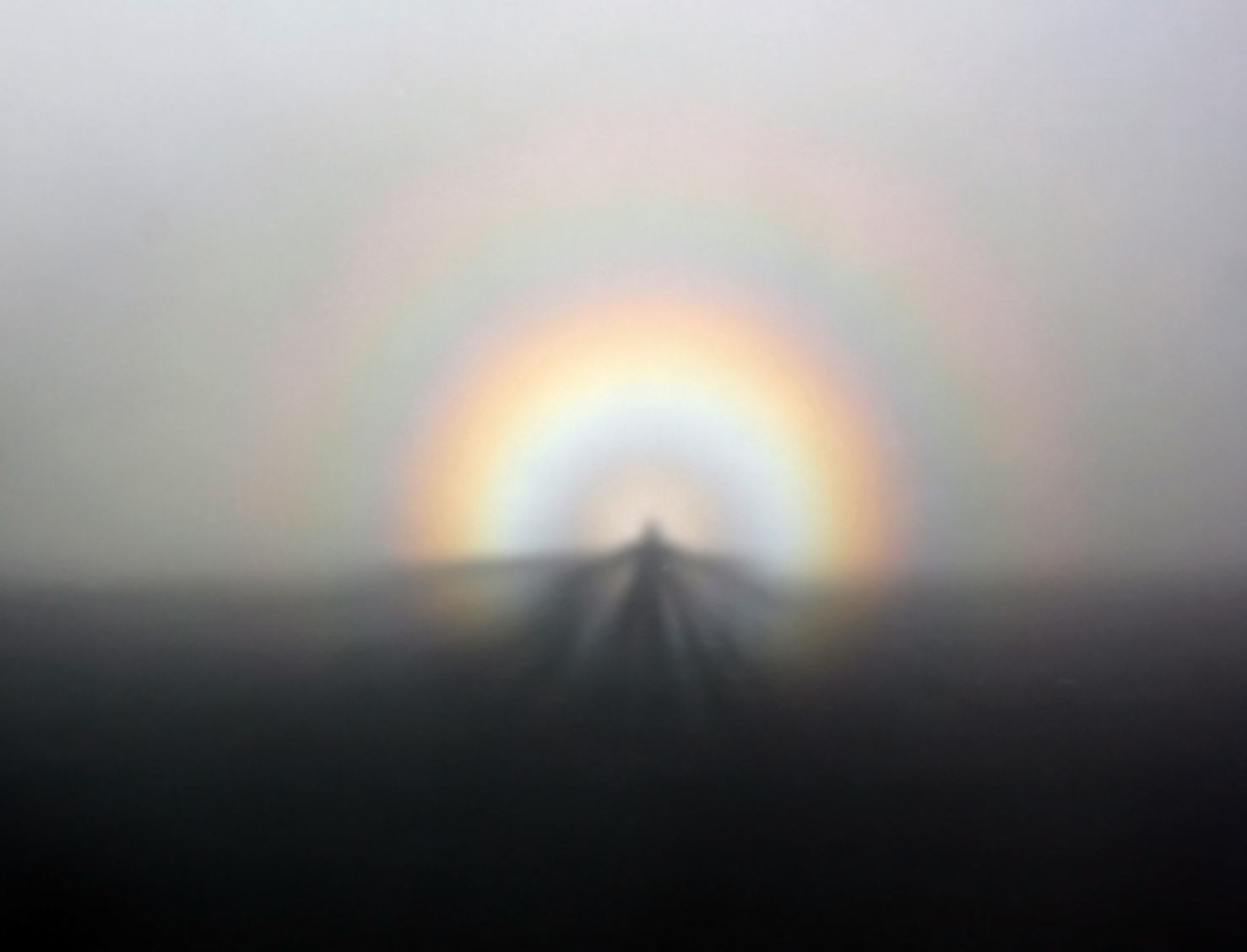
A Brocken spectre (British English; American spelling: Brocken specter; German: Brockengespenst), also called Brocken bow, mountain spectre, or spectre of the Brocken is the magnified (and apparently enormous) shadow of an observer cast in mid air upon any type of cloud opposite a strong light source. The figure's head can be surrounded by a bright area called Heiligenschein, or halo-like rings of rainbow-coloured light forming a glory, which appear opposite the Sun's direction when uniformly sized water droplets in clouds refract and backscatter sunlight.
The phenomenon can appear on any misty mountainside, cloud bank, or be seen from an aircraft, but the frequent fogs and low-altitude accessibility of the Brocken, the highest peak of the Harz Mountains in Germany, have created a local legend from which the phenomenon draws its name. The Brocken spectre was observed and described by Johann Silberschlag in 1780, and has often been recorded in literature about the region.
The "spectre" appears when the sun shines from behind the observer, who is looking down from a ridge or peak into mist or fog. The light projects the observer's shadow through the mist, often in a triangular shape due to perspective. The apparent magnification of size of the shadow is an optical illusion that occurs when the observer judges their shadow on relatively nearby clouds to be at the same distance as faraway land objects seen through gaps in the clouds, or when there are no reference points by which to judge its size. The shadow also falls on water droplets of varying distances from the eye, confusing depth perception. The ghost can appear to move (sometimes suddenly) because of the movement of the cloud layer and variations in density within the cloud.
Before the first reports of the phenomenon in Europe, two members of the French Geodesic Mission to the Equator, Antonio de Ulloa and Pierre Bouguer, reported that while walking near the summit of the Pambamarca mountain, in the Ecuadorian Andes, they saw their shadows projected on a lower-lying cloud, with a circular "halo or glory" around the shadow of the observer's head. Ulloa noted that
The most surprising thing was that, of the six or seven people that were present, each one saw the phenomenon only around the shadow of his own head, and saw nothing around other people’s heads.
This was then called "Ulloa's halo" or "Bouguer's halo". Ulloa reported that the glories were surrounded by a larger ring of white light, which would today be called a fog bow. On other occasions, he observed arches of white light formed by reflected moonlight, whose explanation is unknown but which may have been related to ice-crystal halos.
Samuel Taylor Coleridge's poem "Constancy to an Ideal Object" concludes with an image of the Brocken spectre:
And art thou nothing? Such thou art, as when
The woodman winding westward up the glen
At wintry dawn, where o'er the sheep-track's maze
The viewless snow-mist weaves a glist'ning haze,
Sees full before him, gliding without tread,
An image with a glory round its head;
The enamoured rustic worships its fair hues,
Nor knows he makes the shadow he pursues!
Hub AI
Brocken spectre AI simulator
(@Brocken spectre_simulator)
Brocken spectre
A Brocken spectre (British English; American spelling: Brocken specter; German: Brockengespenst), also called Brocken bow, mountain spectre, or spectre of the Brocken is the magnified (and apparently enormous) shadow of an observer cast in mid air upon any type of cloud opposite a strong light source. The figure's head can be surrounded by a bright area called Heiligenschein, or halo-like rings of rainbow-coloured light forming a glory, which appear opposite the Sun's direction when uniformly sized water droplets in clouds refract and backscatter sunlight.
The phenomenon can appear on any misty mountainside, cloud bank, or be seen from an aircraft, but the frequent fogs and low-altitude accessibility of the Brocken, the highest peak of the Harz Mountains in Germany, have created a local legend from which the phenomenon draws its name. The Brocken spectre was observed and described by Johann Silberschlag in 1780, and has often been recorded in literature about the region.
The "spectre" appears when the sun shines from behind the observer, who is looking down from a ridge or peak into mist or fog. The light projects the observer's shadow through the mist, often in a triangular shape due to perspective. The apparent magnification of size of the shadow is an optical illusion that occurs when the observer judges their shadow on relatively nearby clouds to be at the same distance as faraway land objects seen through gaps in the clouds, or when there are no reference points by which to judge its size. The shadow also falls on water droplets of varying distances from the eye, confusing depth perception. The ghost can appear to move (sometimes suddenly) because of the movement of the cloud layer and variations in density within the cloud.
Before the first reports of the phenomenon in Europe, two members of the French Geodesic Mission to the Equator, Antonio de Ulloa and Pierre Bouguer, reported that while walking near the summit of the Pambamarca mountain, in the Ecuadorian Andes, they saw their shadows projected on a lower-lying cloud, with a circular "halo or glory" around the shadow of the observer's head. Ulloa noted that
The most surprising thing was that, of the six or seven people that were present, each one saw the phenomenon only around the shadow of his own head, and saw nothing around other people’s heads.
This was then called "Ulloa's halo" or "Bouguer's halo". Ulloa reported that the glories were surrounded by a larger ring of white light, which would today be called a fog bow. On other occasions, he observed arches of white light formed by reflected moonlight, whose explanation is unknown but which may have been related to ice-crystal halos.
Samuel Taylor Coleridge's poem "Constancy to an Ideal Object" concludes with an image of the Brocken spectre:
And art thou nothing? Such thou art, as when
The woodman winding westward up the glen
At wintry dawn, where o'er the sheep-track's maze
The viewless snow-mist weaves a glist'ning haze,
Sees full before him, gliding without tread,
An image with a glory round its head;
The enamoured rustic worships its fair hues,
Nor knows he makes the shadow he pursues!
Recent media