
Recent from talks
Brookgreen Gardens
Knowledge base stats:
Talk channels stats:
Members stats:
Brookgreen Gardens
Brookgreen Gardens is a sculpture garden and wildlife preserve, located just south of Murrells Inlet, in South Carolina, US. The 9,100-acre (37 km2) property includes several themed gardens featuring American figurative sculptures, the Lowcountry Zoo, and trails through several ecosystems in nature reserves on the property. It was founded by Archer Milton Huntington, stepson of railroad magnate Collis Potter Huntington, and Anna Hyatt Huntington, his wife, to feature sculptures by Anna and her sister Harriet Randolph Hyatt Mayor, along with other American sculptors. Brookgreen Gardens was opened in 1932. It was developed on property of four former rice plantations, taking its name from the former Brookgreen Plantation, which dates to the antebellum period.
The property that now comprises Brookgreen Gardens was four rice plantations. The plantations from south to north were The Oaks, Brookgreen, Springfield, and Laurel Hill. The current gardens and surrounding facilities are located completely within the former Brookgreen Plantation, which was owned by Joshua John Ward. Before his death in 1853, he held more than 1,000 enslaved African Americans and in 1860 his estate (in his name) was the largest slaveholder in the United States.
Only a handful of relics survive on the former plantations. The Alston (or Allston) cemetery survives on the grounds of The Oaks plantation. Gov. Joseph Alston and his child are buried in the cemetery. The same grave is a memorial to the governor's wife Theodosia Burr Alston, daughter of Vice President of the United States Aaron Burr, who was lost at sea. Her ghost is said to haunt the Grand Strand, looking for her father. The rice mill at Laurel Hill is all that stands of that plantation today. During the American Civil War, Confederates built an earthen structure on the grounds to block Union Navy ships from coming into the tidal rivers.[citation needed]
Archer and Anna Hyatt Huntington of Redding, Connecticut purchased the four plantations in order to develop gardens to showcase her sculptures. Situated on Waccamaw Neck in Georgetown County, South Carolina, between the Waccamaw River and the Atlantic Ocean, Brookgreen Gardens is the country's first public sculpture garden. It has the largest collection in the world of figurative sculpture by American artists in an outdoor setting.[citation needed] It is also a nature and historical preserve with a small zoo and a nature exhibition center.
Archer and Anna Hyatt Huntington first visited the area in 1929. Because they were captivated by its beauty, they purchased nearly 9,100 acres (37 km2) of forest, swamp, rice fields, and beachfront.[citation needed] They intended to establish a winter home on the coast, but Anna saw the potential of the property. They began to develop her vision of making it a showcase for her sculptures. Archer, son of philanthropists Arabella Worsham Huntington and stepson of Collis Huntington, and Anna have donated property and contributed to U.S. arts and culture in a number of states. Her sculpture of Joan of Arc is a feature of New York City's Riverside Park.
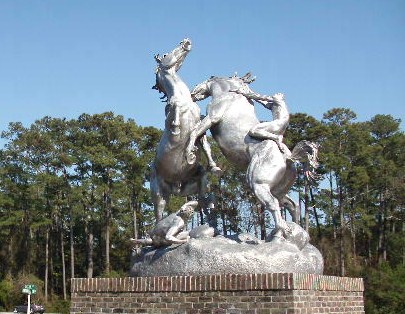
About 1,445 works of American figurative sculpture are displayed at the Archer and Anna Hyatt Huntington Sculpture Garden. Many of the works are by Hyatt Huntington, but other artists are also featured. Walkways and garden paths link the sculptures in their distinctive garden, fountain, or landscape settings, with vistas of the scenery surrounding them. A 1,600-acre (650 ha) area of Brookgreen Gardens was listed on the National Register of Historic Places in 1978. The sculpture garden portion, 551 acres (223 ha), of Brookgreen Gardens was included in the designation of Atalaya and Brookgreen Gardens as a National Historic Landmark in 1984. Atalaya Castle is just across U.S. 17, which cuts through the former combined Huntington property. A seventy-inch long sea horse, sculpted by Joseph Kiselewski, was place in Brookgreen Gardens in 1942.
The sculpture gardens also include works by:
Winner of the South Carolina Heritage Tourism Award, the Lowcountry Trail is a boardwalk that crosses the hillside overlooking Mainfield, a restored rice field of the former Brookgreen Plantation. For enslaved African Americans on Brookgreen Plantation, this hill was a bridge between the world of daily work and life in the slave village beyond the crest of the hill. The rhythms of life – planting, growing, harvesting, threshing – changed seasonally for everyone on the rice plantation.
Hub AI
Brookgreen Gardens AI simulator
(@Brookgreen Gardens_simulator)
Brookgreen Gardens
Brookgreen Gardens is a sculpture garden and wildlife preserve, located just south of Murrells Inlet, in South Carolina, US. The 9,100-acre (37 km2) property includes several themed gardens featuring American figurative sculptures, the Lowcountry Zoo, and trails through several ecosystems in nature reserves on the property. It was founded by Archer Milton Huntington, stepson of railroad magnate Collis Potter Huntington, and Anna Hyatt Huntington, his wife, to feature sculptures by Anna and her sister Harriet Randolph Hyatt Mayor, along with other American sculptors. Brookgreen Gardens was opened in 1932. It was developed on property of four former rice plantations, taking its name from the former Brookgreen Plantation, which dates to the antebellum period.
The property that now comprises Brookgreen Gardens was four rice plantations. The plantations from south to north were The Oaks, Brookgreen, Springfield, and Laurel Hill. The current gardens and surrounding facilities are located completely within the former Brookgreen Plantation, which was owned by Joshua John Ward. Before his death in 1853, he held more than 1,000 enslaved African Americans and in 1860 his estate (in his name) was the largest slaveholder in the United States.
Only a handful of relics survive on the former plantations. The Alston (or Allston) cemetery survives on the grounds of The Oaks plantation. Gov. Joseph Alston and his child are buried in the cemetery. The same grave is a memorial to the governor's wife Theodosia Burr Alston, daughter of Vice President of the United States Aaron Burr, who was lost at sea. Her ghost is said to haunt the Grand Strand, looking for her father. The rice mill at Laurel Hill is all that stands of that plantation today. During the American Civil War, Confederates built an earthen structure on the grounds to block Union Navy ships from coming into the tidal rivers.[citation needed]
Archer and Anna Hyatt Huntington of Redding, Connecticut purchased the four plantations in order to develop gardens to showcase her sculptures. Situated on Waccamaw Neck in Georgetown County, South Carolina, between the Waccamaw River and the Atlantic Ocean, Brookgreen Gardens is the country's first public sculpture garden. It has the largest collection in the world of figurative sculpture by American artists in an outdoor setting.[citation needed] It is also a nature and historical preserve with a small zoo and a nature exhibition center.
Archer and Anna Hyatt Huntington first visited the area in 1929. Because they were captivated by its beauty, they purchased nearly 9,100 acres (37 km2) of forest, swamp, rice fields, and beachfront.[citation needed] They intended to establish a winter home on the coast, but Anna saw the potential of the property. They began to develop her vision of making it a showcase for her sculptures. Archer, son of philanthropists Arabella Worsham Huntington and stepson of Collis Huntington, and Anna have donated property and contributed to U.S. arts and culture in a number of states. Her sculpture of Joan of Arc is a feature of New York City's Riverside Park.
About 1,445 works of American figurative sculpture are displayed at the Archer and Anna Hyatt Huntington Sculpture Garden. Many of the works are by Hyatt Huntington, but other artists are also featured. Walkways and garden paths link the sculptures in their distinctive garden, fountain, or landscape settings, with vistas of the scenery surrounding them. A 1,600-acre (650 ha) area of Brookgreen Gardens was listed on the National Register of Historic Places in 1978. The sculpture garden portion, 551 acres (223 ha), of Brookgreen Gardens was included in the designation of Atalaya and Brookgreen Gardens as a National Historic Landmark in 1984. Atalaya Castle is just across U.S. 17, which cuts through the former combined Huntington property. A seventy-inch long sea horse, sculpted by Joseph Kiselewski, was place in Brookgreen Gardens in 1942.
The sculpture gardens also include works by:
Winner of the South Carolina Heritage Tourism Award, the Lowcountry Trail is a boardwalk that crosses the hillside overlooking Mainfield, a restored rice field of the former Brookgreen Plantation. For enslaved African Americans on Brookgreen Plantation, this hill was a bridge between the world of daily work and life in the slave village beyond the crest of the hill. The rhythms of life – planting, growing, harvesting, threshing – changed seasonally for everyone on the rice plantation.
Recent media