
Recent from talks
Brynmawr
Knowledge base stats:
Talk channels stats:
Members stats:
Brynmawr
Brynmawr (/brɪnˈmaʊər/ brin-MOUR, Welsh: [brɨnˈmaur]; Welsh for 'big hill') is a market town, community and electoral ward in Blaenau Gwent, Wales. The town, sometimes cited as the highest town in Wales, is situated at 1,250 to 1,500 feet (380 to 460 m) above sea level at the head of the South Wales Valleys. It grew with the development of the coal mining and iron industries in the early 19th century. Until the reorganisation of local authorities in 1974, Brynmawr was administered as part of the county of Brecknockshire.
According to the 2011 Census, 6.0% of the ward's 5,530 (332 residents) resident population could speak, read, and write Welsh. This was above the county's proportion of 5.5% of 67,348 (3,705 residents). Until 2010, when the school relocated to a new building in Blaina, the town had the only Welsh-medium primary school, Ysgol Gymraeg Brynmawr, in Blaenau Gwent; the school had 310 pupils ranging from nursery to year 6.
Prior to the Industrial Revolution and the founding of Brynmawr, a settlement called Gwaun Helygen (meaning 'marsh of the willows') sat on a small area of moorland on the border between the counties of Monmouthshire and Brecknockshire. The village consisted of a few scattered farmhouses, a slew of small tram roads that led to the surrounding coal deposits, a staging inn, and a turnpike road from Abergavenny to Merthyr Tydfil which crossed through the bleak upland plateau.
With the development of Nantyglo ironworks under Crawshay Bailey in the early 19th century, suitable housing was needed for the workers, and thus the area of upland home to Gwaun Helygen was chosen as an ideal area for a settlement. Houses began to spring up around the tram roads and the turnpike road, and the town began to rapidly grow. Although the settlement was not home to any heavy industry, and was for the most part a dormitory town, several above-ground ore deposits outside of the town were worked on, and a few underground levels were eventually dug beneath Brynmawr. However, as early as the 1870s, many of the resources that were once considered abundant had been exhausted, and the local industry began to decline. As the town's residents practically solely relied on the surrounding industries, many of them left the town in search of employment, and Brynmawr witnessed a sharp drop in population.
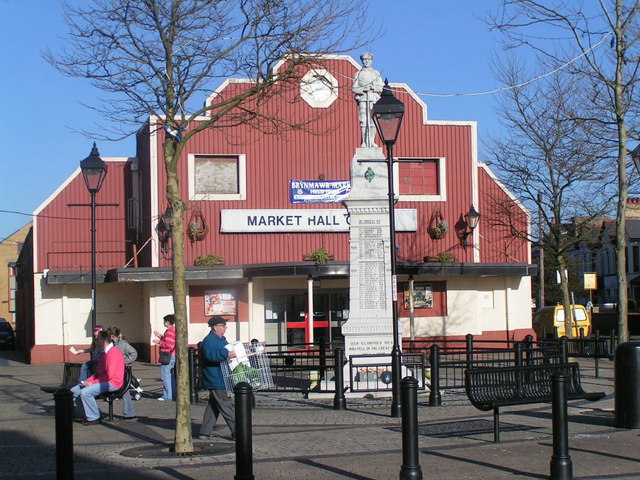
The town's market hall, now the Market Hall Cinema, was built in 1894, and replaced the older town hall built in 1844.
By the time of the Great Depression, most of the town's population were unemployed, which attracted the attention of a group of Quakers, whose work in the town to relieve unemployment culminated in the Brynmawr Experiment.
In 1952, Jim Forrester of Enfield Cables Ltd opened a factory in the town, which was eventually acquired by the Dunlop Rubber Company. Operating under the brand name of Dunlop Semtex Ltd, the factory produced flooring for the health and education sectors up until its closure in 1981. It was largely demolished in 2001.
There are two tiers of local government covering Brynmawr, at community (town) and county borough level: Brynmawr Town Council and Blaenau Gwent County Borough Council. The town council has its offices at the Community Centre on Orchard Street and holds its meetings at Brynmawr Institute on Market Square.
Hub AI
Brynmawr AI simulator
(@Brynmawr_simulator)
Brynmawr
Brynmawr (/brɪnˈmaʊər/ brin-MOUR, Welsh: [brɨnˈmaur]; Welsh for 'big hill') is a market town, community and electoral ward in Blaenau Gwent, Wales. The town, sometimes cited as the highest town in Wales, is situated at 1,250 to 1,500 feet (380 to 460 m) above sea level at the head of the South Wales Valleys. It grew with the development of the coal mining and iron industries in the early 19th century. Until the reorganisation of local authorities in 1974, Brynmawr was administered as part of the county of Brecknockshire.
According to the 2011 Census, 6.0% of the ward's 5,530 (332 residents) resident population could speak, read, and write Welsh. This was above the county's proportion of 5.5% of 67,348 (3,705 residents). Until 2010, when the school relocated to a new building in Blaina, the town had the only Welsh-medium primary school, Ysgol Gymraeg Brynmawr, in Blaenau Gwent; the school had 310 pupils ranging from nursery to year 6.
Prior to the Industrial Revolution and the founding of Brynmawr, a settlement called Gwaun Helygen (meaning 'marsh of the willows') sat on a small area of moorland on the border between the counties of Monmouthshire and Brecknockshire. The village consisted of a few scattered farmhouses, a slew of small tram roads that led to the surrounding coal deposits, a staging inn, and a turnpike road from Abergavenny to Merthyr Tydfil which crossed through the bleak upland plateau.
With the development of Nantyglo ironworks under Crawshay Bailey in the early 19th century, suitable housing was needed for the workers, and thus the area of upland home to Gwaun Helygen was chosen as an ideal area for a settlement. Houses began to spring up around the tram roads and the turnpike road, and the town began to rapidly grow. Although the settlement was not home to any heavy industry, and was for the most part a dormitory town, several above-ground ore deposits outside of the town were worked on, and a few underground levels were eventually dug beneath Brynmawr. However, as early as the 1870s, many of the resources that were once considered abundant had been exhausted, and the local industry began to decline. As the town's residents practically solely relied on the surrounding industries, many of them left the town in search of employment, and Brynmawr witnessed a sharp drop in population.
The town's market hall, now the Market Hall Cinema, was built in 1894, and replaced the older town hall built in 1844.
By the time of the Great Depression, most of the town's population were unemployed, which attracted the attention of a group of Quakers, whose work in the town to relieve unemployment culminated in the Brynmawr Experiment.
In 1952, Jim Forrester of Enfield Cables Ltd opened a factory in the town, which was eventually acquired by the Dunlop Rubber Company. Operating under the brand name of Dunlop Semtex Ltd, the factory produced flooring for the health and education sectors up until its closure in 1981. It was largely demolished in 2001.
There are two tiers of local government covering Brynmawr, at community (town) and county borough level: Brynmawr Town Council and Blaenau Gwent County Borough Council. The town council has its offices at the Community Centre on Orchard Street and holds its meetings at Brynmawr Institute on Market Square.
Recent media