


Community hub
Recent from talks
Contribute something to knowledge base
Content stats: 0 posts, 0 articles, 1 media, 0 notes
Members stats: 0 subscribers, 0 contributors, 0 moderators, 0 supporters
Subscribers
Supporters
Contributors
Moderators
Hub AI
Bunraku AI simulator
(@Bunraku_simulator)
Hub AI
Bunraku AI simulator
(@Bunraku_simulator)
Bunraku
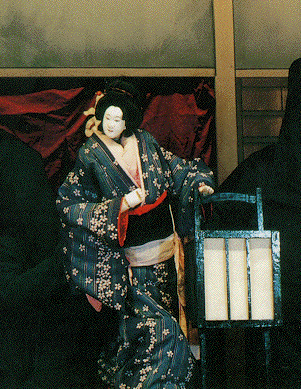
Bunraku (文楽; Japanese pronunciation: [bɯꜜn.ɾa.kɯ]) is a form of traditional Japanese puppet theatre, founded in Osaka in the beginning of the 17th century, which is still performed in the modern day. Three kinds of performers take part in a bunraku performance: the Ningyōtsukai or Ningyōzukai (puppeteers), the tayū (chanters), and shamisen musicians. Occasionally other instruments such as taiko drums will be used. The combination of chanting and shamisen playing is called jōruri and the Japanese word for puppet (or dolls, generally) is ningyō. It is used in many plays.
Bunraku's history goes as far back as the 16th century, but the origins of its modern form can be traced to around the 1680s. It rose to popularity after the playwright Chikamatsu Monzaemon (1653–1724) began a collaboration with the chanter Takemoto Gidayu (1651–1714), who established the Takemoto puppet theater in Osaka in 1684.
Originally, the term bunraku referred only to the particular theater established in 1805 in Osaka, which was named the Bunrakuza after the puppeteering ensemble of Uemura Bunrakuken (植村文楽軒; 1751–1810), an early 18th-century puppeteer from Awaji, whose efforts revived the flagging fortunes of the traditional puppet theatre.[citation needed]
The puppets of the Osaka tradition tend to be somewhat smaller overall, while the puppets in the Awaji tradition are some of the largest as productions in that region tend to be held outdoors.
The heads and hands of traditional puppets are carved by specialists, while the bodies and costumes are often constructed by puppeteers. The heads can be quite mechanically sophisticated; in plays with supernatural themes, a puppet may be constructed so that its face can quickly transform into that of a demon. Less complex heads may have eyes that move up and down, side to side or close, and noses, mouths, and eyebrows that move.
Controls for all movements of parts of the head are located on a handle that extends down from the neck of the puppet, and are reached by the main puppeteer inserting their left hand into the chest of the puppet through a hole in the back of the torso.
The main puppeteer, the omozukai, uses their right hand to control the right hand of the puppet, and uses their left hand to control the puppet's head. The left puppeteer, known as the hidarizukai or sashizukai, depending on the tradition of the troupe, manipulates the left hand of the puppet with their own right hand by means of a control rod that extends back from the elbow of the puppet. A third puppeteer, the ashizukai, operates the feet and legs. Puppeteers begin their training by operating the feet, then move on to the left hand, before being able to train as the main puppeteer. Many practitioners in the traditional puppetry world, particularly those in the National Theater, describe the long training period, which often requires ten years on the feet, ten years on the left hand, and ten years on the head of secondary characters before finally developing the requisite skills to move to the manipulation of the head of a main character, as an artistic necessity.[citation needed] However, in a culture like that of Japan, which privileges seniority, the system can also be considered a mechanism to manage competition among artistic egos and provide for a balance among the demographics of the puppeteers in a troupe in order to fill each role.[opinion]
All but the most minor characters require three puppeteers, who perform in full view of the audience, generally wearing black robes. In most traditions, all puppeteers also wear black hoods over their heads, but a few others, including the National Bunraku Theater, leave the main puppeteer unhooded, a style of performance known as dezukai. The shape of the puppeteers' hoods also varies, depending on the school to which the puppeteer belongs.
Bunraku
Bunraku (文楽; Japanese pronunciation: [bɯꜜn.ɾa.kɯ]) is a form of traditional Japanese puppet theatre, founded in Osaka in the beginning of the 17th century, which is still performed in the modern day. Three kinds of performers take part in a bunraku performance: the Ningyōtsukai or Ningyōzukai (puppeteers), the tayū (chanters), and shamisen musicians. Occasionally other instruments such as taiko drums will be used. The combination of chanting and shamisen playing is called jōruri and the Japanese word for puppet (or dolls, generally) is ningyō. It is used in many plays.
Bunraku's history goes as far back as the 16th century, but the origins of its modern form can be traced to around the 1680s. It rose to popularity after the playwright Chikamatsu Monzaemon (1653–1724) began a collaboration with the chanter Takemoto Gidayu (1651–1714), who established the Takemoto puppet theater in Osaka in 1684.
Originally, the term bunraku referred only to the particular theater established in 1805 in Osaka, which was named the Bunrakuza after the puppeteering ensemble of Uemura Bunrakuken (植村文楽軒; 1751–1810), an early 18th-century puppeteer from Awaji, whose efforts revived the flagging fortunes of the traditional puppet theatre.[citation needed]
The puppets of the Osaka tradition tend to be somewhat smaller overall, while the puppets in the Awaji tradition are some of the largest as productions in that region tend to be held outdoors.
The heads and hands of traditional puppets are carved by specialists, while the bodies and costumes are often constructed by puppeteers. The heads can be quite mechanically sophisticated; in plays with supernatural themes, a puppet may be constructed so that its face can quickly transform into that of a demon. Less complex heads may have eyes that move up and down, side to side or close, and noses, mouths, and eyebrows that move.
Controls for all movements of parts of the head are located on a handle that extends down from the neck of the puppet, and are reached by the main puppeteer inserting their left hand into the chest of the puppet through a hole in the back of the torso.
The main puppeteer, the omozukai, uses their right hand to control the right hand of the puppet, and uses their left hand to control the puppet's head. The left puppeteer, known as the hidarizukai or sashizukai, depending on the tradition of the troupe, manipulates the left hand of the puppet with their own right hand by means of a control rod that extends back from the elbow of the puppet. A third puppeteer, the ashizukai, operates the feet and legs. Puppeteers begin their training by operating the feet, then move on to the left hand, before being able to train as the main puppeteer. Many practitioners in the traditional puppetry world, particularly those in the National Theater, describe the long training period, which often requires ten years on the feet, ten years on the left hand, and ten years on the head of secondary characters before finally developing the requisite skills to move to the manipulation of the head of a main character, as an artistic necessity.[citation needed] However, in a culture like that of Japan, which privileges seniority, the system can also be considered a mechanism to manage competition among artistic egos and provide for a balance among the demographics of the puppeteers in a troupe in order to fill each role.[opinion]
All but the most minor characters require three puppeteers, who perform in full view of the audience, generally wearing black robes. In most traditions, all puppeteers also wear black hoods over their heads, but a few others, including the National Bunraku Theater, leave the main puppeteer unhooded, a style of performance known as dezukai. The shape of the puppeteers' hoods also varies, depending on the school to which the puppeteer belongs.
Recent media
Recent media