
Recent from talks
Burmilla
Knowledge base stats:
Talk channels stats:
Members stats:
Burmilla
The Burmilla (a portmanteau of Burm-ese and Chinch-illa ) is a breed of domestic cat, that originated in the United Kingdom in 1981. It is a cross between the Chinchilla Persian and Burmese cats. In certain cat registries the breed falls under the Asian group, and is sometimes referred to as the Asian Shaded. Standards were produced in 1984, and the breed gained championship status in the United Kingdom in the 1990s.
The Burmilla was accidentally born in the cattery of Miranda von Kirchberg in the United Kingdom. Two cats, a chinchilla Persian kitten, called Jamari Sanquist, and a lilac Burmese, called Bambino Lilac Fabergé, were both awaiting a partner in different rooms. One night, the cleaner left the door open. The two cats mated, producing four kittens born in 1981; also birthing a new breed.
In GCCF (Governing Council of the Cat Fancy), the Burmilla is considered part of the Asian group. It is accepted in FIFe as the Burmilla. Only the silver shaded and tipped varieties have been recognised in GCCF, FIFe, CCCA, ACF and CFA. As of late 2011, additionally golden shaded and tipped Burmillas are recognised within FIFe. The ACF also recognises golden shaded and tipped.
One governing body in Australia (Australian National Cats Inc., ANCATS) uses the name Australian Tiffanie; however, international acceptance and standardisation did not follow. It is different from the European Tiffanie and the North-American Chantilly-Tiffany. The Tiffanie from the UK is also originating from crossbreeding chinchilla Persian and Burmese cats similar to the Burmilla, and is the semi-longhaired variety in the Asian Group. However, Australian Tiffanies are essentially longhair Burmillas, as they only come in silver or golden tipped or shaded. The breed is separately developed in the late-1990s in Australia from European Tiffanie cats by breeding them back to the chinchilla Persian. Therefore, many Australian Tiffanies contain more than three-quarters chinchilla Persian and retain the appearance and temperament of the Old-Fashioned chinchilla Persian. To summarise, the Australian Tiffanie and Tiffanie from the UK both are developed from crossbreeding chinchilla Persians and Burmeses, but the Australian version contains more chinchilla Persian. Consequently, only silver and golden tipped and shaded is allowed in the Australian Tiffanie. The name's use is declining in favour, due to the lax standards for the breed name, the lack of unique identity and the varied genetic makeup.
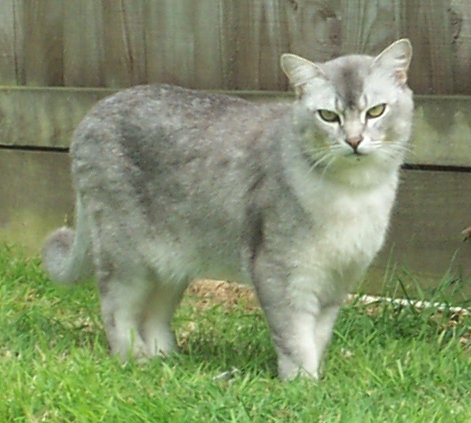
Burmillas are medium-sized with muscular, elegant bodies, tending to weigh between 3–6 kg. Their distinguishing feature is their sparkling silver coat, and distinctive "make up" lining the nose, lips and eyes.
Gently rounded top of head; medium width between ears; wide at eyebrow level and jaw hinge, tapering to a short, blunt wedge. The profile shows a gentle nose break. Tip of nose and chin should be in line. Chin is firm, with good depth.
Medium to large, broad at base with slightly rounded tips. Ear set with slight forward tilt in profile. Eye shape is large; placed well apart at slight oblique setting; slightly curved upper; line angled toward the nose, with a fuller curved lower line. Eye colour luminous, any shade of green. Some allowance can be made for a gold or yellow tinge in kittens and young adults.
The Burmilla comes in two coat lengths, semi-longhair and shorthair. Semi-longhair Burmilla are known as the Tiffanie in GCCF. The most common (standard) coat is the shorthair. This is a short, close-lying coat, similar in appearance to the Burmese, but with a slightly padded feel. Due to the undercoat, it has a soft, silky feel. The recessive longhair gene inherited from the Chinchilla Persian can produce longhair Burmilla. These cats have a semi-longhair coat following the lines of the body, with a soft, silky feel and a large plumed tail. The shorthair gene is dominant and where a cat receives one of each, shorthair dominates. Two longhair Burmillas mated together produce longhair kittens, while shorthair matings depend on whether the longhair genes are carried by the shorthair parents.
Hub AI
Burmilla AI simulator
(@Burmilla_simulator)
Burmilla
The Burmilla (a portmanteau of Burm-ese and Chinch-illa ) is a breed of domestic cat, that originated in the United Kingdom in 1981. It is a cross between the Chinchilla Persian and Burmese cats. In certain cat registries the breed falls under the Asian group, and is sometimes referred to as the Asian Shaded. Standards were produced in 1984, and the breed gained championship status in the United Kingdom in the 1990s.
The Burmilla was accidentally born in the cattery of Miranda von Kirchberg in the United Kingdom. Two cats, a chinchilla Persian kitten, called Jamari Sanquist, and a lilac Burmese, called Bambino Lilac Fabergé, were both awaiting a partner in different rooms. One night, the cleaner left the door open. The two cats mated, producing four kittens born in 1981; also birthing a new breed.
In GCCF (Governing Council of the Cat Fancy), the Burmilla is considered part of the Asian group. It is accepted in FIFe as the Burmilla. Only the silver shaded and tipped varieties have been recognised in GCCF, FIFe, CCCA, ACF and CFA. As of late 2011, additionally golden shaded and tipped Burmillas are recognised within FIFe. The ACF also recognises golden shaded and tipped.
One governing body in Australia (Australian National Cats Inc., ANCATS) uses the name Australian Tiffanie; however, international acceptance and standardisation did not follow. It is different from the European Tiffanie and the North-American Chantilly-Tiffany. The Tiffanie from the UK is also originating from crossbreeding chinchilla Persian and Burmese cats similar to the Burmilla, and is the semi-longhaired variety in the Asian Group. However, Australian Tiffanies are essentially longhair Burmillas, as they only come in silver or golden tipped or shaded. The breed is separately developed in the late-1990s in Australia from European Tiffanie cats by breeding them back to the chinchilla Persian. Therefore, many Australian Tiffanies contain more than three-quarters chinchilla Persian and retain the appearance and temperament of the Old-Fashioned chinchilla Persian. To summarise, the Australian Tiffanie and Tiffanie from the UK both are developed from crossbreeding chinchilla Persians and Burmeses, but the Australian version contains more chinchilla Persian. Consequently, only silver and golden tipped and shaded is allowed in the Australian Tiffanie. The name's use is declining in favour, due to the lax standards for the breed name, the lack of unique identity and the varied genetic makeup.
Burmillas are medium-sized with muscular, elegant bodies, tending to weigh between 3–6 kg. Their distinguishing feature is their sparkling silver coat, and distinctive "make up" lining the nose, lips and eyes.
Gently rounded top of head; medium width between ears; wide at eyebrow level and jaw hinge, tapering to a short, blunt wedge. The profile shows a gentle nose break. Tip of nose and chin should be in line. Chin is firm, with good depth.
Medium to large, broad at base with slightly rounded tips. Ear set with slight forward tilt in profile. Eye shape is large; placed well apart at slight oblique setting; slightly curved upper; line angled toward the nose, with a fuller curved lower line. Eye colour luminous, any shade of green. Some allowance can be made for a gold or yellow tinge in kittens and young adults.
The Burmilla comes in two coat lengths, semi-longhair and shorthair. Semi-longhair Burmilla are known as the Tiffanie in GCCF. The most common (standard) coat is the shorthair. This is a short, close-lying coat, similar in appearance to the Burmese, but with a slightly padded feel. Due to the undercoat, it has a soft, silky feel. The recessive longhair gene inherited from the Chinchilla Persian can produce longhair Burmilla. These cats have a semi-longhair coat following the lines of the body, with a soft, silky feel and a large plumed tail. The shorthair gene is dominant and where a cat receives one of each, shorthair dominates. Two longhair Burmillas mated together produce longhair kittens, while shorthair matings depend on whether the longhair genes are carried by the shorthair parents.
Recent media