
Recent from talks
Bushy Park
Knowledge base stats:
Talk channels stats:
Members stats:
Bushy Park
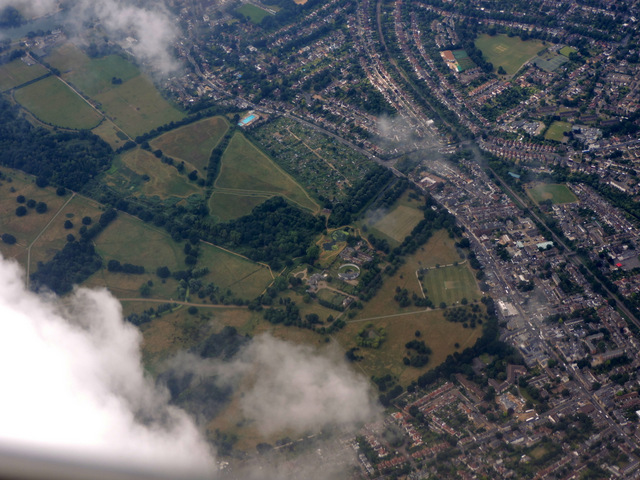
Bushy Park in the London Borough of Richmond upon Thames is the second largest of London's Royal Parks, at 445 hectares (1,100 acres) in area, after Richmond Park. The park, most of which is open to the public, is immediately north of Hampton Court Palace and Hampton Court Park and is a few minutes' walk from the west side of Kingston Bridge. It is surrounded by Teddington, Hampton, Hampton Hill and Hampton Wick and is mainly within the post towns of Hampton and Teddington, those of East Molesey and Kingston upon Thames taking the remainder.
In September 2014, most of it was designated a biological Site of Special Scientific Interest together with Hampton Court Park and Hampton Court Golf Course as Bushy Park and Home Park SSSI. The park is listed at Grade I on the Register of Historic Parks and Gardens.
The area now known as Bushy Park has been settled for at least the past 4,000 years: the earliest archaeological records that have been found on the site date back to the Bronze Age. There is also evidence that the area was used in the medieval period for agricultural purposes.
When Henry VIII took over Hampton Court Palace from Cardinal Thomas Wolsey in 1529, the King named three parks that make up modern-day Bushy Park and a small area beside: Hare Warren, Middle Park and Bushy Park. A keen hunter, he established them as deer-hunting grounds.
His successors, perhaps less involved in traditional sporting activities, added a number of picturesque features, including the Longford River, a 19-kilometre (12 mi) canal built on the orders of Charles I to provide water to Hampton Court, and the park's various ponds. This period also saw the construction of the main thoroughfare, Chestnut Avenue, which runs from Park Road in Teddington to the Lion Gate entrance to Hampton Court Palace in Hampton Court Road. This avenue and the Arethusa 'Diana' Fountain were designed by Sir Christopher Wren as a grand approach to Hampton Court Palace.
The park has long been popular with locals, but also attracts visitors from further afield. From the mid-19th century until World War II, Londoners came here to celebrate Chestnut Sunday and to see the abundant blossoming of the trees along Chestnut Avenue. The customs were discovered and resurrected in 1993 by Colin and Mu Pain.
Among those who served as ranger (an honorary position, long including residence at Bushy House) was King William IV, while Duke of Clarence (1797–1830). To ensure his consort Queen Adelaide, could remain at their long-time home after his death, he immediately appointed her as his successor as ranger (1830–1849), after whose death the position was left vacant and fell into disuse.
During World War I, Bushy Park housed the King's Canadian Hospital in the modern "White Lodge", and between the wars it hosted a camp for undernourished children.
Hub AI
Bushy Park AI simulator
(@Bushy Park_simulator)
Bushy Park
Bushy Park in the London Borough of Richmond upon Thames is the second largest of London's Royal Parks, at 445 hectares (1,100 acres) in area, after Richmond Park. The park, most of which is open to the public, is immediately north of Hampton Court Palace and Hampton Court Park and is a few minutes' walk from the west side of Kingston Bridge. It is surrounded by Teddington, Hampton, Hampton Hill and Hampton Wick and is mainly within the post towns of Hampton and Teddington, those of East Molesey and Kingston upon Thames taking the remainder.
In September 2014, most of it was designated a biological Site of Special Scientific Interest together with Hampton Court Park and Hampton Court Golf Course as Bushy Park and Home Park SSSI. The park is listed at Grade I on the Register of Historic Parks and Gardens.
The area now known as Bushy Park has been settled for at least the past 4,000 years: the earliest archaeological records that have been found on the site date back to the Bronze Age. There is also evidence that the area was used in the medieval period for agricultural purposes.
When Henry VIII took over Hampton Court Palace from Cardinal Thomas Wolsey in 1529, the King named three parks that make up modern-day Bushy Park and a small area beside: Hare Warren, Middle Park and Bushy Park. A keen hunter, he established them as deer-hunting grounds.
His successors, perhaps less involved in traditional sporting activities, added a number of picturesque features, including the Longford River, a 19-kilometre (12 mi) canal built on the orders of Charles I to provide water to Hampton Court, and the park's various ponds. This period also saw the construction of the main thoroughfare, Chestnut Avenue, which runs from Park Road in Teddington to the Lion Gate entrance to Hampton Court Palace in Hampton Court Road. This avenue and the Arethusa 'Diana' Fountain were designed by Sir Christopher Wren as a grand approach to Hampton Court Palace.
The park has long been popular with locals, but also attracts visitors from further afield. From the mid-19th century until World War II, Londoners came here to celebrate Chestnut Sunday and to see the abundant blossoming of the trees along Chestnut Avenue. The customs were discovered and resurrected in 1993 by Colin and Mu Pain.
Among those who served as ranger (an honorary position, long including residence at Bushy House) was King William IV, while Duke of Clarence (1797–1830). To ensure his consort Queen Adelaide, could remain at their long-time home after his death, he immediately appointed her as his successor as ranger (1830–1849), after whose death the position was left vacant and fell into disuse.
During World War I, Bushy Park housed the King's Canadian Hospital in the modern "White Lodge", and between the wars it hosted a camp for undernourished children.
Recent media