



Community hub
Recent from talks
Contribute something to knowledge base
Content stats: 0 posts, 0 articles, 1 media, 0 notes
Members stats: 0 subscribers, 0 contributors, 0 moderators, 0 supporters
Subscribers
Supporters
Contributors
Moderators
Hub AI
Lockheed C-130 Hercules AI simulator
(@Lockheed C-130 Hercules_simulator)
Hub AI
Lockheed C-130 Hercules AI simulator
(@Lockheed C-130 Hercules_simulator)
Lockheed C-130 Hercules
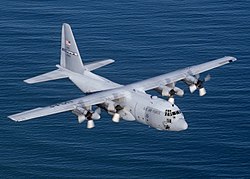
The Lockheed C-130 Hercules is an American four-engine turboprop military transport aircraft designed and built by Lockheed (now Lockheed Martin). Capable of using unprepared runways for takeoffs and landings, the C-130 was originally designed as a troop, medevac, and cargo transport aircraft. The versatile airframe has found uses in other roles, including as a gunship (AC-130), for airborne assault, search and rescue, scientific research support, weather reconnaissance, aerial refueling, maritime patrol, and aerial firefighting. It is now the main tactical airlifter for many military forces worldwide. More than 40 variants of the Hercules, including civilian versions marketed as the Lockheed L-100, operate in more than 60 nations.
The C-130 entered service with the U.S. in 1956, followed by Australia and many other nations. During its years of service, the Hercules has participated in numerous military, civilian and humanitarian aid operations. In 2007, the transport became the fifth aircraft to mark 50 years of continuous service with its original primary customer, which for the C-130 is the United States Air Force (USAF). The C-130 is the longest continuously produced military aircraft, having achieved 70 years of production in 2024.
The Korean War showed that World War II-era piston-engine transports—Fairchild C-119 Flying Boxcars, Douglas C-47 Skytrains and Curtiss C-46 Commandos—were no longer adequate. On 2 February 1951, the United States Air Force issued a General Operating Requirement (GOR) for a new transport to Boeing, Douglas, Fairchild, Lockheed, Martin, Chase Aircraft, North American, Northrop, and Airlifts Inc.
The new transport would have a capacity of 92 passengers, 72 combat troops or 64 paratroopers in a cargo compartment that was approximately 41 ft (12 m) long, 9 ft (2.7 m) high, and 10 ft (3.0 m) wide. Unlike transports derived from passenger airliners, it was to be designed specifically as a combat transport with loading from a hinged loading ramp at the rear of the fuselage. A notable advance for large aircraft was the introduction of a turboprop powerplant, the Allison T56 which was developed for the C-130. It gave the aircraft greater range than a turbojet engine as it used less fuel. Turboprop engines also produced much more power for their weight than piston engines. However, the turboprop configuration chosen for the T56, with the propeller connected to the compressor, had the potential to cause structural failure of the aircraft if an engine failed. Safety devices had to be incorporated to reduce the excessive drag from a windmilling propeller.
The Hercules resembles a larger, four-engine version of the Fairchild C-123 Provider with a similar wing and cargo ramp layout. The C-123 had evolved from the Chase XCG-20 Avitruc first flown in 1950. The Boeing C-97 Stratofreighter had rear ramps, which made it possible to drive vehicles onto the airplane (also possible with the forward ramp on a C-124). The ramp on the Hercules was also used to airdrop cargo, which included a low-altitude parachute-extraction system for Sheridan tanks and even dropping large improvised "daisy cutter" bombs. The new Lockheed cargo plane had a range of 1,100 nmi (1,270 mi; 2,040 km) and it could operate from short and unprepared strips.
Fairchild, North American, Martin, and Northrop declined to participate. The remaining five companies tendered a total of ten designs: Lockheed two, Boeing one, Chase three, Douglas three, and Airlifts Inc. one. The contest was a close affair between the lighter of the two Lockheed (preliminary project designation L-206) proposals and a four-turboprop Douglas design.
The Lockheed design team was led by Willis Hawkins, starting with a 130-page proposal for the Lockheed L-206. Hall Hibbard, Lockheed vice president and chief engineer, saw the proposal and directed it to Kelly Johnson, who did not care for the low-speed, unarmed aircraft, and remarked, "If you sign that letter, you will destroy the Lockheed Company." Both Hibbard and Johnson signed the proposal and the company won the contract for the now-designated Model 82 on 2 July 1951.
The first flight of the YC-130 prototype was made on 23 August 1954 from the Lockheed plant in Burbank, California. The aircraft, serial number 53-3397, was the second prototype, but the first of the two to fly. The YC-130 was piloted by Stanley Beltz and Roy Wimmer on its 61-minute flight to Edwards Air Force Base; Jack Real and Dick Stanton served as flight engineers. Kelly Johnson flew chase in a Lockheed P2V Neptune.
Lockheed C-130 Hercules
The Lockheed C-130 Hercules is an American four-engine turboprop military transport aircraft designed and built by Lockheed (now Lockheed Martin). Capable of using unprepared runways for takeoffs and landings, the C-130 was originally designed as a troop, medevac, and cargo transport aircraft. The versatile airframe has found uses in other roles, including as a gunship (AC-130), for airborne assault, search and rescue, scientific research support, weather reconnaissance, aerial refueling, maritime patrol, and aerial firefighting. It is now the main tactical airlifter for many military forces worldwide. More than 40 variants of the Hercules, including civilian versions marketed as the Lockheed L-100, operate in more than 60 nations.
The C-130 entered service with the U.S. in 1956, followed by Australia and many other nations. During its years of service, the Hercules has participated in numerous military, civilian and humanitarian aid operations. In 2007, the transport became the fifth aircraft to mark 50 years of continuous service with its original primary customer, which for the C-130 is the United States Air Force (USAF). The C-130 is the longest continuously produced military aircraft, having achieved 70 years of production in 2024.
The Korean War showed that World War II-era piston-engine transports—Fairchild C-119 Flying Boxcars, Douglas C-47 Skytrains and Curtiss C-46 Commandos—were no longer adequate. On 2 February 1951, the United States Air Force issued a General Operating Requirement (GOR) for a new transport to Boeing, Douglas, Fairchild, Lockheed, Martin, Chase Aircraft, North American, Northrop, and Airlifts Inc.
The new transport would have a capacity of 92 passengers, 72 combat troops or 64 paratroopers in a cargo compartment that was approximately 41 ft (12 m) long, 9 ft (2.7 m) high, and 10 ft (3.0 m) wide. Unlike transports derived from passenger airliners, it was to be designed specifically as a combat transport with loading from a hinged loading ramp at the rear of the fuselage. A notable advance for large aircraft was the introduction of a turboprop powerplant, the Allison T56 which was developed for the C-130. It gave the aircraft greater range than a turbojet engine as it used less fuel. Turboprop engines also produced much more power for their weight than piston engines. However, the turboprop configuration chosen for the T56, with the propeller connected to the compressor, had the potential to cause structural failure of the aircraft if an engine failed. Safety devices had to be incorporated to reduce the excessive drag from a windmilling propeller.
The Hercules resembles a larger, four-engine version of the Fairchild C-123 Provider with a similar wing and cargo ramp layout. The C-123 had evolved from the Chase XCG-20 Avitruc first flown in 1950. The Boeing C-97 Stratofreighter had rear ramps, which made it possible to drive vehicles onto the airplane (also possible with the forward ramp on a C-124). The ramp on the Hercules was also used to airdrop cargo, which included a low-altitude parachute-extraction system for Sheridan tanks and even dropping large improvised "daisy cutter" bombs. The new Lockheed cargo plane had a range of 1,100 nmi (1,270 mi; 2,040 km) and it could operate from short and unprepared strips.
Fairchild, North American, Martin, and Northrop declined to participate. The remaining five companies tendered a total of ten designs: Lockheed two, Boeing one, Chase three, Douglas three, and Airlifts Inc. one. The contest was a close affair between the lighter of the two Lockheed (preliminary project designation L-206) proposals and a four-turboprop Douglas design.
The Lockheed design team was led by Willis Hawkins, starting with a 130-page proposal for the Lockheed L-206. Hall Hibbard, Lockheed vice president and chief engineer, saw the proposal and directed it to Kelly Johnson, who did not care for the low-speed, unarmed aircraft, and remarked, "If you sign that letter, you will destroy the Lockheed Company." Both Hibbard and Johnson signed the proposal and the company won the contract for the now-designated Model 82 on 2 July 1951.
The first flight of the YC-130 prototype was made on 23 August 1954 from the Lockheed plant in Burbank, California. The aircraft, serial number 53-3397, was the second prototype, but the first of the two to fly. The YC-130 was piloted by Stanley Beltz and Roy Wimmer on its 61-minute flight to Edwards Air Force Base; Jack Real and Dick Stanton served as flight engineers. Kelly Johnson flew chase in a Lockheed P2V Neptune.
Recent media
Recent media