



Community hub
Recent from talks
Knowledge base stats:
Talk channels stats:
Members stats:
Changhe Z-10
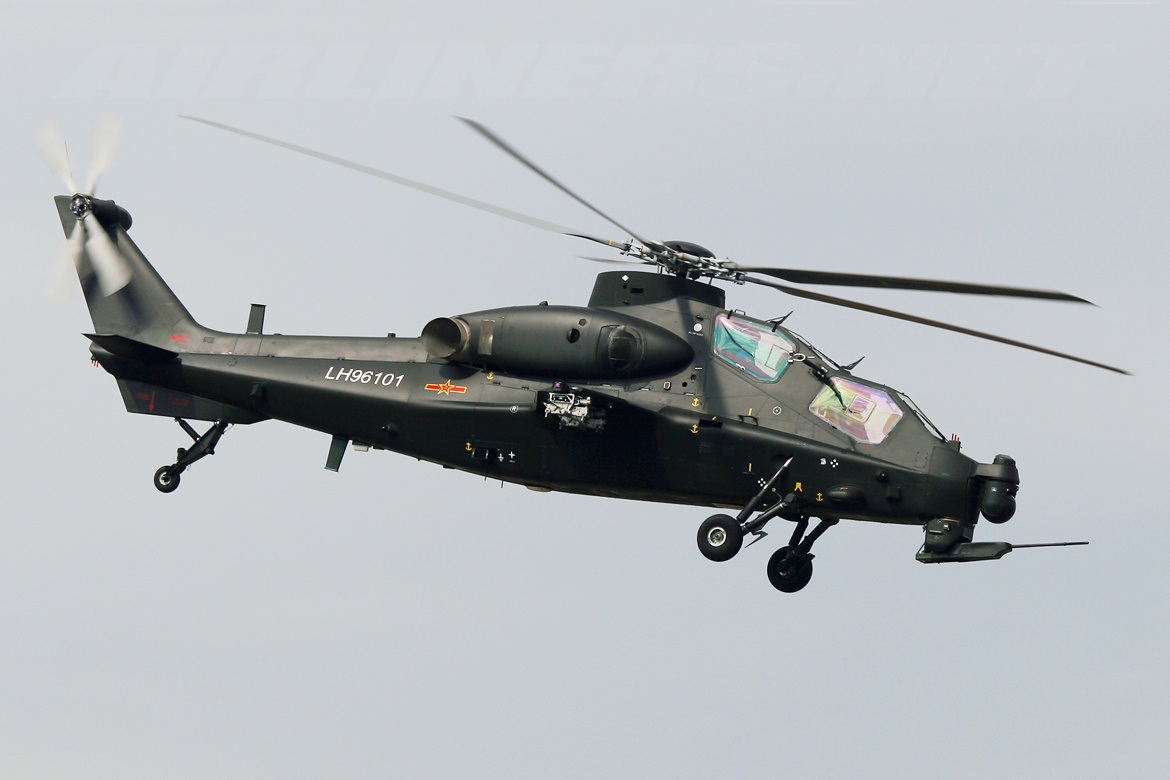
The Changhe Z-10 (Chinese: 直-10; pinyin: Zhí-Shí; lit. 'helicopter-10') is a Chinese medium-weight, twin-turboshaft, attack helicopter built by the Changhe Aircraft Industries Corporation for the People's Liberation Army Ground Force Aviation. Designed by 602nd Aircraft Design Institute of Aviation Industry Corporation of China and Kamov Design Bureau, the aircraft is intended primarily for antitank warfare missions with secondary air-to-air combat capability.
The plan to develop a medium-weight helicopter program was initiated in 1994 with the attack helicopter program formally beginning in 1998. The preliminary design of the aircraft was provided by Kamov, while prototyping was conducted by the 602nd Aircraft Design Institute of Aviation Industry Corporation of China (AVIC). The Z-10 first flew on 29 April 2003 and entered Chinese Army Aviation service in 2009.
Nicknames of characters in the Chinese classic novel Water Margin have been used to name Z-10 and its light-weight counterpart, the Harbin Z-19 by Chinese Army Aviation Corps; Z-10 is called Fierce Thunderbolt (Pi Li Huo, 霹雳火), the nickname of Qin Ming, while Z-19 is called Black Whirlwind (Hei Xuan Feng, 黑旋风), the nickname of Li Kui.
The People's Liberation Army Ground Force (PLAGF) established its army aviation units in January 1988. The unit used helicopters transferred from People's Liberation Army Air Force (PLAAF), including Mil Mi-4, Harbin Z-5, Mil Mi-8, and Aérospatiale Gazelle. By the mid-1980s, the Chinese decided to field dedicated attack helicopters. The brief honeymoon period between China and the West provided China opportunities to evaluate Agusta A129 Mangusta, AH-1 Cobra, and BGM-71 TOW missiles. However, the 1989 Tiananmen Square protests and massacre and the ensuing arms embargo prevented many deals from going through. Nevertheless, China successfully imported or licensed aircraft types such as Changhe Z-8, Harbin Z-9, Sikorsky S-70, Mi-17, and Aerospatiale AS332 Super Puma.
Also, debate had arisen in China about whether the PLAGF or PLAAF should operate attack helicopters. Eventually, the PLAGF won and began to induct armed helicopters based on the Harbin Z-9 design. The use of the Z-9WA modification helped China realize the requirement for a dedicated attack helicopter platform.
A preliminary plan to develop an attack helicopter in China began in 1992. China began to develop the 6-ton class China Helicopter Medium (CHM) program in 1994, headed by the 602nd and 608th Research Institutes. This program was later developed into Harbin Z-20. In 1995, China commissioned Kamov to develop a preliminary design for the 6-ton helicopter, known as Project 941 internally. Project 941 was a large departure from traditional Soviet design, focusing entirely on the CHM requirement. The concept was then handed to China for further development, in which Kamov did not participate. Based on the concept, Chinese engineers developed prototypes and iterate designs based on the testing results. The changes include modification on the airframe shapes to optimize radar cross section, changes on the engine bay shape to accommodate domestic engines, and the engine nozzle layout.
China also secured assistance from Eurocopter France for the rotor system and AgustaWestland in 1997 for the transmission system in 1998. Pratt & Whitney Canada and Hamilton Sundstrand secretly provided PT6C-67C engines and digital engine control systems to aid the programs, leading to them receiving investigations and penalties from the United States government.
In 1998, the 602nd Research Institute proposed the Special Armed Project to develop the final design, which was designated the Z-10. Initially, the Z-10 project was planned to share its propulsion system with the CHM program, but the two programs were separated and the Z-10 was prioritized to be completed first. During the development in 2000, Denel also provided technical assistance to the project in the area of flight stability. After the US government cut off engine sources from Pratt and Whitney, China turned to domestic replacements with lower thrust ratings, leading to further weight-saving design changes. The replacement engine was the indigenous WZ-9 turboshaft.
Hub AI
Changhe Z-10 AI simulator
(@Changhe Z-10_simulator)
Changhe Z-10
The Changhe Z-10 (Chinese: 直-10; pinyin: Zhí-Shí; lit. 'helicopter-10') is a Chinese medium-weight, twin-turboshaft, attack helicopter built by the Changhe Aircraft Industries Corporation for the People's Liberation Army Ground Force Aviation. Designed by 602nd Aircraft Design Institute of Aviation Industry Corporation of China and Kamov Design Bureau, the aircraft is intended primarily for antitank warfare missions with secondary air-to-air combat capability.
The plan to develop a medium-weight helicopter program was initiated in 1994 with the attack helicopter program formally beginning in 1998. The preliminary design of the aircraft was provided by Kamov, while prototyping was conducted by the 602nd Aircraft Design Institute of Aviation Industry Corporation of China (AVIC). The Z-10 first flew on 29 April 2003 and entered Chinese Army Aviation service in 2009.
Nicknames of characters in the Chinese classic novel Water Margin have been used to name Z-10 and its light-weight counterpart, the Harbin Z-19 by Chinese Army Aviation Corps; Z-10 is called Fierce Thunderbolt (Pi Li Huo, 霹雳火), the nickname of Qin Ming, while Z-19 is called Black Whirlwind (Hei Xuan Feng, 黑旋风), the nickname of Li Kui.
The People's Liberation Army Ground Force (PLAGF) established its army aviation units in January 1988. The unit used helicopters transferred from People's Liberation Army Air Force (PLAAF), including Mil Mi-4, Harbin Z-5, Mil Mi-8, and Aérospatiale Gazelle. By the mid-1980s, the Chinese decided to field dedicated attack helicopters. The brief honeymoon period between China and the West provided China opportunities to evaluate Agusta A129 Mangusta, AH-1 Cobra, and BGM-71 TOW missiles. However, the 1989 Tiananmen Square protests and massacre and the ensuing arms embargo prevented many deals from going through. Nevertheless, China successfully imported or licensed aircraft types such as Changhe Z-8, Harbin Z-9, Sikorsky S-70, Mi-17, and Aerospatiale AS332 Super Puma.
Also, debate had arisen in China about whether the PLAGF or PLAAF should operate attack helicopters. Eventually, the PLAGF won and began to induct armed helicopters based on the Harbin Z-9 design. The use of the Z-9WA modification helped China realize the requirement for a dedicated attack helicopter platform.
A preliminary plan to develop an attack helicopter in China began in 1992. China began to develop the 6-ton class China Helicopter Medium (CHM) program in 1994, headed by the 602nd and 608th Research Institutes. This program was later developed into Harbin Z-20. In 1995, China commissioned Kamov to develop a preliminary design for the 6-ton helicopter, known as Project 941 internally. Project 941 was a large departure from traditional Soviet design, focusing entirely on the CHM requirement. The concept was then handed to China for further development, in which Kamov did not participate. Based on the concept, Chinese engineers developed prototypes and iterate designs based on the testing results. The changes include modification on the airframe shapes to optimize radar cross section, changes on the engine bay shape to accommodate domestic engines, and the engine nozzle layout.
China also secured assistance from Eurocopter France for the rotor system and AgustaWestland in 1997 for the transmission system in 1998. Pratt & Whitney Canada and Hamilton Sundstrand secretly provided PT6C-67C engines and digital engine control systems to aid the programs, leading to them receiving investigations and penalties from the United States government.
In 1998, the 602nd Research Institute proposed the Special Armed Project to develop the final design, which was designated the Z-10. Initially, the Z-10 project was planned to share its propulsion system with the CHM program, but the two programs were separated and the Z-10 was prioritized to be completed first. During the development in 2000, Denel also provided technical assistance to the project in the area of flight stability. After the US government cut off engine sources from Pratt and Whitney, China turned to domestic replacements with lower thrust ratings, leading to further weight-saving design changes. The replacement engine was the indigenous WZ-9 turboshaft.