
Recent from talks
Attack helicopter
Knowledge base stats:
Talk channels stats:
Members stats:
Attack helicopter
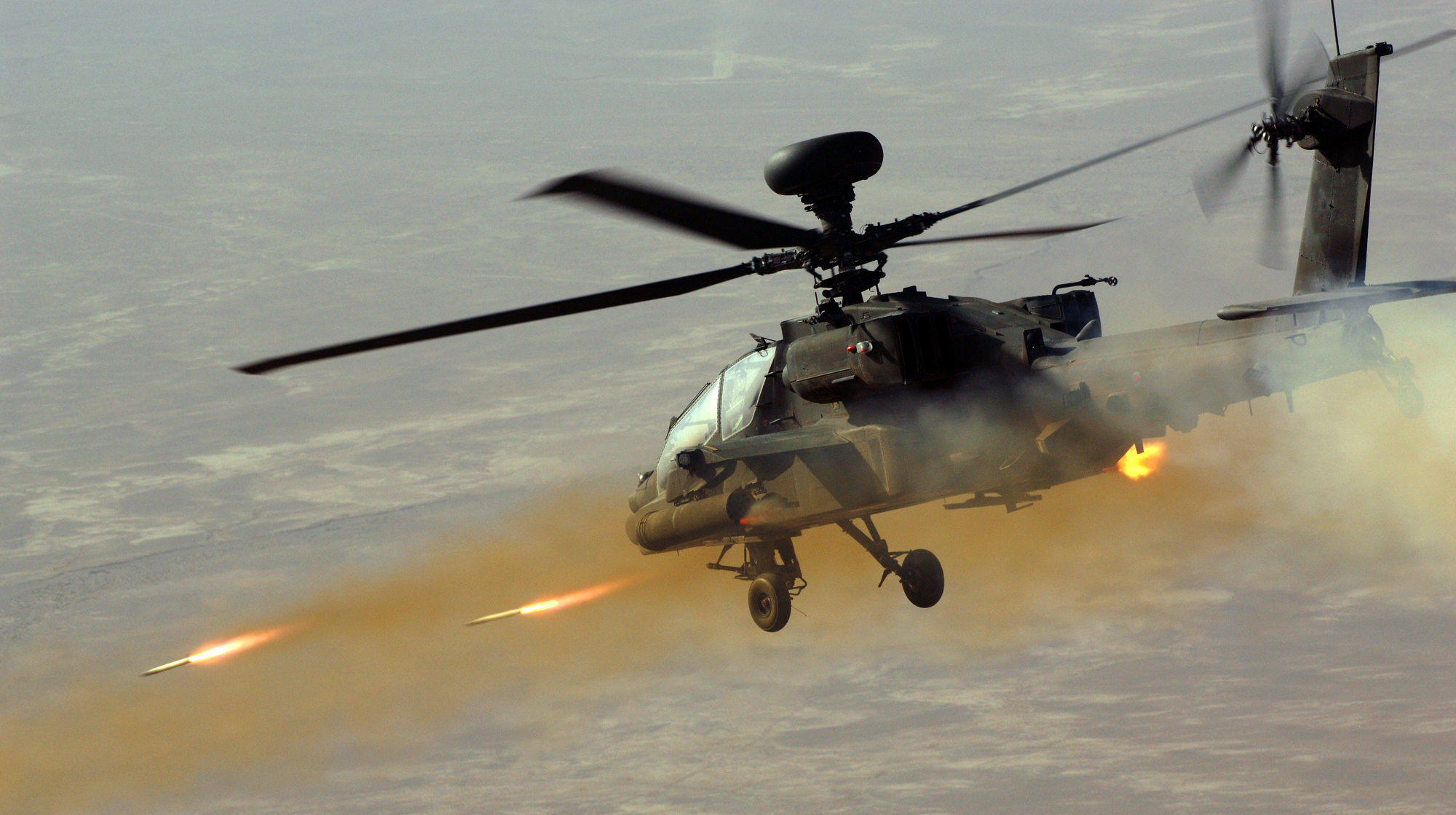
An attack helicopter is an armed helicopter with the primary role of an attack aircraft, with the offensive capability of engaging ground targets such as enemy infantry, military vehicles and fortifications. Due to their heavy armament they are sometimes called helicopter gunships.
Attack helicopters can use weapons including autocannons, machine guns, rockets, and anti-tank missiles such as the AGM-114 Hellfire. Some attack helicopters are also capable of carrying air-to-air missiles, though mostly for purposes of self-defense against other helicopters and low-flying light combat aircraft.
A modern attack helicopter has two primary roles: first, to provide direct and accurate close air support for ground troops; and second, the anti-tank role to destroy grouped enemy armored vehicles. Attack helicopters are also used as protective escort for transport helicopters, or to supplement lighter helicopters in the armed reconnaissance roles. In combat, an attack helicopter is projected to destroy targets worth around 17 times its own production cost before being destroyed.
Low-speed, fixed wing Allied aircraft like the Soviet Polikarpov Po-2 training and utility biplane had been used as early as 1942 to provide night harassment attack capability against the Wehrmacht Heer on the Eastern Front, most effectively in the Battle of the Caucasus as exemplified by the Night Witches all-female Soviet air unit. Following Operation Overlord in 1944, the military version of the similarly slow-flying Piper J-3 Cub high-wing civilian monoplane, the L-4 Grasshopper, begun to be used in a light anti-armor role by a few U.S. Army artillery spotter units over France; these aircraft were field-outfitted with either two or four bazooka rocket launchers attached to the lift struts, against German armored fighting vehicles. During the summer of 1944, U.S. Army Major Charles Carpenter managed to successfully take on an anti-armor role with his rocket-armed Piper L-4. His L-4, bearing US Army serial number 43-30426 and named Rosie the Rocketer, armed with six bazookas, had notable success in an engagement during the Battle of Arracourt on September 20, 1944, employing top attack tactics in knocking out at least four German armored vehicles, as a pioneering example of taking on heavy enemy armor from a slow-flying aircraft.
The Germans were also engaged in such ad hoc low-speed light aircraft platforms for ground attack very late in the war, with one subtype of the Bücker Bestmann trainer—the Bü 181C-3—armed with four Panzerfaust 100 anti-tank grenade launchers, two under each of the low-winged monoplane's wing panels, for the concluding two months of the war in Europe. This sort of role, being undertaken by low-speed fixed-wing light aircraft was something that was also likely to be achievable after World War II, from the increasing numbers of post-war military helicopter designs. The only American helicopter in use during the war years, the Sikorsky R-4, was only being used for rescue and were still very much experimental in nature.
In the early 1950s, various countries around the world started to make increased use of helicopters in their operations in transport and liaison roles. Later on it was realised that these helicopters, successors to the World War II-era Sikorsky R-4, could be armed with weapons in order to provide them with limited combat capability. Early examples include armed Sikorsky H-34s in service with the US Air Force and armed Mil Mi-4 in service with the Soviet Air Forces. This "experimental" trend towards the development of dedicated attack helicopters continued into the 1960s with the deployment of armed Bell UH-1s and Mil Mi-8s during the Vietnam War, to this day the pair of most produced helicopter designs in aviation history. These helicopters proved to be moderately successful in these configurations, but due to a lack of armor protection and speed, they were ultimately ineffective platforms for mounting weapons in higher-threat ground combat environments.
Since the 1960s, various countries around the world started to design and develop various types of helicopters with the purpose of providing a heavily armed and protected aerial vehicle that can perform a variety of combat roles, from reconnaissance to aerial assault missions. By the 1990s, the missile-armed attack helicopter evolved into a primary anti-tank weapon. Able to quickly move about the battlefield and launch fleeting "pop-up attacks", helicopters presented a major threat even with the presence of organic air defenses. The helicopter gunship became a major tool against tank warfare, and most attack helicopters became more and more optimized for the antitank mission.
Amid the opening months of the Korean War era, during August 1950, a joint US Navy and Marine Corps test used a newly acquired Bell HTL-4 helicopter to test if a bazooka could be fired from a helicopter in flight. One of the larger 3.5 inch (90mm calibre) models of the bazooka was chosen, and was mounted ahead and to the right of the helicopter to allow the door to remain clear. The bazooka was successfully tested, although it was discovered that it would require shielding for the engine compartment, which was exposed in the model 47 and other early helicopters. The helicopter itself belonged to HMX-1, a Marine experimental helicopter squadron.
Hub AI
Attack helicopter AI simulator
(@Attack helicopter_simulator)
Attack helicopter
An attack helicopter is an armed helicopter with the primary role of an attack aircraft, with the offensive capability of engaging ground targets such as enemy infantry, military vehicles and fortifications. Due to their heavy armament they are sometimes called helicopter gunships.
Attack helicopters can use weapons including autocannons, machine guns, rockets, and anti-tank missiles such as the AGM-114 Hellfire. Some attack helicopters are also capable of carrying air-to-air missiles, though mostly for purposes of self-defense against other helicopters and low-flying light combat aircraft.
A modern attack helicopter has two primary roles: first, to provide direct and accurate close air support for ground troops; and second, the anti-tank role to destroy grouped enemy armored vehicles. Attack helicopters are also used as protective escort for transport helicopters, or to supplement lighter helicopters in the armed reconnaissance roles. In combat, an attack helicopter is projected to destroy targets worth around 17 times its own production cost before being destroyed.
Low-speed, fixed wing Allied aircraft like the Soviet Polikarpov Po-2 training and utility biplane had been used as early as 1942 to provide night harassment attack capability against the Wehrmacht Heer on the Eastern Front, most effectively in the Battle of the Caucasus as exemplified by the Night Witches all-female Soviet air unit. Following Operation Overlord in 1944, the military version of the similarly slow-flying Piper J-3 Cub high-wing civilian monoplane, the L-4 Grasshopper, begun to be used in a light anti-armor role by a few U.S. Army artillery spotter units over France; these aircraft were field-outfitted with either two or four bazooka rocket launchers attached to the lift struts, against German armored fighting vehicles. During the summer of 1944, U.S. Army Major Charles Carpenter managed to successfully take on an anti-armor role with his rocket-armed Piper L-4. His L-4, bearing US Army serial number 43-30426 and named Rosie the Rocketer, armed with six bazookas, had notable success in an engagement during the Battle of Arracourt on September 20, 1944, employing top attack tactics in knocking out at least four German armored vehicles, as a pioneering example of taking on heavy enemy armor from a slow-flying aircraft.
The Germans were also engaged in such ad hoc low-speed light aircraft platforms for ground attack very late in the war, with one subtype of the Bücker Bestmann trainer—the Bü 181C-3—armed with four Panzerfaust 100 anti-tank grenade launchers, two under each of the low-winged monoplane's wing panels, for the concluding two months of the war in Europe. This sort of role, being undertaken by low-speed fixed-wing light aircraft was something that was also likely to be achievable after World War II, from the increasing numbers of post-war military helicopter designs. The only American helicopter in use during the war years, the Sikorsky R-4, was only being used for rescue and were still very much experimental in nature.
In the early 1950s, various countries around the world started to make increased use of helicopters in their operations in transport and liaison roles. Later on it was realised that these helicopters, successors to the World War II-era Sikorsky R-4, could be armed with weapons in order to provide them with limited combat capability. Early examples include armed Sikorsky H-34s in service with the US Air Force and armed Mil Mi-4 in service with the Soviet Air Forces. This "experimental" trend towards the development of dedicated attack helicopters continued into the 1960s with the deployment of armed Bell UH-1s and Mil Mi-8s during the Vietnam War, to this day the pair of most produced helicopter designs in aviation history. These helicopters proved to be moderately successful in these configurations, but due to a lack of armor protection and speed, they were ultimately ineffective platforms for mounting weapons in higher-threat ground combat environments.
Since the 1960s, various countries around the world started to design and develop various types of helicopters with the purpose of providing a heavily armed and protected aerial vehicle that can perform a variety of combat roles, from reconnaissance to aerial assault missions. By the 1990s, the missile-armed attack helicopter evolved into a primary anti-tank weapon. Able to quickly move about the battlefield and launch fleeting "pop-up attacks", helicopters presented a major threat even with the presence of organic air defenses. The helicopter gunship became a major tool against tank warfare, and most attack helicopters became more and more optimized for the antitank mission.
Amid the opening months of the Korean War era, during August 1950, a joint US Navy and Marine Corps test used a newly acquired Bell HTL-4 helicopter to test if a bazooka could be fired from a helicopter in flight. One of the larger 3.5 inch (90mm calibre) models of the bazooka was chosen, and was mounted ahead and to the right of the helicopter to allow the door to remain clear. The bazooka was successfully tested, although it was discovered that it would require shielding for the engine compartment, which was exposed in the model 47 and other early helicopters. The helicopter itself belonged to HMX-1, a Marine experimental helicopter squadron.
Recent media