



Community hub
Recent from talks
Knowledge base stats:
Talk channels stats:
Members stats:
COMPASS experiment
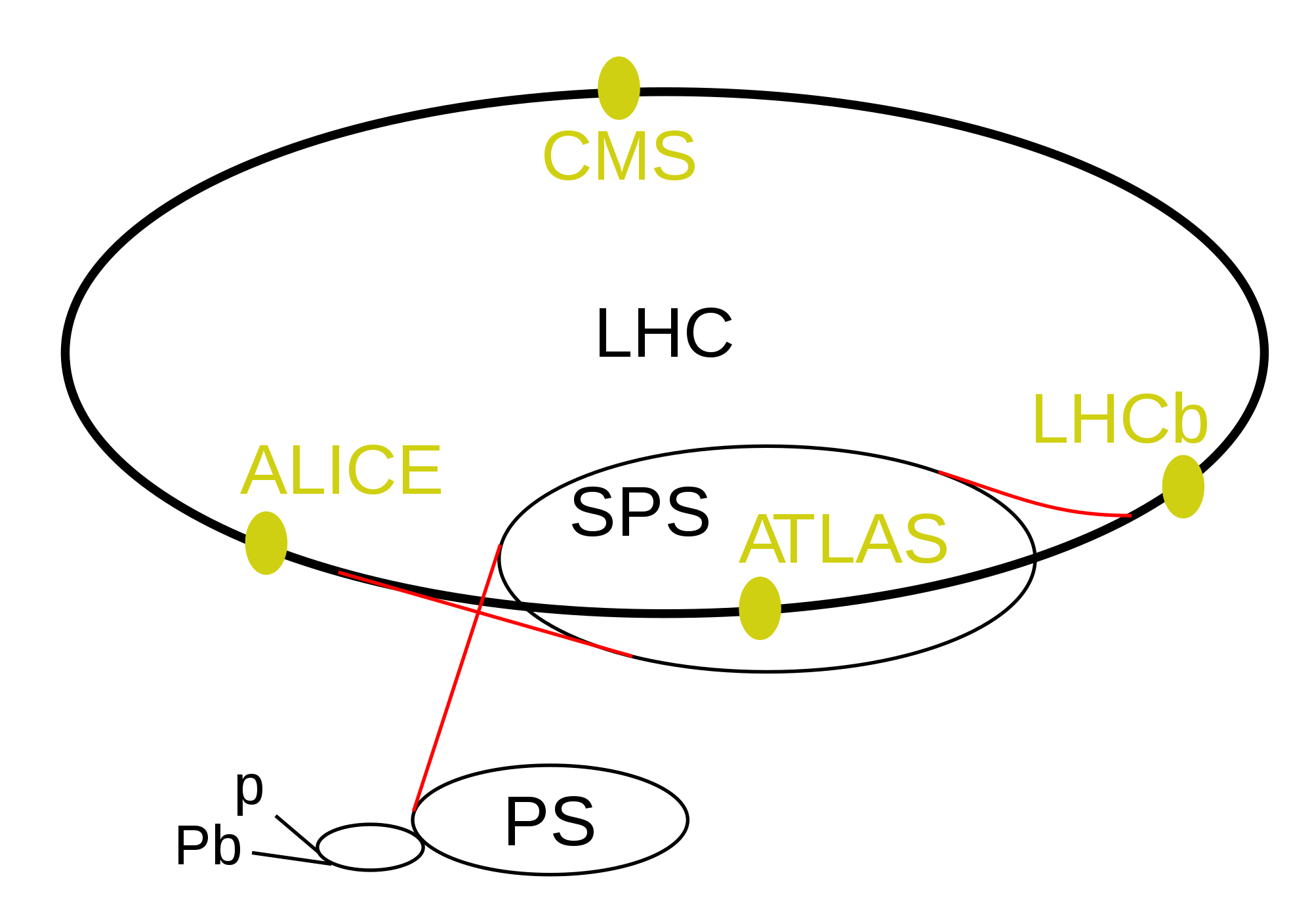
The NA58 experiment, or COMPASS (standing for "Common Muon and Proton Apparatus for Structure and Spectroscopy") is a 60-metre-long fixed-target experiment at the M2 beam line of the SPS at CERN. The experimental hall is located at the CERN North Area, close to the French village of Prévessin-Moëns. The experiment is a two-staged spectrometer with numerous tracking detectors, particle identification and calorimetry. The physics results are extracted by recording and analysing the final states of the scattering processes.
The versatile set-up, the use of different targets and particle beams allow the investigation of various processes. The main physics goals are the investigation of the nucleon spin structure and hadron spectroscopy. The collaboration consists of 220 physicists from 13 different countries, involving 28 universities and research institutes.
The COMPASS experiment was proposed in 1996 and approved by the CERN research committee. Between 1999 and 2001, the experiment was set up and finally in 2001, the first commissioning run was performed. Until the start of the LHC experiments, COMPASS was the largest data-taking experiment at CERN. It is also a pioneer in adopting new detector and readout technologies, such as MicroMegas, GEM detectors and most recently THGEM photon detection. The data taking is divided into the COMPASS I and II phases.
COMPASS I (2002-2011)
COMPASS II (2012-2021)
The experiment consists of three major parts: the beam telescope, the target area and the two-staged spectrometer.
The M2 beam line is able to transport various secondary and tertiary particle beams, which all originate from the Super Proton Synchrotron. The primary proton beam (400 GeV/c and up to 1.5E13 protons per super cycle) is steered on a beryllium production target producing secondary hadrons, mainly consisting of (anti-) protons, pions and kaons. The production target and the experiment are separated by a 1.1 km long transfer line, allowing through weak decay and use of massive hadron absorbers the production of a naturally spin-polarised muon beam. The beam line is designed to transport beams up to a momentum of 280 GeV/c. Usually, five different beams are used by COMPASS:
The timing and the position of the incident particles are determined with cold silicon strip detectors and scintillating fibre detectors. These informations are crucial to determine the interaction point inside the target material. Depending on the beam type, modifications in the beam telescope are done:
Hub AI
COMPASS experiment AI simulator
(@COMPASS experiment_simulator)
COMPASS experiment
The NA58 experiment, or COMPASS (standing for "Common Muon and Proton Apparatus for Structure and Spectroscopy") is a 60-metre-long fixed-target experiment at the M2 beam line of the SPS at CERN. The experimental hall is located at the CERN North Area, close to the French village of Prévessin-Moëns. The experiment is a two-staged spectrometer with numerous tracking detectors, particle identification and calorimetry. The physics results are extracted by recording and analysing the final states of the scattering processes.
The versatile set-up, the use of different targets and particle beams allow the investigation of various processes. The main physics goals are the investigation of the nucleon spin structure and hadron spectroscopy. The collaboration consists of 220 physicists from 13 different countries, involving 28 universities and research institutes.
The COMPASS experiment was proposed in 1996 and approved by the CERN research committee. Between 1999 and 2001, the experiment was set up and finally in 2001, the first commissioning run was performed. Until the start of the LHC experiments, COMPASS was the largest data-taking experiment at CERN. It is also a pioneer in adopting new detector and readout technologies, such as MicroMegas, GEM detectors and most recently THGEM photon detection. The data taking is divided into the COMPASS I and II phases.
COMPASS I (2002-2011)
COMPASS II (2012-2021)
The experiment consists of three major parts: the beam telescope, the target area and the two-staged spectrometer.
The M2 beam line is able to transport various secondary and tertiary particle beams, which all originate from the Super Proton Synchrotron. The primary proton beam (400 GeV/c and up to 1.5E13 protons per super cycle) is steered on a beryllium production target producing secondary hadrons, mainly consisting of (anti-) protons, pions and kaons. The production target and the experiment are separated by a 1.1 km long transfer line, allowing through weak decay and use of massive hadron absorbers the production of a naturally spin-polarised muon beam. The beam line is designed to transport beams up to a momentum of 280 GeV/c. Usually, five different beams are used by COMPASS:
The timing and the position of the incident particles are determined with cold silicon strip detectors and scintillating fibre detectors. These informations are crucial to determine the interaction point inside the target material. Depending on the beam type, modifications in the beam telescope are done: