


Community hub
0 subscribers8 pages, 0 posts
Recent from talks
All channels
Be the first to start a discussion here.
Be the first to start a discussion here.
Be the first to start a discussion here.
Be the first to start a discussion here.
Contribute something
Welcome to the community hub built to collect knowledge and have discussions related to CP Class 9100.
Nothing was collected or created yet.
CP Class 9100
View on Wikipediafrom Wikipedia
 | This article needs additional citations for verification. (February 2012) |
| CP Class 0100 | |
|---|---|
 A CP railcar of Série 9100 at Amarante station on the Tâmega line, May 1996 | |
| In service | 1949-2002 |
| Manufacturer | NOHAB |
| Constructed | 1949 |
| Number built | 3 |
| Capacity | 1st class: 8 seats 2nd class: 28 seats standing: 20 places |
| Operators | Comboios de Portugal |
| Lines served | Tâmega line |
| Specifications | |
| Car body construction | Steel |
| Wheel diameter | 700 mm (27.6 in) |
| Maximum speed | 70 km/h (43 mph) |
| Weight | 26,125 kg (57,595.8 lb) |
| Traction system | Diesel-hydraulic |
| Prime mover(s) | 2 × Scania-Vabis D-802 4 stroke 8-cylinder diesel |
| Power output | 2 × 150 hp (110 kW) |
| Tractive effort | 3,680 kgf (8,113.0 lbf) |
| Transmission | 2 × A.B Atlas Diesel D F B-10-Lysholm-Smit |
| UIC classification | B' B' |
| Braking system(s) | Knorr compressed-air |
| Safety system(s) | Dead man's switch |
| Track gauge | 1,000 mm (3 ft 3+3⁄8 in) metre gauge |
| Notes/references | |
| primary reference[1] | |
The Série 9100 were a class of metre gauge diesel railcars built for use by the Portuguese Railways (CP) on the Tâmega line.
Three 9100 series railcars were built in 1949 by Swedish manufacturer NOHAB of Trollhättan. They were essentially a narrow gauge version of CP's larger Iberian broad gauge Série 0100 diesel railcars. They were in revenue service until 2002, when they were withdrawn and replaced by the new CP Série 9500 railcars.
Gallery
[edit]-
 two CP 9100 railcars in Livração in 2003
 -
 CP 1901 at Amarante on 7 November 1993
 -
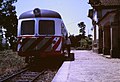

.jpg)
.jpg)
References
[edit]- ^ "CP class 9100". trainlogistics.com. Retrieved 2024-01-27.
See also
[edit]
Wikimedia Commons has media related to Portuguese train type 9100.
Related articles
[edit]External links
[edit]- Website with extra technical data