
Recent from talks
CS-BLAST
Knowledge base stats:
Talk channels stats:
Members stats:
CS-BLAST
CS-BLAST (Context-Specific BLAST) is a tool that searches a protein sequence that extends BLAST (Basic Local Alignment Search Tool), using context-specific mutation probabilities. More specifically, CS-BLAST derives context-specific amino-acid similarities on each query sequence from short windows on the query sequences. Using CS-BLAST doubles sensitivity and significantly improves alignment quality without a loss of speed in comparison to BLAST. CSI-BLAST (Context-Specific Iterated BLAST) is the context-specific analog of PSI-BLAST (Position-Specific Iterated BLAST), which computes the mutation profile with substitution probabilities and mixes it with the query profile. CSI-BLAST (Context-Specific Iterated BLAST) is the context specific analog of PSI-BLAST (Position-Specific Iterated BLAST). Both of these programs are available as web-server and are available for free download.
Homology is the relationship between biological structures or sequences derived from a common ancestor. Homologous proteins (proteins who have common ancestry) are inferred from their sequence similarity. Inferring homologous relationships involves calculating scores of aligned pairs minus penalties for gaps. Aligning pairs of proteins identify regions of similarity indicating a relationship between the two, or more, proteins. In order to have a homologous relationship, the sum of scores over all the aligned pairs of amino acids or nucleotides must be sufficiently high [2]. Standard methods of sequence comparisons use a substitution matrix to accomplish this [4]. Similarities between amino acids or nucleotides are quantified in these substitution matrices. The substitution score () of amino acids and can we written as follows:


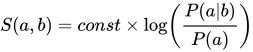
where denotes the probability of amino acid mutating into amino acid [2]. In a large set of sequence alignments, counting the number of amino acids as well as the number of aligned pairs will allow you to derive the probabilities and .


Since protein sequences need to maintain a stable structure, a residue’s substitution probabilities are largely determined by the structural context of where it is found. As a result, substitution matrices are trained for structural contexts. Since context information is encoded in transition probabilities between states, mixing mutation probabilities from substitution matrices weighted for corresponding states achieves improved alignment qualities when compared to standard substitution matrices. CS-BLAST improves further upon this concept. The figure illustrates the sequence to sequence and profile to sequence equivalence with the alignment matrix. The query profile results from the artificial mutations in which the bar heights are proportional to the corresponding amino acid probabilities.
(A FIGURE NEEDS TO GO HERE THIS IS THE CAPTION) “Sequence search/alignment algorithms find the path that maximizes the sum of similarity scores (color-coded blue to red). Substitution matrix scores are equivalent to profile scores if the sequence profile (colored histogram) is generated from the query sequence by adding artificial mutations with the substitution matrix pseudocount scheme. Histogram bar heights represent the fraction of amino acids in profile columns”.
CS-BLAST greatly improves alignment quality over the entire range of sequence identities and especially for difficult alignments in comparison to regular BLAST and PSI-BLAST. PSI-BLAST (Position-Specific Iterated BLAST) runs at about the same speed per iteration as regular BLAST, but is able to detect weaker sequence similarities that are still biologically relevant. Alignment quality is based on alignment sensitivity and alignment precision.
Alignment sensitivity is measured by correctly comparing predicted alignments of residue pairs to the total number of possible alignable pairs. This is calculated with the fraction: (pairs correctly aligned)/(pairs structurally alignable)
Hub AI
CS-BLAST AI simulator
(@CS-BLAST_simulator)
CS-BLAST
CS-BLAST (Context-Specific BLAST) is a tool that searches a protein sequence that extends BLAST (Basic Local Alignment Search Tool), using context-specific mutation probabilities. More specifically, CS-BLAST derives context-specific amino-acid similarities on each query sequence from short windows on the query sequences. Using CS-BLAST doubles sensitivity and significantly improves alignment quality without a loss of speed in comparison to BLAST. CSI-BLAST (Context-Specific Iterated BLAST) is the context-specific analog of PSI-BLAST (Position-Specific Iterated BLAST), which computes the mutation profile with substitution probabilities and mixes it with the query profile. CSI-BLAST (Context-Specific Iterated BLAST) is the context specific analog of PSI-BLAST (Position-Specific Iterated BLAST). Both of these programs are available as web-server and are available for free download.
Homology is the relationship between biological structures or sequences derived from a common ancestor. Homologous proteins (proteins who have common ancestry) are inferred from their sequence similarity. Inferring homologous relationships involves calculating scores of aligned pairs minus penalties for gaps. Aligning pairs of proteins identify regions of similarity indicating a relationship between the two, or more, proteins. In order to have a homologous relationship, the sum of scores over all the aligned pairs of amino acids or nucleotides must be sufficiently high [2]. Standard methods of sequence comparisons use a substitution matrix to accomplish this [4]. Similarities between amino acids or nucleotides are quantified in these substitution matrices. The substitution score () of amino acids and can we written as follows:
where denotes the probability of amino acid mutating into amino acid [2]. In a large set of sequence alignments, counting the number of amino acids as well as the number of aligned pairs will allow you to derive the probabilities and .
Since protein sequences need to maintain a stable structure, a residue’s substitution probabilities are largely determined by the structural context of where it is found. As a result, substitution matrices are trained for structural contexts. Since context information is encoded in transition probabilities between states, mixing mutation probabilities from substitution matrices weighted for corresponding states achieves improved alignment qualities when compared to standard substitution matrices. CS-BLAST improves further upon this concept. The figure illustrates the sequence to sequence and profile to sequence equivalence with the alignment matrix. The query profile results from the artificial mutations in which the bar heights are proportional to the corresponding amino acid probabilities.
(A FIGURE NEEDS TO GO HERE THIS IS THE CAPTION) “Sequence search/alignment algorithms find the path that maximizes the sum of similarity scores (color-coded blue to red). Substitution matrix scores are equivalent to profile scores if the sequence profile (colored histogram) is generated from the query sequence by adding artificial mutations with the substitution matrix pseudocount scheme. Histogram bar heights represent the fraction of amino acids in profile columns”.
CS-BLAST greatly improves alignment quality over the entire range of sequence identities and especially for difficult alignments in comparison to regular BLAST and PSI-BLAST. PSI-BLAST (Position-Specific Iterated BLAST) runs at about the same speed per iteration as regular BLAST, but is able to detect weaker sequence similarities that are still biologically relevant. Alignment quality is based on alignment sensitivity and alignment precision.
Alignment sensitivity is measured by correctly comparing predicted alignments of residue pairs to the total number of possible alignable pairs. This is calculated with the fraction: (pairs correctly aligned)/(pairs structurally alignable)