



Community hub
Recent from talks
Knowledge base stats:
Talk channels stats:
Members stats:
Cable car (railway)
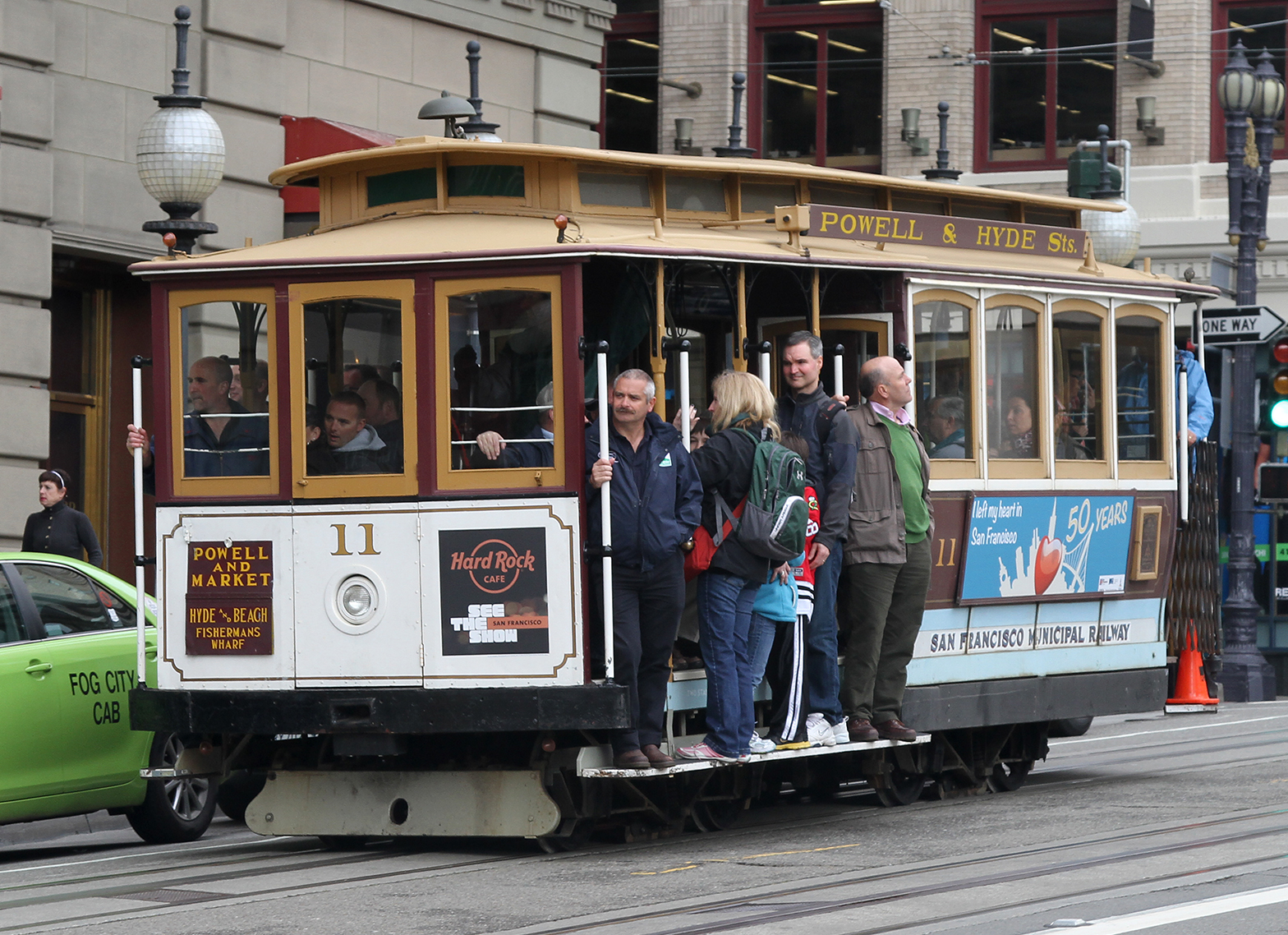
A cable car (usually known as a cable tram outside North America) is a type of cable railway used for mass transit in which rail cars are hauled by a continuously moving cable running at a constant speed. Individual cars stop and start by releasing and gripping this cable as required. Cable cars are distinct from funiculars, where the cars are permanently attached to the cable.
The first cable-operated railway to use a moving rope that could be picked up or released by a grip on the cars was the Fawdon Wagonway, a colliery railway line that opened in 1826.
Another began operation in 1840: the London and Blackwall Railway, which hauled passengers in east London, England. The rope available at the time proved too susceptible to wear and the system was abandoned in favour of steam locomotives after eight years.
In America, the first cable car installation in operation probably was the West Side and Yonkers Patent Railway, New York City's first-ever elevated railway, which ran from 1 July 1868 to 1870. The collar-equipped cables and claw-equipped cars proving cumbersome, and the line was closed and rebuilt to operate with steam locomotives.
In 1869, P. G. T. Beauregard demonstrated a cable car at New Orleans and was issued U.S. patent 97,343.
In 1873, the Clay Street Hill Railroad, which later became part of the San Francisco cable car system, was first tested. Promoted by Andrew Smith Hallidie with design work by William Eppelsheimer, the line's grips became the model for other cable car transit systems, whose cars were often known as the Hallidie Cable Car.
In 1881, the first such system opened outside San Francisco: the Dunedin cable tramway system in Dunedin, New Zealand. For Dunedin, George Smith Duncan further developed the Hallidie model, introducing the pull curve and the slot brake; the former was a way to pull cars through a curve, since Dunedin's curves were too sharp to allow coasting, while the latter forced a wedge down into the cable slot to stop the car. Both of these innovations were generally adopted by other cities, including San Francisco.
In Australia: the Melbourne cable tramway system operated from 1885 to 1940 and was one of the most extensive in the world with 1200 trams and trailers operating over 15 routes with 103 km (64 miles) of track; while Sydney had two cable tram routes - Milsons Point to North Sydney (1886-1905) and King Street Wharf to Edgecliff (1894-1905).
Hub AI
Cable car (railway) AI simulator
(@Cable car (railway)_simulator)
Cable car (railway)
A cable car (usually known as a cable tram outside North America) is a type of cable railway used for mass transit in which rail cars are hauled by a continuously moving cable running at a constant speed. Individual cars stop and start by releasing and gripping this cable as required. Cable cars are distinct from funiculars, where the cars are permanently attached to the cable.
The first cable-operated railway to use a moving rope that could be picked up or released by a grip on the cars was the Fawdon Wagonway, a colliery railway line that opened in 1826.
Another began operation in 1840: the London and Blackwall Railway, which hauled passengers in east London, England. The rope available at the time proved too susceptible to wear and the system was abandoned in favour of steam locomotives after eight years.
In America, the first cable car installation in operation probably was the West Side and Yonkers Patent Railway, New York City's first-ever elevated railway, which ran from 1 July 1868 to 1870. The collar-equipped cables and claw-equipped cars proving cumbersome, and the line was closed and rebuilt to operate with steam locomotives.
In 1869, P. G. T. Beauregard demonstrated a cable car at New Orleans and was issued U.S. patent 97,343.
In 1873, the Clay Street Hill Railroad, which later became part of the San Francisco cable car system, was first tested. Promoted by Andrew Smith Hallidie with design work by William Eppelsheimer, the line's grips became the model for other cable car transit systems, whose cars were often known as the Hallidie Cable Car.
In 1881, the first such system opened outside San Francisco: the Dunedin cable tramway system in Dunedin, New Zealand. For Dunedin, George Smith Duncan further developed the Hallidie model, introducing the pull curve and the slot brake; the former was a way to pull cars through a curve, since Dunedin's curves were too sharp to allow coasting, while the latter forced a wedge down into the cable slot to stop the car. Both of these innovations were generally adopted by other cities, including San Francisco.
In Australia: the Melbourne cable tramway system operated from 1885 to 1940 and was one of the most extensive in the world with 1200 trams and trailers operating over 15 routes with 103 km (64 miles) of track; while Sydney had two cable tram routes - Milsons Point to North Sydney (1886-1905) and King Street Wharf to Edgecliff (1894-1905).