


Community hub
Recent from talks
Contribute something
Nothing was collected or created yet.
Calder Memorial Trophy
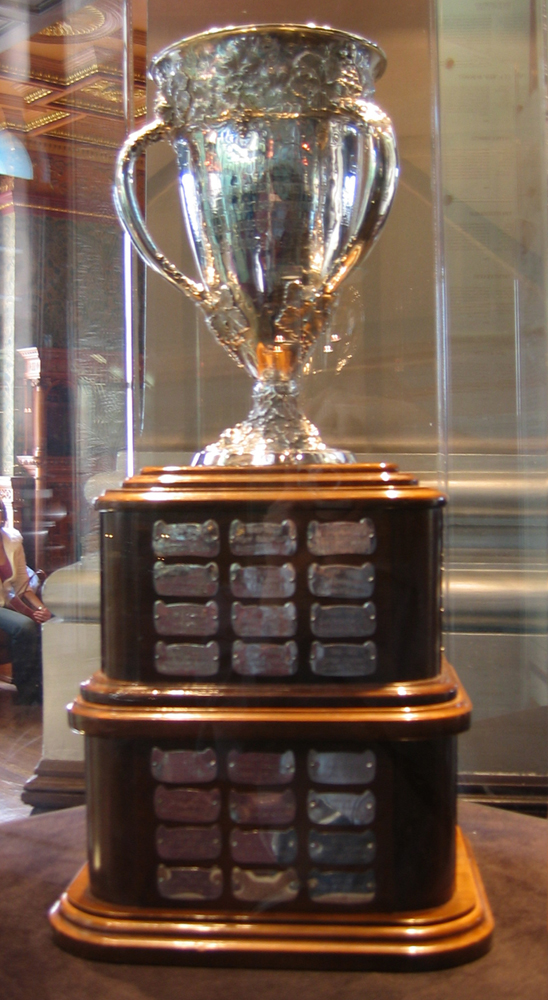
View on WikipediaThe Calder Memorial Trophy is an annual award given "to the player selected as the most proficient in his first year of competition in the National Hockey League (NHL)." It is named after Frank Calder, the first president of the NHL. Serving as the NHL's Rookie of the Year award, this version of the trophy has been awarded since its creation for the 1936–37 NHL season. The voting is conducted by members of the Professional Hockey Writers' Association at the conclusion of each regular season to determine the winner.
Key Information


Eligibility
[edit]When the award was established in 1937, there were no requirements beyond that the winner be in his first year of competition in the NHL, and the winner was decided by League President Frank Calder himself.[1]
Currently, the eligibility requirements are that a player cannot have played more than 25 regular season games in any single preceding season, nor in six or more games in each of any two preceding regular seasons, in any major professional league.[2] The last requirement was implemented in 1979 to block Wayne Gretzky (who had played a single season in the World Hockey Association the year before) from winning the award.[3] After the Calder win of 31-year-old Sergei Makarov in 1991 (following the influx of Eastern Bloc players around the fall of the Soviet Union), the rules were further amended to require that winners be 26 years of age or younger.[4]
Further, the limitation is for regular season games only, exempting games played in the playoffs. This has led to aberrations such as Ken Dryden winning the Calder in 1972, despite leading the Montreal Canadiens to a Stanley Cup victory the season before, and winning the Conn Smythe Trophy as the playoff MVP.
History
[edit]
The Calder Memorial Trophy is named in honour of Frank Calder, the former president of the National Hockey League (NHL) from its inception in 1917 to his death in 1943. Although Rookie of the Year honors were handed out beginning in 1932–33, the Calder Trophy was first presented at the conclusion of the 1936–37 NHL season.[5] Calder himself purchased a trophy each year to award to the winner.[6]
After Calder's death in 1943 a permanent trophy was cast, and it was renamed the Calder Memorial Trophy.[7]
The trophy has been won the most times by rookies from the Toronto Maple Leafs, who have won it on ten occasions, with the most recent being Auston Matthews in 2017. The second-most is the Chicago Blackhawks with nine wins.
Since the 1948 season, the voting is conducted at the end of the regular season by members of the Professional Hockey Writers' Association, and each individual voter ranks their top five candidates on a 10–7–5–3–1 points system.[8] Three finalists are named and the trophy is awarded at the NHL Awards ceremony after the playoffs.
Winners
[edit]| C | Centre |
|---|---|
| LW | Left wing |
| RW | Right wing |
| D | Defence |
| G | Goaltender |
- ^ Player's age at the time of award win
- ^ No winner because of the 2004–05 NHL lockout
-
 Howie Meeker, winner in 1947
 -
 Terry Sawchuk, winner in 1951
 -
 Eric Vail, winner in 1975
 -
 Mario Lemieux, winner in 1985
 -
 Pavel Bure, winner in 1992
 -
 Daniel Alfredsson, winner in 1996
 -
 Alexander Ovechkin, winner in 2006
 -
 Gabriel Landeskog, winner in 2012
 -
 Auston Matthews, winner in 2017
 -
 Moritz Seider, winner in 2022
 -
 Matty Beniers, winner in 2023
 -
 Connor Bedard, winner in 2024


See also
[edit]References
[edit]- Calder Trophy history at NHL.com Archived 2019-08-16 at the Wayback Machine
- Calder Trophy profile at Legends of Hockey.net
- ^ Coleman, Charles L. (1969). Trail of the Stanley Cup, Vol. II. Sherbrooke, PQ: Progressive Publications Ltd. p. XXXII.
- ^ "NHL Calder Memorial Trophy Winners". nhl.com. National Hockey League. Archived from the original on 29 August 2023. Retrieved 29 August 2023.
- ^ Klein, Jeff Z.; Reif, Karl-Eric (1987). The Klein and Reif Hockey Compendium. Toronto: McClelland and Stewart. p. 185. ISBN 0-7710-4528-X.
- ^ "NHL Calder Memorial Trophy Winners". nhl.com. National Hockey League. Archived from the original on 29 August 2023. Retrieved 29 August 2023.
- ^ "Silverware: Calder Memorial Trophy". Legends Of Hockey. Archived from the original on September 30, 2007. Retrieved August 21, 2007.
- ^ "NHL Calder Memorial Trophy Winners". nhl.com. National Hockey League. Archived from the original on 29 August 2023. Retrieved 29 August 2023.
- ^ "Calder Memorial Trophy". National Hockey League. Archived from the original on August 16, 2019. Retrieved August 21, 2007.
- ^ Dolezar, Jon (April 20, 2003). "Foppa shows the most Hart". Sports Illustrated. Archived from the original on December 5, 2007. Retrieved August 17, 2007.
| |||||||||

Calder Memorial Trophy
View on GrokipediaBackground and Establishment
Founding and Purpose
The Calder Memorial Trophy was first presented in 1936 at the conclusion of the 1936–37 NHL season to Toronto Maple Leafs center Syl Apps, though the NHL had recognized a top rookie since the 1932–33 season.[3][1] This marked the formalization of an annual trophy for outstanding rookies, initiated by NHL President Frank Calder, who personally funded and provided the award from that season until his death in 1943.[3] In the early years, the outstanding rookie was selected by NHL officials, including President Frank Calder himself, prior to formal voting by the Professional Hockey Writers' Association starting in 1967.[5] The primary purpose of the trophy is to recognize the player judged most proficient in their first year of competition in North American professional hockey leagues, highlighting exceptional skill, development, and impact among newcomers to the professional level.[1] It emphasizes standout performances that demonstrate readiness and contribution to the sport, distinguishing true rookies from more experienced players.[6] Initially, eligibility was restricted to players entering their first full season in the NHL, excluding those with any prior professional experience in North American leagues to ensure the award celebrated genuine first-year transitions.[6] This scope has evolved over time, but the founding criteria underscored a focus on pure newcomers without established pro backgrounds.[1]Namesake and Dedication
The Calder Memorial Trophy is named in honor of Frank Calder, the inaugural president of the National Hockey League (NHL), who served from 1917 until his death in 1943.[7][4] Born in Bristol, England, in 1877, Calder immigrated to Canada and rose through hockey administration ranks, becoming secretary of the National Hockey Association before helping establish the NHL amid post-World War I instability.[8] Under his leadership, the league stabilized after its turbulent founding with just four teams, navigating financial challenges and rival leagues to foster sustainable growth.[7] Calder's key contributions included expanding the NHL into the United States, such as granting a franchise to the New York Rangers in 1926, which helped elevate the league from a Canadian-centric operation to a North American powerhouse.[9] He also introduced mechanisms for player development, notably signing a professional-amateur agreement in October 1940 that compensated amateur clubs with $500 for each player signing an NHL contract, plus an additional $250 upon the player's NHL debut, laying groundwork for organized talent pipelines. These efforts guided the league through expansions to 10 teams by the mid-1920s and eventual contraction to the Original Six by 1942, solidifying its structure during Calder's 26-year tenure.[7] Following Calder's sudden death from a heart attack on February 4, 1943, the NHL Board of Governors posthumously dedicated the league's rookie award to him, renaming it the Calder Memorial Trophy effective retroactively from the 1936–37 season onward.[3][4] Prior to the formal naming, Calder himself had personally funded and presented a trophy annually to the top rookie starting in 1936–37, reflecting his commitment to recognizing emerging talent; the memorial designation honored his foundational role in the NHL's development.[3]Eligibility and Selection
Player Eligibility Criteria
The Calder Memorial Trophy recognizes the most proficient player in their inaugural National Hockey League (NHL) season, with eligibility strictly defined to identify true rookies lacking substantial prior professional experience. A player qualifies only if their current season marks their first in the NHL, provided they have not exceeded specified game thresholds in previous professional play across major leagues. Specifically, candidates cannot have appeared in more than 25 games during any single preceding season, nor in six or more games across each of any two preceding seasons, in leagues such as the NHL, American Hockey League (AHL), or other recognized professional circuits.[1][3] These game limits apply uniformly to all positions, including goaltenders, ensuring consistency in evaluating prior exposure. The rules explicitly bar players with meaningful experience in defunct leagues like the World Hockey Association (WHA); for instance, Wayne Gretzky was deemed ineligible for the 1979-80 award despite leading the NHL in scoring as a rookie, owing to his full WHA season the prior year. This framework underscores the award's focus on players entering the NHL without significant professional seasoning, thereby highlighting emerging talent over seasoned professionals masquerading as newcomers.[3] In the 1990-91 season, the NHL introduced an age restriction to refine eligibility amid evolving player pathways, particularly for international prospects from European professional leagues and those delayed by junior or college development. Under this amendment, players must not have turned 26 by September 15 of their eligible season, preventing older athletes with extensive non-NHL careers—such as extended stints abroad—from qualifying. This update reinforces the trophy's intent to honor the "first year of competition" in the NHL while adapting to a globalized talent pool and discouraging veteran returns or late-career debuts.[1][3]Voting and Announcement Process
The voting for the Calder Memorial Trophy is conducted annually by members of the Professional Hockey Writers' Association (PHWA), a group of approximately 175–200 qualified voters comprising writers from NHL markets and select broadcasters.[5] Each voter submits a ballot at the end of the NHL regular season, ranking up to five eligible rookies in order of preference, based on their performance during the season.[1] Points are awarded on a 10-7-5-3-1 scale, with 10 points for a first-place vote, 7 for second place, 5 for third, 3 for fourth, and 1 for fifth place. The player accumulating the highest total points across all ballots is named the winner. The top three vote-getters are announced as the finalists, and the winner is revealed during the NHL Awards ceremony, typically held in late spring or early summer after the Stanley Cup Playoffs conclude.[3][1] Ballots must be submitted by the conclusion of the regular season to avoid playoff performance influencing selections.[1]Historical Overview
Early Years (1936–1950)
The Calder Memorial Trophy, recognizing the NHL's outstanding rookie, was first awarded in the 1932–33 season to Carl Voss of the Detroit Red Wings. Prior to 1936–37, recipients included Russ Blinco (1933–34, Montreal Maroons), Sweeney Schriner (1934–35, New York Americans), and Mike Karakas (1935–36, Chicago Black Hawks).[10] The physical trophy was first presented at the conclusion of the 1936–37 NHL season to Toronto Maple Leafs center Syl Apps, who recorded 45 points in 48 games, marking the start of the league's tradition of honoring its top first-year player with a dedicated trophy.[1] From 1936–37 through 1943, NHL President Frank Calder personally purchased a new trophy each year to be presented permanently to the outstanding rookie, reflecting the award's foundational purpose of honoring emerging talent in a competitive professional landscape.[3] Following Calder's death in February 1943, the NHL renamed and formalized it as the Calder Memorial Trophy starting in the 1943–44 season, with the league assuming responsibility for its perpetual presentation.[1] The award was presented annually without interruption during this period, even amid the challenges of World War II, which depleted rosters but highlighted resilient newcomers.[10] Early recipients underscored a balance between forward prowess and goaltending excellence in an era of low-scoring hockey. Forwards dominated the honors, with Apps leading as the first trophy recipient, followed by Chicago Black Hawks center Cully Dahlstrom in 1937–38 (21 goals, 20 assists in 48 games) and Montreal Canadiens center Johnny Quilty in 1940–41 (18 goals in 48 games despite injury setbacks).[10] Goaltenders like Boston Bruins' Frank Brimsek in 1938–39, who posted a 1.93 goals-against average and led his team to the Stanley Cup, and Toronto's Frank McCool in 1944–45 (3.31 GAA in a war-shortened schedule), demonstrated the award's recognition of defensive impact when rookies filled critical voids.[1] Edgar Laprade's 1945–46 win as a New York Rangers center (33 assists in 60 games) exemplified post-war recovery, as leagues reintegrated players and emphasized playmaking in smaller lineups.[10] These selections highlighted the trophy's role in spotlighting players who adapted to the era's physical, low-offense style. The pre-expansion NHL context shaped the award's early narrative, with the league stabilizing at six teams—the Original Six—by the 1942–43 season after economic pressures and wartime enlistments forced franchises like the New York Americans to fold or suspend operations.[1] Smaller rosters, typically 15–18 skaters per team, intensified competition for rookie spots, favoring versatile performers from Canadian junior circuits such as the Ontario Hockey Association, where talents like Apps and Brimsek honed their skills before professional debuts.[10] The Great Depression's lingering effects from the late 1920s into the 1930s further constrained scouting efforts, as financial hardships reduced team budgets for travel and recruitment, resulting in overlooked prospects from remote areas who might otherwise have been signed earlier.[11] This environment prioritized cost-effective, locally sourced Canadian players, reinforcing the league's national identity during its formative professional years.Postwar Expansion and Changes (1950–Present)
Following the conclusion of World War II, the Calder Memorial Trophy continued to recognize standout NHL rookies amid the league's gradual modernization and growth. In the 1950s, winners such as Frank Mahovlich in 1958 highlighted the era's emphasis on robust, physical forwards who could dominate through size and skill in a six-team league.[3] By the mid-1960s, the NHL's landscape shifted dramatically with the 1967 expansion, which doubled the league to 12 teams by adding the Los Angeles Kings, Minnesota North Stars, Philadelphia Flyers, Pittsburgh Penguins, St. Louis Blues, and Oakland Seals. This influx created a larger pool of eligible rookies, as new franchises scouted and integrated fresh talent more aggressively, leading to a broader competition for the award and showcasing diverse playing styles in the expanded era.[12] The 1970s brought further evolution through the absorption of the rival World Hockey Association (WHA) in 1979, which merged four teams—the Edmonton Oilers, Hartford Whalers, Quebec Nordiques, and Winnipeg Jets—into the NHL, increasing the league to 21 teams. This merger necessitated clarifications to the Calder eligibility rules to account for players' prior professional experience in the WHA; the updated criteria stipulated that a player could not have exceeded 25 games in any single preceding season or six games in each of two preceding seasons in a major league, ensuring true novices were prioritized despite cross-league histories.[3] Into the 1980s and 1990s, geopolitical changes opened the NHL to international talent, particularly after the fall of the Soviet Union in 1989, which facilitated defections and releases of skilled players. This influx diversified Calder recipients, with Soviet stars like Sergei Makarov winning in 1990 as the oldest rookie at 31 years old, followed by Pavel Bure in 1992, marking a shift toward speed and finesse from Eastern European influences in an increasingly global league.[3] From the 2000s onward, labor disputes disrupted the award's continuity, including the 2004–05 lockout that cancelled the entire season and resulted in no Calder being awarded, while the 2012–13 lockout shortened the campaign to 48 games, compressing rookie evaluations and affecting game thresholds for eligibility.[13] These interruptions highlighted the award's resilience, with post-lockout winners like Alexander Ovechkin in 2006 exemplifying explosive offensive impacts in rebounding seasons. More recently, enhancements to the voting process have incorporated digital platforms for the Professional Hockey Writers' Association (PHWA) ballots, streamlining submissions and increasing transparency through public release of full voting results. Additionally, evaluations have increasingly integrated advanced analytics, such as expected goals and on-ice metrics, to assess rookies' contributions beyond traditional stats, reflecting the NHL's data-driven evolution.[14]Recipients and Achievements
Complete List of Winners
The Calder Memorial Trophy has been awarded annually since the 1936–37 NHL season to the league's most proficient rookie player, with exceptions for the 1979–80 season (due to eligibility rules excluding Wayne Gretzky after his prior professional experience) and the 2004–05 season (canceled due to a league lockout).[3] The following table lists all recipients chronologically, including the season, winner's name, team, position, games played (GP), goals (G), assists (A), and points (PTS) for skaters; for goaltenders, offensive stats reflect any recorded, but their award recognizes performance in wins, save percentage, and goals against average. Stats are sourced from official NHL records and reflect regular-season totals as of 2025.[10]| Season | Winner | Team | Position | GP | G | A | PTS |
|---|---|---|---|---|---|---|---|
| 1936–37 | Syl Apps | Toronto Maple Leafs | C | 48 | 16 | 29 | 45 |
| 1937–38 | Cully Dahlstrom | Chicago Black Hawks | C | 48 | 10 | 9 | 19 |
| 1938–39 | Frank Brimsek | Boston Bruins | G | 48 | 0 | 0 | 0 |
| 1939–40 | Kilby MacDonald | New York Rangers | LW | 48 | 15 | 13 | 28 |
| 1940–41 | John Quilty | Montreal Canadiens | C | 48 | 18 | 16 | 34 |
| 1941–42 | Grant Warwick | New York Rangers | RW | 46 | 16 | 17 | 33 |
| 1942–43 | Gaye Stewart | Toronto Maple Leafs | LW | 50 | 24 | 23 | 47 |
| 1943–44 | Gus Bodnar | Toronto Maple Leafs | C | 50 | 22 | 40 | 62 |
| 1944–45 | Frank McCool | Toronto Maple Leafs | G | 50 | 0 | 0 | 0 |
| 1945–46 | Edgar Laprade | New York Rangers | C | 60 | 15 | 19 | 34 |
| 1946–47 | Howie Meeker | Toronto Maple Leafs | RW | 60 | 27 | 18 | 45 |
| 1947–48 | Jim McFadden | Detroit Red Wings | C | 60 | 24 | 24 | 48 |
| 1948–49 | Pentti Lund | New York Rangers | RW | 60 | 14 | 16 | 30 |
| 1949–50 | Jack Gelineau | Boston Bruins | G | 60 | 0 | 0 | 0 |
| 1950–51 | Terry Sawchuk | Detroit Red Wings | G | 70 | 0 | 0 | 0 |
| 1951–52 | Bernie Geoffrion | Montreal Canadiens | RW | 70 | 30 | 24 | 54 |
| 1952–53 | Gump Worsley | New York Rangers | G | 70 | 0 | 0 | 0 |
| 1953–54 | Camille Henry | New York Rangers | C | 70 | 24 | 15 | 39 |
| 1954–55 | Ed Litzenberger | Chicago Black Hawks | RW | 70 | 23 | 28 | 51 |
| 1955–56 | Glenn Hall | Detroit Red Wings | G | 70 | 0 | 0 | 0 |
| 1956–57 | Larry Regan | Boston Bruins | RW | 70 | 14 | 19 | 33 |
| 1957–58 | Frank Mahovlich | Toronto Maple Leafs | LW | 70 | 20 | 16 | 36 |
| 1958–59 | Ralph Backstrom | Montreal Canadiens | C | 70 | 18 | 22 | 40 |
| 1959–60 | Bill Hay | Chicago Black Hawks | C | 70 | 18 | 37 | 55 |
| 1960–61 | Dave Keon | Toronto Maple Leafs | C | 70 | 20 | 25 | 45 |
| 1961–62 | Bobby Rousseau | Montreal Canadiens | RW | 70 | 21 | 24 | 45 |
| 1962–63 | Kent Douglas | Toronto Maple Leafs | D | 70 | 7 | 15 | 22 |
| 1963–64 | Jacques Laperriere | Montreal Canadiens | D | 70 | 2 | 28 | 30 |
| 1964–65 | Roger Crozier | Detroit Red Wings | G | 51 | 0 | 0 | 0 |
| 1965–66 | Brit Selby | Toronto Maple Leafs | LW | 65 | 14 | 13 | 27 |
| 1966–67 | Bobby Orr | Boston Bruins | D | 61 | 13 | 28 | 41 |
| 1967–68 | Derek Sanderson | Boston Bruins | C | 76 | 24 | 25 | 49 |
| 1968–69 | Danny Grant | Minnesota North Stars | LW | 76 | 34 | 31 | 65 |
| 1969–70 | Tony Esposito | Chicago Black Hawks | G | 63 | 0 | 2 | 2 |
| 1970–71 | Gilbert Perreault | Buffalo Sabres | C | 78 | 38 | 34 | 72 |
| 1971–72 | Ken Dryden | Montreal Canadiens | G | 6 | 0 | 3 | 3 |
| 1972–73 | Steve Vickers | New York Rangers | LW | 78 | 30 | 23 | 53 |
| 1973–74 | Denis Potvin | New York Islanders | D | 78 | 17 | 37 | 54 |
| 1974–75 | Eric Vail | Atlanta Flames | LW | 80 | 39 | 21 | 60 |
| 1975–76 | Bryan Trottier | New York Islanders | C | 80 | 32 | 63 | 95 |
| 1976–77 | Willi Plett | Atlanta Flames | RW | 80 | 33 | 23 | 56 |
| 1977–78 | Mike Bossy | New York Islanders | RW | 73 | 53 | 38 | 91 |
| 1978–79 | Bobby Smith | Minnesota North Stars | C | 80 | 30 | 44 | 74 |
| 1979–80 | No award | - | - | - | - | - | - |
| 1980–81 | Peter Stastny | Quebec Nordiques | C | 80 | 39 | 70 | 109 |
| 1981–82 | Dale Hawerchuk | Winnipeg Jets | C | 80 | 45 | 58 | 103 |
| 1982–83 | Steve Larmer | Chicago Black Hawks | RW | 80 | 43 | 50 | 93 |
| 1983–84 | Tom Barrasso | Buffalo Sabres | G | 42 | 0 | 5 | 5 |
| 1984–85 | Mario Lemieux | Pittsburgh Penguins | C | 73 | 45 | 93 | 138 |
| 1985–86 | Gary Suter | Calgary Flames | D | 80 | 18 | 59 | 77 |
| 1986–87 | Luc Robitaille | Los Angeles Kings | LW | 79 | 45 | 33 | 78 |
| 1987–88 | Joe Nieuwendyk | Calgary Flames | C | 77 | 51 | 31 | 82 |
| 1988–89 | Brian Leetch | New York Rangers | D | 68 | 23 | 48 | 71 |
| 1989–90 | Sergei Makarov | Calgary Flames | RW | 80 | 24 | 63 | 87 |
| 1990–91 | Ed Belfour | Chicago Black Hawks | G | 74 | 0 | 1 | 1 |
| 1991–92 | Pavel Bure | Vancouver Canucks | RW | 65 | 34 | 40 | 74 |
| 1992–93 | Teemu Selanne | Winnipeg Jets | RW | 76 | 76 | 56 | 132 |
| 1993–94 | Martin Brodeur | New Jersey Devils | G | 26 | 0 | 1 | 1 |
| 1994–95 | Peter Forsberg | Quebec Nordiques | C | 47 | 15 | 35 | 50 |
| 1995–96 | Daniel Alfredsson | Ottawa Senators | RW | 82 | 23 | 45 | 68 |
| 1996–97 | Bryan Berard | New York Islanders | D | 82 | 8 | 29 | 37 |
| 1997–98 | Sergei Samsonov | Boston Bruins | LW | 81 | 22 | 47 | 69 |
| 1998–99 | Chris Drury | Colorado Avalanche | C | 82 | 24 | 28 | 52 |
| 1999–00 | Scott Gomez | New Jersey Devils | C | 81 | 11 | 32 | 43 |
| 2000–01 | Evgeni Nabokov | San Jose Sharks | G | 65 | 0 | 2 | 2 |
| 2001–02 | Dany Heatley | Atlanta Thrashers | RW | 82 | 26 | 29 | 55 |
| 2002–03 | Barret Jackman | St. Louis Blues | D | 82 | 3 | 16 | 19 |
| 2003–04 | Andrew Raycroft | Boston Bruins | G | 57 | 0 | 1 | 1 |
| 2004–05 | No award | - | - | - | - | - | - |
| 2005–06 | Alex Ovechkin | Washington Capitals | LW | 81 | 52 | 54 | 106 |
| 2006–07 | Evgeni Malkin | Pittsburgh Penguins | C | 82 | 33 | 52 | 85 |
| 2007–08 | Patrick Kane | Chicago Blackhawks | RW | 82 | 21 | 51 | 72 |
| 2008–09 | Steve Mason | Columbus Blue Jackets | G | 60 | 0 | 0 | 0 |
| 2009–10 | Tyler Myers | Buffalo Sabres | D | 82 | 11 | 37 | 48 |
| 2010–11 | Jeff Skinner | Carolina Hurricanes | C | 82 | 31 | 32 | 63 |
| 2011–12 | Gabriel Landeskog | Colorado Avalanche | LW | 82 | 22 | 30 | 52 |
| 2012–13 | Jonathan Huberdeau | Florida Panthers | LW | 75 | 17 | 30 | 47 |
| 2013–14 | Nathan MacKinnon | Colorado Avalanche | C | 64 | 21 | 39 | 60 |
| 2014–15 | Aaron Ekblad | Florida Panthers | D | 80 | 9 | 25 | 34 |
| 2015–16 | Artemi Panarin | Chicago Blackhawks | LW | 80 | 30 | 48 | 78 |
| 2016–17 | Auston Matthews | Toronto Maple Leafs | C | 82 | 40 | 29 | 69 |
| 2017–18 | Mathew Barzal | New York Islanders | C | 82 | 18 | 51 | 69 |
| 2018–19 | Elias Pettersson | Vancouver Canucks | C | 71 | 28 | 38 | 66 |
| 2019–20 | Cale Makar | Colorado Avalanche | D | 57 | 12 | 38 | 50 |
| 2020–21 | Kirill Kaprizov | Minnesota Wild | LW | 55 | 22 | 27 | 49 |
| 2021–22 | Moritz Seider | Detroit Red Wings | D | 82 | 7 | 30 | 37 |
| 2022–23 | Matty Beniers | Seattle Kraken | C | 82 | 24 | 33 | 57 |
| 2023–24 | Connor Bedard | Chicago Blackhawks | C | 68 | 22 | 39 | 61 |
| 2024–25 | Lane Hutson | Montreal Canadiens | D | 82 | 6 | 60 | 66 |