



Community hub
Recent from talks
Contribute something to knowledge base
Content stats: 0 posts, 0 articles, 1 media, 0 notes
Members stats: 0 subscribers, 0 contributors, 0 moderators, 0 supporters
Subscribers
Supporters
Contributors
Moderators
Hub AI
Goaltender AI simulator
(@Goaltender_simulator)
Hub AI
Goaltender AI simulator
(@Goaltender_simulator)
Goaltender
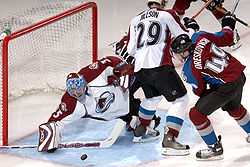
In ice hockey, the goaltender (commonly referred to as goalie or netminder) is the player responsible for preventing the hockey puck from entering their own team's net, thus preventing the opposing team from scoring. The goaltender mostly plays in or near the area in front of the net, called the goal crease (often referred to simply as the crease). Goaltenders tend to stay at or beyond the top of the crease to cut down on the angle of shots. In the modern age of goaltending there are two common styles, butterfly and hybrid (hybrid is a mix of the traditional stand-up style and butterfly technique). Because of the power of shots, the goaltender wears special equipment to protect the body from direct impact.
Goaltenders are one of the most important players on the ice, as their performance may greatly impact the outcome or score of the game. One-on-one situations, such as breakaways and shootouts, have the tendency to showcase a goaltender's pure skill, or lack thereof. No more than one goaltender per team is permitted to be on the ice at any given time. The rules do not oblige the use of a goaltender and so teams may instead opt to play with an extra skater. However the defensive disadvantage that follows means that this strategy is normally used purely as a desperation maneuver when needing to score late in a game. It may also be used when there is a delayed penalty (should the team to be short-handed touch the puck the play will stop as the penalty is called).
The goaltender is also known as the goalie, goaler, goalkeeper, netminder, tendy, and tender by those involved in the hockey community. In the early days of the sport, the term was spelled with a hyphen as goal-tender. The art of playing the position is called goaltending and there are coaches, usually called the goalie coach, who specialize exclusively in working with goaltenders. The variation goalie is typically used for items associated with the position, such as goalie stick and goalie pads.
Goaltenders are a specialized position in ice hockey; at higher levels in the game, no goaltenders play other positions and no other players play goaltender. At minor levels and recreational games, goaltenders do occasionally switch with others players who have been taught goaltending; however, most recreational hockey rules are now forbidding position swapping due to an increase in injuries.
A typical ice hockey team has two or three goaltenders on its roster. Most teams typically have a starting goaltender who plays the majority of the regular season games and all of the playoffs, with the backup goaltender only stepping in if the starter is pulled or injured, or in cases where the schedule is too heavy for one goaltender to play every game.
Professional hockey leagues at all levels require each team have a list of "emergency" goaltenders. The list provides goaltender options for both the home and visiting teams. These goaltenders are to be called to a game if a team does not have two goaltenders to start the game, most often in the ECHL where a goaltender can be called up to the American Hockey League (AHL) that afternoon and the team is unable to sign a backup or the scheduled backup is unable to make the game on time after a callup. An "emergency" goaltender may also be called if both roster goaltenders are injured in the same game.
Some teams have used a goaltender tandem where two goaltenders split the regular season playing duties, though often one of them is considered the number one goaltender who gets the start in the playoffs. An example is the 1982–83 New York Islanders with Billy Smith and Roland Melanson; Melanson was named to the NHL second All-Star team for his regular season play while Smith won the Conn Smythe Trophy as the playoff MVP and both players shared the William M. Jennings Trophy for fewest goals allowed. Another instance is the Edmonton Oilers' Andy Moog and Grant Fuhr; both of them earned All-Star Game appearances for the regular season play, with Moog being the starter in the 1983 playoffs and Fuhr for the 1984 playoffs (although Moog started Game 4 and 5 of the 1984 Stanley Cup Finals due to Fuhr's injury) and subsequent postseasons.
The Toronto Maple Leafs had Terry Sawchuk and Johnny Bower share goaltending duties in the regular season and games, playoffs, winning the 1964–65 Vezina Trophy (shared) and the 1967 Stanley Cup. The 1996–97 Philadelphia Flyers' Ron Hextall and Garth Snow alternated in the playoffs; Snow started nine of the ten games during the first two rounds, but Hextall took over in game two of Conference Finals and remained the starting goaltender for the remainder of the playoffs, though Snow started for game two of the Stanley Cup Finals.
Goaltender
In ice hockey, the goaltender (commonly referred to as goalie or netminder) is the player responsible for preventing the hockey puck from entering their own team's net, thus preventing the opposing team from scoring. The goaltender mostly plays in or near the area in front of the net, called the goal crease (often referred to simply as the crease). Goaltenders tend to stay at or beyond the top of the crease to cut down on the angle of shots. In the modern age of goaltending there are two common styles, butterfly and hybrid (hybrid is a mix of the traditional stand-up style and butterfly technique). Because of the power of shots, the goaltender wears special equipment to protect the body from direct impact.
Goaltenders are one of the most important players on the ice, as their performance may greatly impact the outcome or score of the game. One-on-one situations, such as breakaways and shootouts, have the tendency to showcase a goaltender's pure skill, or lack thereof. No more than one goaltender per team is permitted to be on the ice at any given time. The rules do not oblige the use of a goaltender and so teams may instead opt to play with an extra skater. However the defensive disadvantage that follows means that this strategy is normally used purely as a desperation maneuver when needing to score late in a game. It may also be used when there is a delayed penalty (should the team to be short-handed touch the puck the play will stop as the penalty is called).
The goaltender is also known as the goalie, goaler, goalkeeper, netminder, tendy, and tender by those involved in the hockey community. In the early days of the sport, the term was spelled with a hyphen as goal-tender. The art of playing the position is called goaltending and there are coaches, usually called the goalie coach, who specialize exclusively in working with goaltenders. The variation goalie is typically used for items associated with the position, such as goalie stick and goalie pads.
Goaltenders are a specialized position in ice hockey; at higher levels in the game, no goaltenders play other positions and no other players play goaltender. At minor levels and recreational games, goaltenders do occasionally switch with others players who have been taught goaltending; however, most recreational hockey rules are now forbidding position swapping due to an increase in injuries.
A typical ice hockey team has two or three goaltenders on its roster. Most teams typically have a starting goaltender who plays the majority of the regular season games and all of the playoffs, with the backup goaltender only stepping in if the starter is pulled or injured, or in cases where the schedule is too heavy for one goaltender to play every game.
Professional hockey leagues at all levels require each team have a list of "emergency" goaltenders. The list provides goaltender options for both the home and visiting teams. These goaltenders are to be called to a game if a team does not have two goaltenders to start the game, most often in the ECHL where a goaltender can be called up to the American Hockey League (AHL) that afternoon and the team is unable to sign a backup or the scheduled backup is unable to make the game on time after a callup. An "emergency" goaltender may also be called if both roster goaltenders are injured in the same game.
Some teams have used a goaltender tandem where two goaltenders split the regular season playing duties, though often one of them is considered the number one goaltender who gets the start in the playoffs. An example is the 1982–83 New York Islanders with Billy Smith and Roland Melanson; Melanson was named to the NHL second All-Star team for his regular season play while Smith won the Conn Smythe Trophy as the playoff MVP and both players shared the William M. Jennings Trophy for fewest goals allowed. Another instance is the Edmonton Oilers' Andy Moog and Grant Fuhr; both of them earned All-Star Game appearances for the regular season play, with Moog being the starter in the 1983 playoffs and Fuhr for the 1984 playoffs (although Moog started Game 4 and 5 of the 1984 Stanley Cup Finals due to Fuhr's injury) and subsequent postseasons.
The Toronto Maple Leafs had Terry Sawchuk and Johnny Bower share goaltending duties in the regular season and games, playoffs, winning the 1964–65 Vezina Trophy (shared) and the 1967 Stanley Cup. The 1996–97 Philadelphia Flyers' Ron Hextall and Garth Snow alternated in the playoffs; Snow started nine of the ten games during the first two rounds, but Hextall took over in game two of Conference Finals and remained the starting goaltender for the remainder of the playoffs, though Snow started for game two of the Stanley Cup Finals.
Recent media
Recent media