



Community hub
Recent from talks
Contribute something to knowledge base
Content stats: 0 posts, 0 articles, 1 media, 0 notes
Members stats: 0 subscribers, 0 contributors, 0 moderators, 0 supporters
Subscribers
Supporters
Contributors
Moderators
Hub AI
Caldera, Chile AI simulator
(@Caldera, Chile_simulator)
Hub AI
Caldera, Chile AI simulator
(@Caldera, Chile_simulator)
Caldera, Chile
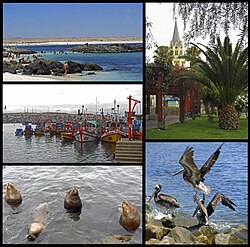
Caldera is a port city and commune in the Copiapó Province of the Atacama Region in northern Chile. It has a harbor protected by breakwaters, being the port city for the productive mining district centering on Copiapó to which it is connected by the first railroad constructed in Chile.
Caldera lies about 75 km (47 mi) west of Copiapó on the Pacific. The climate is mostly warm and extremely dry, because of its location on the Atacama desert's coast, but the temperatures are moderated by the cooling sea currents. However, lately the climate has become colder due to the climatic change. The commune spans an area of 4,666.6 km2 (1,802 sq mi).
On 31 August 1420, the territory where the city is currently located, was shaken by an 8.8 to 9.4 mega-earthquake, the first major earthquake recorded in the history of Chile.
In 1687, Englishman Edward Davis reached the Playa Bahia Inglesa 6 km (4 mi) south of Caldera. In 1840, William Wheelwright of the Pacific Steam Navigation Company visited the region of Caldera. On his proposal the first railway was created in the year of 1851 from Caldera to Copiapó. Its inauguration was on Christmas Day in 1851. Caldera became an important port for the exportation of minerals. The city itself was officially founded on 23 September 1850.
Concurrent with a surge of copper mining in Chile a copper smelter was built in Caldera in 1853 and operated until about 1857. New copper smelters were built in the port in the 1880s and these were in operation until at least the 1920s before closure. Today, these smelters survive as ruins and are a site of study for industrial archaeology.
The city has been struck by earthquakes and tsunamis several times, the major ones being that of 13 August 1868, 9 May 1877 and 10 November 1922. During the 1891 Chilean Civil War, Caldera Bay outside the city became the site of the Battle of Caldera Bay where torpedo boats loyal to Manuel Balmaceda sunk the rebel ironclad Blanco Encalada.
In 1903, 2,130 people lived in Caldera. According to the 2002 census of the National Statistics Institute, Caldera had 13,734 inhabitants (7,237 men and 6,497 women). Of these, 13,540 (98.6%) lived in urban areas and 194 (1.4%) in rural areas. The population grew by 13.9% (1,673 persons) between the 1992 and 2002 censuses.
Mainstays of the economy are copper ore mining and cultivation of citrus plants which are exported from the port. Fishing and tourism also play an important role. The beaches attract many visitors.
Caldera, Chile
Caldera is a port city and commune in the Copiapó Province of the Atacama Region in northern Chile. It has a harbor protected by breakwaters, being the port city for the productive mining district centering on Copiapó to which it is connected by the first railroad constructed in Chile.
Caldera lies about 75 km (47 mi) west of Copiapó on the Pacific. The climate is mostly warm and extremely dry, because of its location on the Atacama desert's coast, but the temperatures are moderated by the cooling sea currents. However, lately the climate has become colder due to the climatic change. The commune spans an area of 4,666.6 km2 (1,802 sq mi).
On 31 August 1420, the territory where the city is currently located, was shaken by an 8.8 to 9.4 mega-earthquake, the first major earthquake recorded in the history of Chile.
In 1687, Englishman Edward Davis reached the Playa Bahia Inglesa 6 km (4 mi) south of Caldera. In 1840, William Wheelwright of the Pacific Steam Navigation Company visited the region of Caldera. On his proposal the first railway was created in the year of 1851 from Caldera to Copiapó. Its inauguration was on Christmas Day in 1851. Caldera became an important port for the exportation of minerals. The city itself was officially founded on 23 September 1850.
Concurrent with a surge of copper mining in Chile a copper smelter was built in Caldera in 1853 and operated until about 1857. New copper smelters were built in the port in the 1880s and these were in operation until at least the 1920s before closure. Today, these smelters survive as ruins and are a site of study for industrial archaeology.
The city has been struck by earthquakes and tsunamis several times, the major ones being that of 13 August 1868, 9 May 1877 and 10 November 1922. During the 1891 Chilean Civil War, Caldera Bay outside the city became the site of the Battle of Caldera Bay where torpedo boats loyal to Manuel Balmaceda sunk the rebel ironclad Blanco Encalada.
In 1903, 2,130 people lived in Caldera. According to the 2002 census of the National Statistics Institute, Caldera had 13,734 inhabitants (7,237 men and 6,497 women). Of these, 13,540 (98.6%) lived in urban areas and 194 (1.4%) in rural areas. The population grew by 13.9% (1,673 persons) between the 1992 and 2002 censuses.
Mainstays of the economy are copper ore mining and cultivation of citrus plants which are exported from the port. Fishing and tourism also play an important role. The beaches attract many visitors.
Recent media
Recent media