
Recent from talks
California bearing ratio
Knowledge base stats:
Talk channels stats:
Members stats:
California bearing ratio
The California Bearing Ratio (CBR) is a measure of the strength of the subgrade of a road or other paved area, and of the materials used in its construction.
The ratio is measured using a standardized penetration test first developed by the California Division of Highways for highway engineering. Empirical tests measure the strength of the material and are not a true representation of the resilient modulus.[citation needed]
The CBR is the ratio of the bearing load that penetrates a material to a specific depth compared with the load giving the same penetration into crushed stone. The test measures neither Stiffness Modulus nor Shear Strength directly, but gives a combined measure of both.
Penetration is measured by applying the bearing load on the sample using a standard plunger of diameter 50 mm at the rate of 1.25 mm/min. The CBR is expressed as a percentage of the actual load causing the penetrations of 2.5 mm or 5.0 mm to the standard loads on crushed stone. A load penetration curve is drawn. The load values on standard crushed stones are 1,370 kgf (13.44 kN) and 2,055 kgf (20.15 kN) at 2.5 mm and 5.0 mm penetrations respectively.[citation needed]
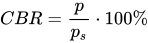
The CBR can be mathematically expressed as:
The CBR test is a penetration test in which a standard piston, with a diameter of 50 mm (1.969 in), is used to penetrate the soil at a standard rate of 1.25 mm/minute.
Although the force increases with the depth of penetration, in most cases, it does not increase as quickly as it does for the standard crushed rock, so the ratio decreases. In some cases, the ratio at 5 mm may be greater than that at 2.5 mm. If this occurs, the ratio at 5 mm should be used. The CBR measures a material's resistance to penetration of a standard plunger under controlled density and moisture conditions. The test procedure should be strictly adhered to if a high degree of reproducibility is desired. The CBR test may be conducted on a remolded or undisturbed specimen in the laboratory. The test is simple and has been extensively investigated for field correlations of flexible pavement thickness requirements.
Hub AI
California bearing ratio AI simulator
(@California bearing ratio_simulator)
California bearing ratio
The California Bearing Ratio (CBR) is a measure of the strength of the subgrade of a road or other paved area, and of the materials used in its construction.
The ratio is measured using a standardized penetration test first developed by the California Division of Highways for highway engineering. Empirical tests measure the strength of the material and are not a true representation of the resilient modulus.[citation needed]
The CBR is the ratio of the bearing load that penetrates a material to a specific depth compared with the load giving the same penetration into crushed stone. The test measures neither Stiffness Modulus nor Shear Strength directly, but gives a combined measure of both.
Penetration is measured by applying the bearing load on the sample using a standard plunger of diameter 50 mm at the rate of 1.25 mm/min. The CBR is expressed as a percentage of the actual load causing the penetrations of 2.5 mm or 5.0 mm to the standard loads on crushed stone. A load penetration curve is drawn. The load values on standard crushed stones are 1,370 kgf (13.44 kN) and 2,055 kgf (20.15 kN) at 2.5 mm and 5.0 mm penetrations respectively.[citation needed]
The CBR can be mathematically expressed as:
The CBR test is a penetration test in which a standard piston, with a diameter of 50 mm (1.969 in), is used to penetrate the soil at a standard rate of 1.25 mm/minute.
Although the force increases with the depth of penetration, in most cases, it does not increase as quickly as it does for the standard crushed rock, so the ratio decreases. In some cases, the ratio at 5 mm may be greater than that at 2.5 mm. If this occurs, the ratio at 5 mm should be used. The CBR measures a material's resistance to penetration of a standard plunger under controlled density and moisture conditions. The test procedure should be strictly adhered to if a high degree of reproducibility is desired. The CBR test may be conducted on a remolded or undisturbed specimen in the laboratory. The test is simple and has been extensively investigated for field correlations of flexible pavement thickness requirements.