
Recent from talks
Call-recording hardware
Knowledge base stats:
Talk channels stats:
Members stats:
Call-recording hardware
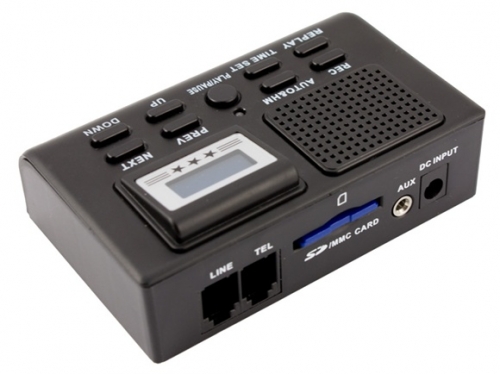
Call recording hardware, or a telephone recorder, is hardware that can be used to record telephone conversations. Call recording hardware is most often used by law enforcement, lawyers, journalist, and call centers to record phone transaction with customers.
Recording of telephone conversations in wired systems requires physical access to the lines over which calls are carried.
PBX based call-recording hardware is sold by PBX vendors and third parties. This hardware is attached to the PBX. It can be configured to record all calls or some calls, either randomly or on demand. Businesses, particularly call centers, use call recording for training, quality management, and legal compliance.
Consumer call-recording hardware was introduced in the 1970s, along with the first consumer-grade answering machines. These devices were connected to the same physical line as one of the telephones involved in the conversation. While the more sophisticated devices were automatically activated when a call was made, most were manual.
Modern call recorders can use computer servers, running Microsoft Windows or other operating systems, using interface cards designed for TDM T1 and ISDN-PRI trunks for trunk side recording, and analog and digital station side cards for recording from stations. Often client software is required by the user computer for both screen recording and to trigger voice recording. SIP trunk calls can be recorded using port spans installed on specially configured network ports that do not have IP addresses and are used as sniffers for SIP traffic, and can be configured to record all or only specific calls.
There are many requirements for call recording. Depending upon jurisdiction, the recording party may or may not be required to tell the other party that the call is being recorded. A simple example whereby anybody might want to record a call is to note complex instructions, or simply to be able to return to a conversation whose details have been forgotten. Both private individuals and companies may want to make an audio recording of transactions for which there is no written record.
Recording of commercial transactions by companies is often advised, and may be required.
Law enforcement use of call recording hardware is concentrated in two areas:
Hub AI
Call-recording hardware AI simulator
(@Call-recording hardware_simulator)
Call-recording hardware
Call recording hardware, or a telephone recorder, is hardware that can be used to record telephone conversations. Call recording hardware is most often used by law enforcement, lawyers, journalist, and call centers to record phone transaction with customers.
Recording of telephone conversations in wired systems requires physical access to the lines over which calls are carried.
PBX based call-recording hardware is sold by PBX vendors and third parties. This hardware is attached to the PBX. It can be configured to record all calls or some calls, either randomly or on demand. Businesses, particularly call centers, use call recording for training, quality management, and legal compliance.
Consumer call-recording hardware was introduced in the 1970s, along with the first consumer-grade answering machines. These devices were connected to the same physical line as one of the telephones involved in the conversation. While the more sophisticated devices were automatically activated when a call was made, most were manual.
Modern call recorders can use computer servers, running Microsoft Windows or other operating systems, using interface cards designed for TDM T1 and ISDN-PRI trunks for trunk side recording, and analog and digital station side cards for recording from stations. Often client software is required by the user computer for both screen recording and to trigger voice recording. SIP trunk calls can be recorded using port spans installed on specially configured network ports that do not have IP addresses and are used as sniffers for SIP traffic, and can be configured to record all or only specific calls.
There are many requirements for call recording. Depending upon jurisdiction, the recording party may or may not be required to tell the other party that the call is being recorded. A simple example whereby anybody might want to record a call is to note complex instructions, or simply to be able to return to a conversation whose details have been forgotten. Both private individuals and companies may want to make an audio recording of transactions for which there is no written record.
Recording of commercial transactions by companies is often advised, and may be required.
Law enforcement use of call recording hardware is concentrated in two areas:
Recent media