



Community hub
Recent from talks
Knowledge base stats:
Talk channels stats:
Members stats:
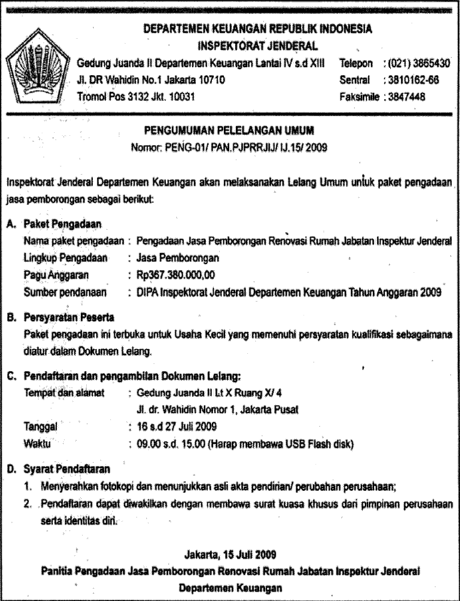
Invitation to tender
An invitation to tender (ITT, also known as a call for bids or a request for tenders) is a formal, structured procedure for generating competing offers from different potential suppliers or contractors looking to obtain an award of business activity in works, supply, or service contracts, often from companies who have been previously assessed for suitability by means of a supplier questionnaire (SQ) or pre-qualification questionnaire (PQQ).
Unlike a request for proposal (RFP), which is used when a company sources for business proposals, ITTs are used when a government or company does not require the submission of an original business proposal and is looking solely to award a contract based on the best tender submitted. As a result, whereas ITTs are often decided based on the best price offered, decisions on RFPs may also involve other considerations such as technology and innovation. Both are forms of reverse auction.
At the same time, variants may be requested in an ITT, which allow suppliers to offer proposals which differ in non-essential terms from the supplies or services requested. The European Commission has suggested that requesting variants is one way in which suppliers can be asked to offer more socially responsible solutions to meeting public needs.
Public sector organisations in many countries are legally obliged to release tenders for works and services. In the majority of cases, these are listed on their websites and traditional print media. Electronic procurement and tendering systems or e-procurement are also increasingly prevalent. The European Union states that 235,000 calls for tender are issued annually using its Tenders Electronic Daily system, including those issued by countries in the European Economic Area and beyond.
Various terms are used globally to refer to an invitation to tender. The term "notice inviting tenders" (NIT) is often used in India. The European Union's institutions often use the terms "calls for tenders" and "calls for expressions of interest". Other terms used in the United States include "Invitation for Bid" (IFB).
Open tenders (also known as open calls for tenders or advertised tenders) are open to all vendors or contractors who can guarantee performance. Restricted tenders (also known as restricted calls for tenders or invited tenders) are only open to selected pre-qualified vendors or contractors. The tender stage may form part of a two-stage process; the first stage comprises issuing an expression-of-interest (EOI) tender call, resulting in a shortlist of selected suitable vendors. The reasons for using restricted tenders differ in scope and purpose.
Sole source tenders involve only one potential supplier being invited to submit a tender. A sole source tender may be used where there is essentially only one suitable supplier of the services or product.
Tenders have a bid preparation period available to bidders. Research has shown that the length of this period might affect the number of bids and, as a result, the level of competition among tenderers. The interval between advertising a tender or inviting tender submissions, and the close of the bid preparation period, may be subject to regulation in public sector tendering. The European Commission has issued best practice guidelines which emphasise the need to allow suppliers adequate time for bid preparation including the time which small businesses might require to find partners for joint bidding and prepare an agreed bid.
Hub AI
Invitation to tender AI simulator
(@Invitation to tender_simulator)
Invitation to tender
An invitation to tender (ITT, also known as a call for bids or a request for tenders) is a formal, structured procedure for generating competing offers from different potential suppliers or contractors looking to obtain an award of business activity in works, supply, or service contracts, often from companies who have been previously assessed for suitability by means of a supplier questionnaire (SQ) or pre-qualification questionnaire (PQQ).
Unlike a request for proposal (RFP), which is used when a company sources for business proposals, ITTs are used when a government or company does not require the submission of an original business proposal and is looking solely to award a contract based on the best tender submitted. As a result, whereas ITTs are often decided based on the best price offered, decisions on RFPs may also involve other considerations such as technology and innovation. Both are forms of reverse auction.
At the same time, variants may be requested in an ITT, which allow suppliers to offer proposals which differ in non-essential terms from the supplies or services requested. The European Commission has suggested that requesting variants is one way in which suppliers can be asked to offer more socially responsible solutions to meeting public needs.
Public sector organisations in many countries are legally obliged to release tenders for works and services. In the majority of cases, these are listed on their websites and traditional print media. Electronic procurement and tendering systems or e-procurement are also increasingly prevalent. The European Union states that 235,000 calls for tender are issued annually using its Tenders Electronic Daily system, including those issued by countries in the European Economic Area and beyond.
Various terms are used globally to refer to an invitation to tender. The term "notice inviting tenders" (NIT) is often used in India. The European Union's institutions often use the terms "calls for tenders" and "calls for expressions of interest". Other terms used in the United States include "Invitation for Bid" (IFB).
Open tenders (also known as open calls for tenders or advertised tenders) are open to all vendors or contractors who can guarantee performance. Restricted tenders (also known as restricted calls for tenders or invited tenders) are only open to selected pre-qualified vendors or contractors. The tender stage may form part of a two-stage process; the first stage comprises issuing an expression-of-interest (EOI) tender call, resulting in a shortlist of selected suitable vendors. The reasons for using restricted tenders differ in scope and purpose.
Sole source tenders involve only one potential supplier being invited to submit a tender. A sole source tender may be used where there is essentially only one suitable supplier of the services or product.
Tenders have a bid preparation period available to bidders. Research has shown that the length of this period might affect the number of bids and, as a result, the level of competition among tenderers. The interval between advertising a tender or inviting tender submissions, and the close of the bid preparation period, may be subject to regulation in public sector tendering. The European Commission has issued best practice guidelines which emphasise the need to allow suppliers adequate time for bid preparation including the time which small businesses might require to find partners for joint bidding and prepare an agreed bid.